The short version
| What | Measured value | Where it was read |
|---|---|---|
| Contact fields served by the API | 2, same value in both | settings endpoint, 27 Oct 2026 |
| Email address in that response | none of its 17 fields | same |
| Email links anywhere in the built site | 0 | all 97 routed pages |
| Pages that fetch the contact config | 3 — home, About Us, How to Play | call sites in the API client |
| Form elements in the built site | 0 | all 97 routed pages |
| Input elements, and their state | 8, all disabled | same |
| Call links in the built site | 0 | same |
| Notices returned by the notices endpoint | 0 items | notices endpoint, 27 Oct 2026 |
| Built pages carrying a WhatsApp link in their HTML | 1 | same census |
| Does that link match the endpoint's value | no — it is a hard-coded fallback | the How to Play component |
| Support questions answered on the FAQs page | 0 of its 9 questions | the FAQs page |
There are two honest sentences that cover most of what a reader searching for mama567 customer support contact needs. The first is that a contact route exists and it is a button, not a string — it is fetched when the page loads, so the place to look for it is the page, not an article. The second is that this site has no email, no chat, no ticket queue and no callback, which means the useful question is not "how do I reach them" but "is my question already answered somewhere that does not need a human". Both are measurable, and both are measured below.
What "contact support" actually means here
The contact value is not written into the site. It is fetched.
fetchPublicSettings() in src/data/api.ts calls GET /api/markets/settings, checks success and settings, and hands the result to whichever page asked. Three pages ask: the home page, About Us and the How to Play guide. Each renders its WhatsApp button from the returned fields, and the footer that every page carries renders its Contact block from the same values — which is why the footer's contact section is absent from the prerendered HTML of all 97 routed pages and appears only once the request resolves.
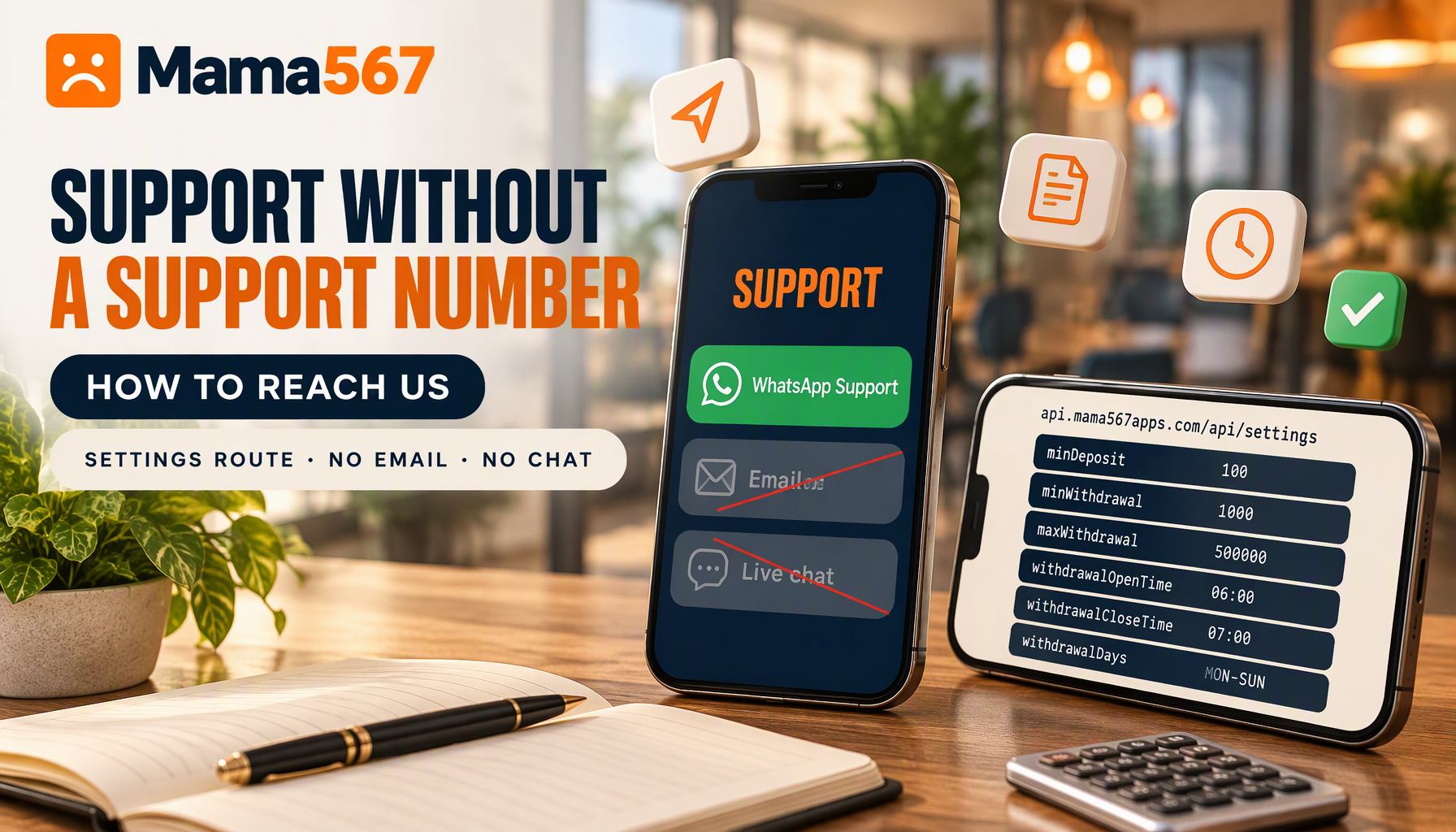
Read on the morning of 27 October 2026, that endpoint returned 599 bytes and seventeen fields. Two of them are contact routes, and both carry the same value. One is a notice banner string, one is an array of notices, and the remaining thirteen are operational configuration: deposit and withdrawal chip amounts, a deposit minimum and a withdrawal minimum, a withdrawal maximum, three on/off switches, a withdrawal window as an open and a close time, the days withdrawals run, and two merchant payment fields.
Two of those seventeen fields are merchant payment details. The site's own type definition asks for them, and the site never displays them.
That list is the whole story about how support works here. There is no support-specific subsystem — no queue, no agent console, no ticket id — just a settings document the client reads and turns into a button.
The routes that exist, and the four that do not
A support page is easiest to write as an inventory, because every line of it can be checked against the build.
Present, once the settings request has resolved:
- On the home page, the number printed as visible text, a Call Now link and a WhatsApp button.
- On About Us and on the How to Play guide, a WhatsApp button in the header — an icon on desktop, a labelled link inside the mobile menu, never both at once — and the guide adds a second one in its body, labelled with the number itself.
- In the footer of every page, a call link that displays the number as its own text, and a WhatsApp link.
- A notice banner on the home page, fed by
noticeTextfrom the same response. - A FAQs page with nine questions, a markets and timings directory, an editorial and data policy, a privacy notice and terms.
Loaded in a browser at 412 pixels on a phone, with the request resolved, that is four visible contact links on the home page, two on About Us and three on the guide, and the number rendered as visible text in two places. Before that request resolves — which is the state every one of these pages is in when it is built, cached and indexed — the picture is different, and it is the state that matters for what this page is arguing. In the built HTML there are zero call links and zero printed numbers, and exactly one WhatsApp link in the whole site.
Absent, and verified absent from the built output:
- Email. Zero
mailto:links, and no email field in the settings response. The brief this page was written against asks for an email address; there is none to give, and inventing one would put a fake route on the one page people come to looking for routes. - Live chat. No widget script of any kind in the built pages.
- Ticketing. Zero form elements across the site. The eight input elements that do exist are disabled checkboxes used as a visual checklist on a single blog page — nothing on this site accepts typed input and sends it anywhere.
- Callback or status lookup. No ticket number means nothing to check on. There is also no status page: the notices array the API returns today is empty, so the announcement channel exists in code and carries nothing.
The FAQs page is the closest thing to a self-serve helpdesk, and it is worth noting what it does not contain: of its nine questions — what satta matka is, whether the site is free, whether results are live, how to read a pana chart, what a jodi means, why days are blank, whether there is an app, whether the site takes bets, and the age limit — none is about reaching a person. That is consistent rather than an oversight. The site answers questions; it does not run a conversation.
Why this page prints no number
The reason is not squeamishness about digits, it is a specific failure mode, and this site has already been caught by it twice.
A printed number is a snapshot of a value that the operator can change at any moment without shipping anything. The settings endpoint exists precisely so that a contact route can be rotated centrally — the point the customer support review makes about keeping stale numbers out of cached static pages. Copy the current value into an article and you have re-created the thing the architecture was designed to avoid, in the most heavily cached, longest-lived place possible: an indexed page that will still be quoting 2026's configuration to a reader in 2028.
So this page tells you where the button is and what it is built from, and stops. That is the same decision the app troubleshooting guide makes for the same reason, and it is now enforced by the build: the QA gate that checks this site's own pages fails the build if a phone-shaped digit string appears in this post or in the nine other guides that made the same choice. The artwork at the top of this page carries no digits either, for the same reason.
It is also the decision the calendar asked for the opposite of. The line behind this page reads "save our support number" — and a number on a page whose entire subject is that the number moves is a page that quietly goes wrong on its own schedule.
The one link that proves the point
Here is what happens when a fallback is used where a fetched value belongs, measured rather than argued.
The How to Play guide builds its WhatsApp link as: use the fetched value, or if there is none, use a literal written into the component. During the build, no settings have been fetched, so the literal wins — and the prerendered HTML of that page therefore contains the only WhatsApp link in the entire static output.
That literal is not the value the settings endpoint returns. It is not even the default written into the API client, which does match. The codebase contains three contact literals in two places, and the built page carries the odd one out.
| Value source | Appears in prerendered HTML? | |
|---|---|---|
| Settings endpoint | what the live product uses | no |
| API client default | fallback if the response omits the field | no |
| Guide page literal | fallback if the fetch has not resolved | yes — the only one that does |
The About Us page handles the same situation correctly: it renders its buttons only when a fetched value exists, so its prerendered HTML contains no contact link at all. One page in the output advertises a route the product does not use, and the difference between it and the page that does not is a single missing condition.
To be exact about the blast radius: a visitor who loads that page in a browser with JavaScript on never sees the wrong route, because the fetched value replaces the fallback the moment the request lands. The stale link is in the HTML the browser was handed first — the copy a search crawler indexes, the copy a CDN serves before hydration, and the copy a reader with scripting disabled reads. That is also precisely the copy that cannot be updated when the number rotates.
This is reported rather than papered over, and it is the strongest argument on this page for not printing numbers: the site's own static output already contains one, and it is wrong.
The same failure, in prose
The contact link is one row of a wider pattern, and the rest of the pattern is in sentences a reader will act on.
That same guide prints four money rules, and every one of them is built the same way: use the fetched value, or if there is none, use a literal written into the component. At build time there is never a fetched value. So the literals are what the static page says, and this is what the settings endpoint returned on the same day, 27 October 2026.
| What the static page states | What the endpoint returned | |
|---|---|---|
| Minimum deposit 100 | 100 | agrees |
| Minimum withdrawal 500 | 1000 | the page says half the true floor |
| Maximum withdrawal 1 Lakh per day | 500000, which the page's own conversion renders as 5 Lakh | the page says one fifth of the true ceiling |
| Withdrawals open 10:00 AM to 06:00 PM | 06:00 to 07:00, which the page's own formatter renders as 06:00 AM to 07:00 AM | an eight-hour window where a one-hour window exists |
| Withdraw available all seven days | Monday through Sunday | agrees |
Three of those five are wrong, and the two that are right are right by accident: their fallbacks happen to match the server, which is exactly why nobody notices the others. Stale configuration is only visible where a fallback and a live value disagree.
Two independent details confirm the endpoint side of the disagreement rather than a bad read. The withdrawal amount buttons offered by the same response start at 1000, so a 500 floor would be a floor nobody can reach; and the maximum line is not a constant at all — the component divides the fetched figure by 100000 and appends the word Lakh, so the same code that prints the static text would print a different number a moment later in the same browser tab.
What matters is not the arithmetic, it is the sequence a reader ends up in. Someone who reads "minimum withdrawal 500" on a static page, then finds the app refuses a 500 request, has now got a discrepancy with no explanation attached to it — and the next thing they do is look for a support route. Someone who reads "open till 06:00 PM" and submits at noon has been told a window exists that the product closed months ago, or never opened. Three of the four stale figures are precisely the kind of thing that generates the messages this page is about, and the page that generates them is the guide that tells you how the game works.
Both numbers in that table will go stale again, including the ones attributed to the endpoint, and that is the point: the reader's answer is in the app, not in an article. What is worth keeping is the method — if a page tells you when you can move money, or how much, check it against the page that has to move the money.
Before you contact anyone
Most searches that end at a support page are questions this site has already answered with arithmetic and a date. The table below is the routing step that a contact form would otherwise perform, and every destination in it is a page in this build.
| Your question | It is answered by |
|---|---|
| "The board is all stars — is it broken?" | How to check live results — what a placeholder means and when the first line of the day lands |
| "This day is blank on my chart" | Verified results for the general rule; for a schedule-caused blank, Time Bazar timings works one market's Sunday gap end to end |
| "The app won't open / crashed / says session expired" | App issues and login and crash troubleshooting |
| "Is this download safe?" | Safe installation guide |
| "My withdrawal is pending" | Withdrawal guide — and note the window caveat above |
| "My KYC was rejected" | KYC steps |
| "Why is the payee on my receipt not Mama567?" | Payment information safety |
| "Is this bonus code real?" | Promotional offer verification |
| "Someone asked me for my OTP" | Account and wallet security |
| "What does '1 ka 9.5' mean?" | Game rates explained |
| "How do I read this grid at all?" | How to read charts and jodi and pana |
| "Is this site charging me?" | No: the site is free and takes no wagers |
Two of those rows are worth dwelling on, because they are the ones that generate support messages out of thin air. An all-star board at 07:50 IST is a correct picture of a day that has not declared anything, not an outage. A blank Sunday cell is a schedule, not a lost result. Both look like failures until you check the one fact next to them, and neither needs anyone's attention.
When support is the wrong door
If money has left your bank account and the counterparty is not this site, the route is not a support button on this site.
- A transfer you made that has not arrived. Your own bank can trace it; the reference is the 12-digit UTR on the receipt, and the dispute desk is at your bank, not with the payee.
- A message from someone claiming to be an agent. Do not reply, do not install anything they suggest, and report it to the National Cyber Crime Reporting Portal at cybercrime.gov.in or on the 1930 helpline.
- A number you were told is "guaranteed". Responsible gaming covers why fixed results do not exist, and probability in number games covers what the actual odds look like.
Only one of those three is a link off this site: cybercrime.gov.in. It is one of six external hosts that appear across the entire built output — the other five being two gambling-help organisations, one Wikipedia article, this site's own canonical host and the one WhatsApp route named above — and that census is what the privacy and safe-browsing guide measures. A page whose subject is fraud has almost nowhere to send you, and that restraint is the point.
"Save our support number"
The line behind this page asks the reader to save a phone number, and this page declines to print one — not for lack of a number to print, but because the number is configuration, and this site's own build already demonstrates what happens when configuration is copied into a permanent page.
What replaces it is the thing that stays correct: the contact route is a button on the home page, About Us and How to Play, built from the settings endpoint each time those pages load. Open one of them and press it. That instruction cannot go stale, and it is the only version of "how to contact Mama567 support" that can be written down without an expiry date.
If you were sent here looking for an email address, there isn't one. If you were sent here by someone who gave you one, or who messaged you first, the answer to your actual question is in the account and wallet security guide.
Where to start
- How to Play guide — the rules page, and the one whose prerendered fallback this page reports above.
- About Us — the authoritative web location for platform details, and the correct pattern for rendering a contact button.
- FAQs — nine questions, none of them about reaching a person.
- How to verify a satta matka website — the same evidence read as an authenticity check, including which of this site's own surfaces score partial.
- Editorial & data policy and privacy notice — what this site does and does not do with what you send it.
- For the advice layer this page deliberately does not repeat: customer support review — how to verify a contact route, how to write a request, and what to keep for a dispute.
The one automated channel this platform does have lives in the app rather than in any of those routes, and How to Set Up Notifications for Live Market Declarations counts what the browser side ships: nothing.
Mama567 records declared results. It publishes no support email, no live chat, no ticket queue and no number on this page, takes no wagers, sells no tips, and never contacts a visitor first; satta matka is illegal in most Indian states, and nothing above is advice. 18+ only.
For information only. Mama567 publishes results and charts, and does not offer predictions or guessing services. Adults 18+.