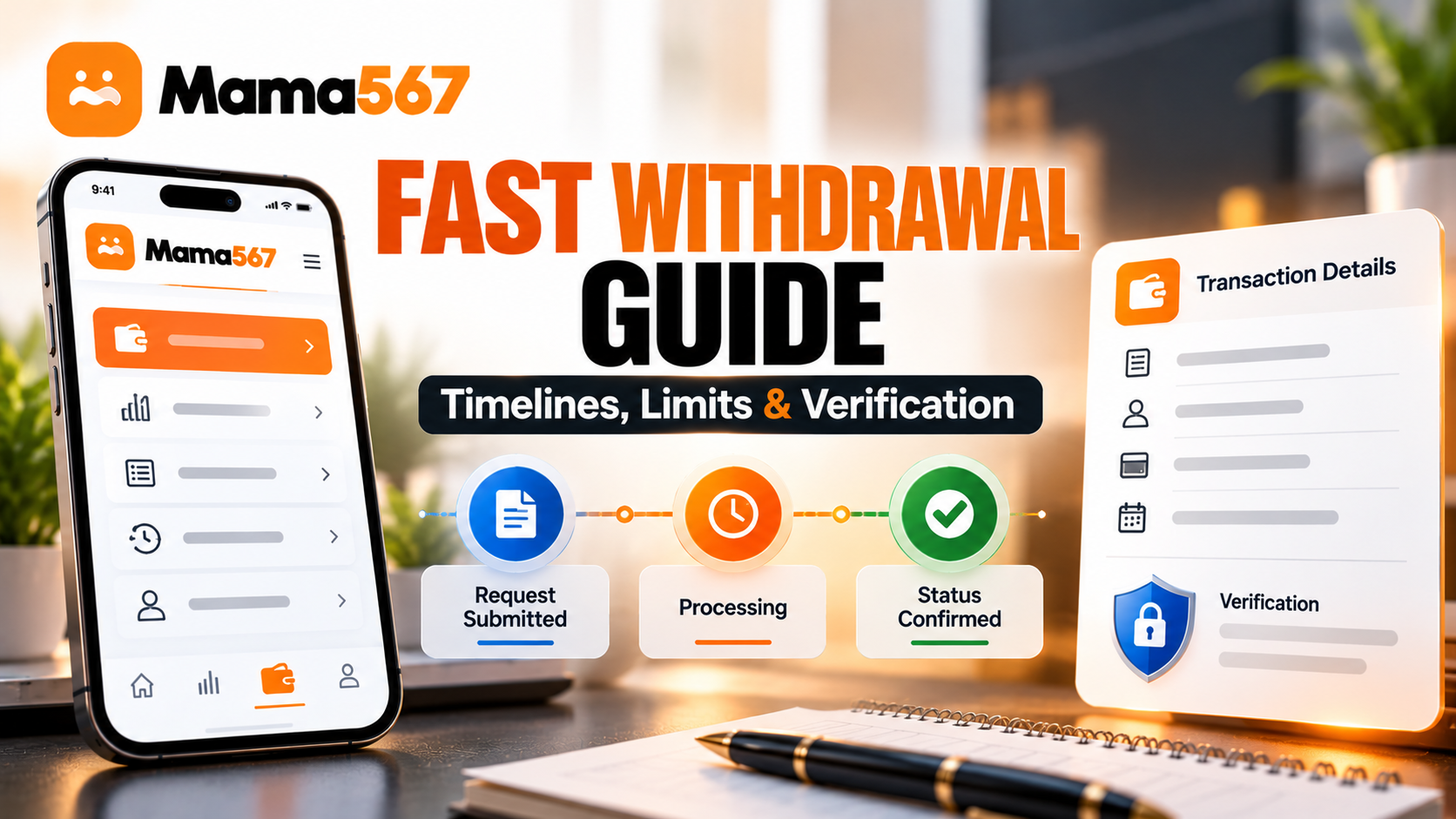
Few topics generate more urgency, confusion, and potential vulnerability online than financial transactions. Users searching for mama567 fast withdrawal information frequently encounter a maze of conflicting claims, unverified promises, third-party social media channels, and predatory fee-advance schemes. When expectations of instant money transfers collide with the realities of interbank settlement rails, users can easily misinterpret standard processing delays or fall victim to impersonation scams.
Financial literacy and digital self-defense require understanding how digital payments function, where authoritative platform terms reside, how to verify transaction claims, and why promises of guaranteed or instant payouts often mask fraudulent activity.
This comprehensive guide breaks down the essential principles of transaction processing, clarifies the scope of Mama567’s public surfaces, explains how to track transaction statuses objectively, and outlines vital safety protocols to safeguard your bank accounts.
1. What Information Readers Must Verify Before Initiating or Evaluating a Request
Before evaluating any claim regarding fund transfers or withdrawal speeds, users must establish what the platform actually publishes and operates. Confusion often arises because users conflate informational websites with transactional applications.
Informational Directory vs. Transactional Systems
An audit of the public web platform at mama567apps.com confirms the following operational realities:
- Free Informational Access: The website is a public reference repository providing pana charts, jodi archives, and declared draw timings across 19 monitored markets.
- No Web Wallet or Accounts: As outlined in Mama567's Terms & Conditions and Privacy Policy, the web portal does not offer account registration, user balances, or integrated payment checkout forms.
- Absence of Web Transaction Processing: The web application does not accept deposits, maintain stored player funds, or execute bank payouts.
Any third-party website, forum post, or Telegram channel claiming you can deposit or withdraw money directly through mama567apps.com is misrepresenting the site’s functionality. For deeper details on how digital payment claims are evaluated, consult our Payment Information Safety Guide.
Avoiding Fabricated Rules and Thresholds
Unscrupulous affiliate marketers frequently publish fabricated withdrawal guidelines—such as claiming guaranteed 5-minute payouts, specific minimum cashout thresholds (e.g., ₹500 or ₹1,000), or fixed daily limits—without factual backing. In real software environments:
- Dynamic Server Configuration: Transaction limits, daily caps, and operational windows are controlled dynamically by backend servers and payment gateway partners, not static blog posts.
- Banking Operational Cycles: Transfer mechanisms such as IMPS, NEFT, and RTGS are subject to interbank settlement windows, system maintenance, and reserve bank clearing rules.
- No Blanket Guarantees: Authoritative services never advertise 100% instantaneous clearance for all users, as automated risk filters and anti-money laundering checks periodically flag transactions for review.
2. Distinguishing a Submitted Request from a Completed Transaction
One of the most common sources of user panic is misunderstanding payment status indicators. When an instruction is sent over a digital network, it passes through multiple discrete stages before funds become usable cash in a recipient's bank account.
| Transaction Stage | Technical Meaning | Recipient Status | Reversibility |
|---|---|---|---|
| Initiated / Submitted | The user has submitted a cashout instruction to the system queue. | Funds have not left the platform pool; not received by bank. | Can be canceled or modified by system administrators. |
| Under Review (Queued) | Automated risk parameters or compliance checks are validating account activity. | Payout is queued; gateway has not accepted dispatch. | Subject to administrative hold or rejection. |
| Dispatched / In Transit | The gateway has pushed the instruction to the interbank network (NPCI / RBI rails). | Interbank rails are routing the transfer; UTR generated. | Cannot be canceled; pending interbank clearance. |
| Settled / Completed | The receiving bank has credited the beneficiary account ledger. | Funds are accessible and reflected in passbook balance. | Irrevocable final settlement. |
| Failed / Returned | Beneficiary bank rejected transfer (e.g., IFSC error, account freeze). | Funds revert to origin pool after standard reconciliation. | Transfer voided; re-initiation required. |
The Illusion of "Instant"
While systems utilizing India's Unified Payments Interface (UPI) or Immediate Payment Service (IMPS) frequently execute within seconds under ideal network conditions, they are not guaranteed to be instantaneous. Server-side batch processing, bank-end server outages, peak-hour clearing congestion, and anti-fraud velocity checks can introduce delays ranging from several minutes to several business days.
3. Where Officially Documented Limits and Terms Are Published
To avoid being misled by predatory actors, users must identify legitimate sources of truth:
- In-App Account Settings: If using a client application, transaction limits (minimum and maximum per request, daily withdrawal limits, and permitted payout methods) are rendered dynamically from backend configuration endpoints (such as
/api/markets/settings). - First-Party Documentation: Verifiable terms will clearly enumerate eligible withdrawal rails (e.g., direct bank transfer via IMPS/NEFT, UPI VPA) without requiring secret handshakes or informal intermediaries.
- Absence of Third-Party Authority: No social media influencer, WhatsApp helpline, or YouTube channel possesses the technical capability to set, alter, or expedite transaction rules on a platform’s core ledger.
When investigating any account or wallet feature, always verify how identity and session tokens are managed by reviewing our Account & Wallet Security Guide.
4. How Transaction References and Banking Ledgers Resolve Disputes
When a payment dispute arises—such as an application indicating "Success" while your bank account reflects no credit—verbal assertions and app screenshots carry zero legal or banking weight. Resolving discrepancies requires empirical transaction data.
The Critical Role of the UTR (Unique Transaction Reference)
In the Indian banking ecosystem, every electronic fund transfer executed via IMPS, NEFT, RTGS, or UPI generates a Unique Transaction Reference (UTR):
- Structure: A 12-digit (for UPI/IMPS) or 16-to-22-character (for NEFT/RTGS) alphanumeric sequence uniquely generated by the clearing switch (such as the National Payments Corporation of India, NPCI).
- Audit Value: A UTR allows your receiving bank branch or customer service desk to trace the exact fate of incoming funds within internal clearing logs.
- Proof of Dispatch: If a platform claims to have dispatched your withdrawal, request the official 12-digit UTR. If a service cannot supply a valid, verifiable UTR, the funds have not entered the interbank clearing pipeline.
Bank Statement as the Sole Ground Truth
Never rely on SMS notifications, app push banners, or digital receipts shared by third parties. Fake SMS apps and forged graphics are readily available to scammers. The only undeniable proof that a withdrawal has completed is an active credit entry visible inside your official banking mobile app, net banking portal, or physical passbook.
5. Common Misunderstandings and Warning Signs of Fraud
Online money games and betting verticals in India are heavily targeted by cybercriminals. Understanding common deception patterns will protect you from catastrophic financial losses.
Impersonation and Fake Helpline Numbers
A widespread trap involves fake customer support listings posted across Google search snippets, social media comments, and scam blogs. Fraudulent operators list phone numbers claiming to be "Mama567 24x7 Fast Withdrawal Helpdesk."
- When users call, scammers claim: "Your withdrawal is blocked due to KYC issues. Send ₹999 to this UPI ID to unlock your funds."
- Alternatively, they instruct callers to download remote-desktop applications (such as AnyDesk, TeamViewer, or RustDesk), granting attackers full control over mobile banking apps.
- Reality: Legitimate platforms never charge upfront fees to process a withdrawal, nor will authentic technical support agents ask you to install screen-sharing software.
The Advance-Fee Scam ("Tax" or "Clearance Fee")
If an account holder is told that a substantial prize or wallet balance cannot be withdrawn unless they first pay an "income tax deposit," "clearance charge," or "VIP upgrade fee," this is an advance-fee fraud scheme. In legal payment workflows, legitimate applicable taxes (such as TDS under Indian tax regulations) are deducted at source from the winning balance—never demanded as a separate upfront transfer to a personal UPI address.
6. How to Preserve Evidence and Seek Legitimate Assistance
If you experience an unexplained payment hold or suspect you are interacting with an unverified party, take disciplined, defensive action:
- Document Everything: Capture full-screen snapshots of transaction history tables, error dialogs, reference numbers, and timestamped communications.
- Verify Bank Records: Download an official PDF bank statement covering the period from the transaction date to the present to establish non-receipt definitively.
- Avoid Secondary Scams: Do not hire "hacker recovery agents" or third-party "chargeback specialists" claiming they can retrieve lost or frozen funds for a fee. These are secondary recovery scams designed to victimize individuals who have already suffered a loss.
- Report Unauthorized Charges: If you inadvertently disclosed your debit card details, UPI PIN, or internet banking password, immediately contact your bank’s 24-hour fraud hotline to block your cards and freeze digital banking access.
- Lodge Official Cybercrime Complaints: In India, financial fraud can be reported directly to the National Cyber Crime Reporting Portal at
cybercrime.gov.inor via the toll-free helpline 1930.
To understand the core principles of safe engagement with number markets and avoid the pitfalls of high-risk activity, consult our dedicated Responsible Play & Safety Overview.
For the contact routes this site actually offers, and why no page here prints a support number, see How to contact Mama567 customer support.