A clone can copy the design. It cannot copy the plumbing.
Counterfeit result sites are not subtle. They reuse a brand's colours, logo and even its chart layout, then sit on a hostname one character away from the real one. The parts that are hard to copy are the parts nobody photographs: the certificate bound to a hostname, the date attached to a dataset, the rate endpoint the product itself reads, and the name of the person answerable for an error.
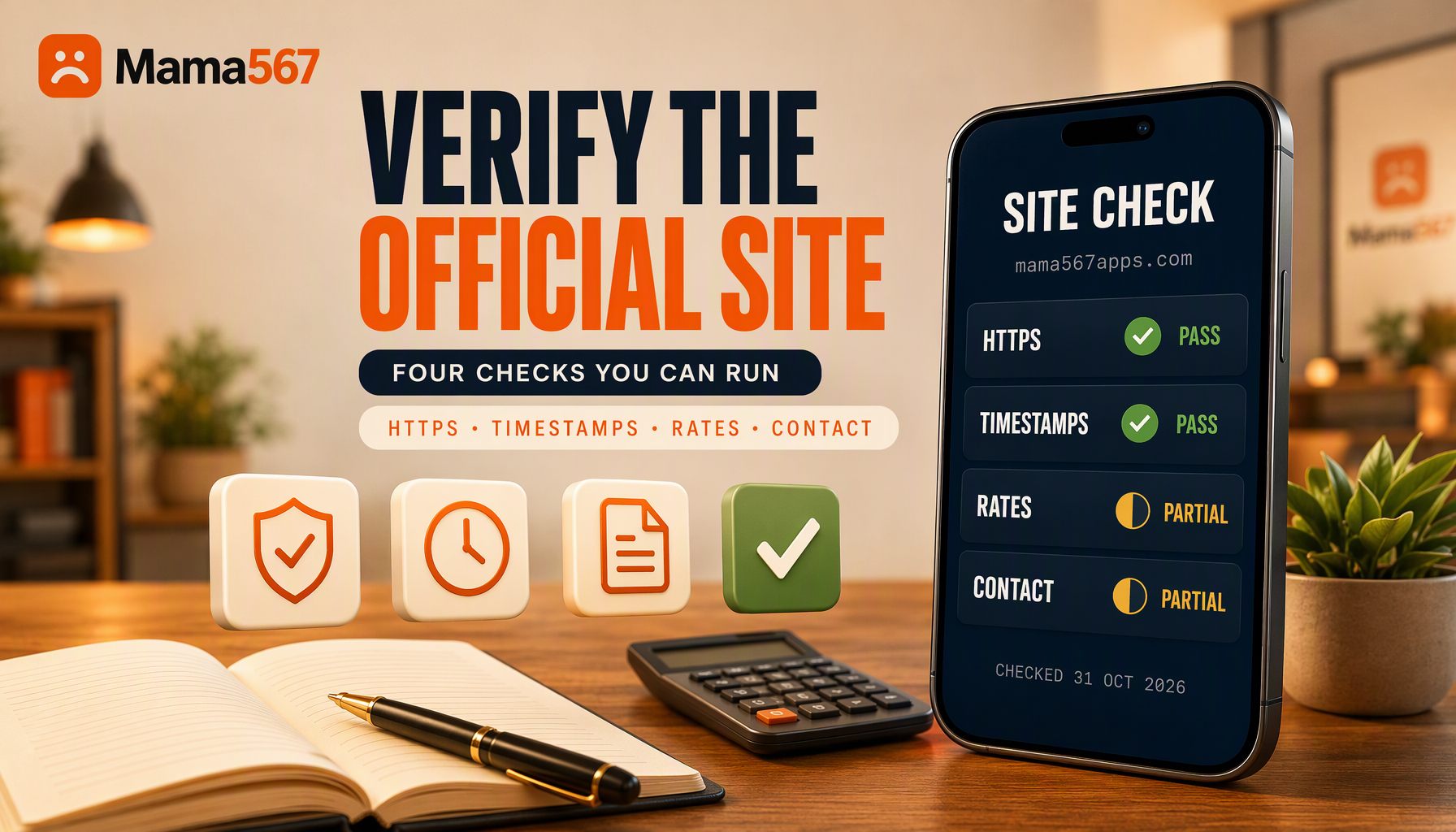
That makes authenticity a set of checks rather than a feeling. Below are four, in the order they are cheapest to run. Each is applied to Mama567 on 31 October 2026, and each result is reported as measured — including the places where this site does not score full marks. A verification guide that only ever returns "pass" is not a check; it is a brochure.
The checklist at a glance
| Check | What you inspect | Pass looks like | Fail looks like |
|---|---|---|---|
| HTTPS | Address bar, certificate, response headers | http redirects to https; certificate names the exact host; no third-party code | Padlock on a lookalike host; a redirect to another domain; a broken padlock |
| Timestamps | The newest date the page prints | A clock that moves or a date that can disagree with the rows | A "live" badge with no date, or a date that changes while the data does not |
| Rates | The published rate table | Every shape, its multiplier and its stake limit, dated | Screenshots, missing limits, language about guaranteed returns |
| Contact | About and policy pages, plus the live route | A named operator, policy pages and a route that loads from the product | DM-only contact, no policies, a support number printed in a poster |
None of these four checks needs a tool you do not already have. A browser can show all of them except the response headers, and those are visible with one extra step described below.
1. HTTPS: read past the padlock
A padlock means the connection is encrypted. It does not mean the site is honest, and it does not even mean the certificate belongs to the site you meant to visit — phishing hosts get certificates too. The check is narrower, and that is what makes it useful.
Start with the redirect. Type the address with http:// rather than https:// and keep the path. On 31 October 2026, a request for http://mama567apps.com/blog/satta-matka-terms-glossary/ returned a 301 whose Location was the same path on https://, so the insecure version does not serve content at all.
Next, open the certificate and read its subject and dates. The certificate served for mama567apps.com was issued by Google Trust Services, named CN=mama567apps.com with only that host in its subject alternative names, and ran from 18 September 2026 to 17 December 2026. Two facts matter here. The name must match the host you typed, character for character; and the validity window must contain today. A certificate that names a different domain, or one that expired months ago, is the browser's warning — do not click through it.
Then read the rest of the response. These are the headers Mama567 returned for its home page, and what each one is for:
| Header | Value on 31 October 2026 | What it does |
|---|---|---|
x-content-type-options |
nosniff |
Stops the browser guessing a file type and executing it as something else |
x-frame-options |
SAMEORIGIN |
Stops another site embedding this one in a frame |
referrer-policy |
strict-origin-when-cross-origin |
Trims what other sites learn about the page you came from |
permissions-policy |
camera=(), microphone=(), geolocation=() |
Denies device APIs the site does not use |
strict-transport-security |
not present | Would tell the browser to skip http on later visits |
content-security-policy |
not present | Would restrict which scripts are allowed to run |
The first four are a pass. The last two are gaps, and they are worth understanding rather than scoring. Without HSTS, a later visit can still begin on http and rely on the 301 to correct it; without CSP, the browser has no header-level allowlist for scripts. Neither gap makes the page a counterfeit, and neither is hidden by the site — the rules live in a public _headers file — but a checklist should report what is absent as carefully as what is present.
The last HTTPS check is the one most guides skip: what else the page loads. On this build, every page loads one bundled script and one stylesheet, both from the site's own host, plus self-hosted fonts. A census of all built pages found zero third-party scripts, zero third-party stylesheets and zero third-party images. The JSON-LD references schema.org and the pages link out to support and government sites, but those are declarations and links, not code that runs.
That matters because a page can be encrypted end to end and still hand your session to an ad network. The privacy policy's claim that the site places no advertising or analytics cookies is consistent with the build, and unlike most marketing copy, it can be checked by opening the page source and counting the script tags.
2. Timestamps: two clocks, two claims
"Updated live" is the easiest sentence on the internet to write and the easiest to disprove. Ask a page three questions: what is the newest date it prints, what does that date refer to, and can it ever disagree with the rows it sits above?
Mama567 answers with two different surfaces, and conflating them is the most common misreading of the site.
The live surface is the homepage. It calls three endpoints — markets, settings and rates — together, then repeats the call every 15,000 milliseconds while the tab is open. Results, betting statuses and the timing display change without a reload. It prints no clock, and that is a decision the code makes rather than a limitation of the source: the markets response carries its own timestamp — the client's type names serverTimeIST, and a 1 November 2026 capture of the same endpoint returned currentIST — and no page reads either field. Across the site's application source serverTimeIST appears in exactly one file, the API client that declares it, and in no page. The honest description is "polled live, with the feed's own timestamp discarded", not "stamped to the second". If you want to verify that the poll is real, leave the page open across a declaration and watch a *** placeholder become a number; that is a change you can observe, and it cannot be faked by a static image.
The dated surfaces are the charts. The 38 pana and jodi pages are built from a committed snapshot and print an as-of date under the headline. On 31 October 2026 those dates ran from 11 September to 14 September 2026, and the results page printed "Dataset generated 2026-10-11". The snapshot itself declares generatedAt as 2026-10-11T17:12:15Z and holds 79 dated rows, of which 75 are complete and four still carry placeholders.
So the chart pages are weeks behind the live board, and they say so. That is the point of the check: a stale date that is printed is honest; a fresh date that is printed over stale data is not. The machine-readable copy at /data/chart-snapshot.json carries the same metadata, is cached for five minutes, and can be diffed against the page you are reading. How to check live satta matka results walks through the same split from the reader's side, and the glossary's as-of entry defines the term.
Three failure signatures are worth memorising:
- a "live" badge with no date anywhere near it;
- a date that updates on every reload while the rows underneath never change;
- a date attached to a result that is later than the day the market declared it — which is impossible, whatever the page says.
3. Rates: a table without a date is an advertisement
A published rate is a claim about arithmetic, and arithmetic can be checked against the endpoint that serves the product. Mama567's homepage has a Game Rates card that reads the rate endpoint live. On 31 October 2026 the endpoint returned seven rows:
| Shape | Multiplier | Bid range (units) |
|---|---|---|
| Single Digit | 9.5 | 10 – 100,000 |
| Jodi Digit | 95 | 10 – 50,000 |
| Single Patti | 150 | 10 – 25,000 |
| Double Patti | 300 | 10 – 15,000 |
| Triple Patti | 1,000 | 10 – 5,000 |
| Half Sangam | 1,000 | 10 – 5,000 |
| Full Sangam | 10,000 | 10 – 2,000 |
Here the checklist finds a partial score rather than a pass. The endpoint carries the multiplier and a minimum and maximum bid for every shape. The homepage card prints only the multiplier, as "1 RS KA … Rs". A reader who never opens the endpoint sees seven numbers and no limits, which is half a rate card. The full table above is what the product itself reads; it is also why the game formats guide spends its time on what the names mean rather than on the headline numbers alone.
Rates move, which is the second lesson. The rates explainer captured the same endpoint on 14 October 2026 and printed 10 for Single Digit and 100 for Jodi Digit. On 31 October 2026 the endpoint returned 9.5 and 95. Neither number was invented; the first is a dated capture and the second is the current one. That is exactly why a rate table with no date is not evidence of anything except that someone once typed it.
What a rate cannot tell you: whether the platform pays, whether the market is fair, or how likely any shape is. A multiplier is the price attached to a shape, not a probability, and the two move in opposite directions. Probability in number games is the page that separates them.
4. Contact and identity: who is answerable
The final check is the one clones fail most often, because a copy can reproduce a chart but cannot invent a person who will answer for it.
Open the About page and the policy pages before you trust anything else. Mama567's About page names Abdul Rahaman as the person who builds and maintains the site, and the editorial and data policy names him again, states where results come from, defines what a blank cell means, gives a correction route through the About page, and carries a review date of 11 October 2026. Those are identity claims you can read in the static HTML, with no JavaScript involved.
The contact route is deliberately different, and it is worth understanding why. The support phone and WhatsApp number are not written into the pages. Three surfaces — the home page, About Us and How to Play — call the settings endpoint and render the contact button from the response. On 31 October 2026 that response contained 17 fields, including both contact values and no email address at all. A number that is fetched can be rotated centrally; a number copied into a page goes stale invisibly.
What the built site contains is measurable:
| Evidence | Measured on 31 October 2026 |
|---|---|
Canonical tags pointing at mama567apps.com |
Every built page |
Telephone links (tel:) |
0 |
| Forms | 0 |
mailto: links |
0 |
| Prerendered WhatsApp links | 1 — a hard-coded fallback on the How to Play page |
| Settings fields at run time | 17, none an email address |
| Non-blog routes with the four policy links in the footer | 49 of 49 |
| Blog posts using the compact footer | All of them; the policy pages are reached through the blog index |
Two of those rows are not perfect, and they are reported here rather than smoothed over. The single prerendered WhatsApp link is a fallback that survives into the static HTML and does not match the value the endpoint returns; the contact guide documents why that is a defect and what the fix is. The compact footer on blog posts means the policy links are one hop away rather than on the page itself. Neither turns a real site into a fake one, but both are the kind of detail a checklist is for.
One more negative result is worth stating because it prevents a false sense of security: the site's structured data names the publisher, its logo and the country it serves, and stops there. There is no contactPoint, no sameAs and no postal address in the Organization node. Markup is not identity; the policy pages are.
The scorecard: this site, checked
| Check | Result | Evidence |
|---|---|---|
| HTTPS transport | Pass | http returns 301 to https; certificate names the host; validity 18 Sep – 17 Dec 2026 |
| Response headers | Pass, with two gaps | Four protective headers present; HSTS and CSP absent |
| Third-party code | Pass | 0 external scripts, stylesheets or images across the build |
| Timestamps | Pass, with one gap | Dated as-of lines and a dataset date; the live board prints no clock |
| Rates | Partial | Seven rows with limits at the endpoint; the homepage card omits the limits |
| Contact and identity | Partial | Named author and policy pages; no email, compact blog footer, one static fallback link |
The pattern is deliberate. The checks that are pass or partial are the ones with a specific, checkable artefact; the two partial scores are places where the artefact exists but is not surfaced where a casual reader would see it. That is a different kind of problem from a site with no policy pages at all, and the difference is exactly what a verification checklist is supposed to expose.
What the four checks cannot prove
They cannot prove that a declared number is the number the market declared. That takes arithmetic, not inspection: add the three digits of the open pana, keep the last digit, do the same for the close pana, and check the two anks against the jodi. Verified satta matka results turns that into a page-by-page routine, and the glossary defines every term in the sentence.
They also cannot prove that play is legal where you live, that a rate will be honoured, or that an operator will still be there next month. Satta matka is illegal in most Indian states; authentication of a website is not authorisation to use it. And they cannot prove that the site's data is complete — Mama567's own policy states that the feed exposes only a recent window of results per market and that the charts show fewer rows rather than padded ones.
What they can prove is narrower and still valuable: which host you are on, when its data was captured, what it says its rates are worth, and who is named as responsible. Those four answers are enough to separate a working results site from a clone, and they take less time than reading the marketing copy.
The 60-second clone test
When a link arrives from a search ad, a Telegram forward or a message, do this before scrolling:
- Read the hostname character by character. The only host this project publishes is
mama567apps.com. A hyphen, a doubled letter or a different ending is a different site. - Check the certificate subject. It must name the host you typed, not a cousin of it.
- Try the URL without its trailing slash. On this host a deployed path returns a 308 to the slash-terminated version; a lookalike may return a page or a redirect somewhere else entirely.
- Open
/robots.txtand the sitemap. The sitemap at/sitemap.xmlshould list this host's own URLs, not a mirror's. - Find the newest date on the page and ask what it refers to. If there is no date, you are reading decoration.
If any step fails, leave. There is no version of a results site where you need to take that risk; the same numbers are either here or they are not worth reading.
If you are on this site
The point of publishing this audit is that its claims can be checked against the thing you are reading. The hostname is in your address bar. The certificate is behind the padlock. The as-of date is on every chart page. The rate table is one endpoint away, and the markets directory lists every market, window and draw day this site covers.
You are on the verified official site when those checks pass on the host you actually typed — not because a sentence on the page says so. Run them once, bookmark the address, and skip the search results next time. Clones are cheap; the habit of checking is not.
Two follow-ups run the same method on narrower ground. Supreme Day and Night: What You Need to Know checks one market family against its own feed and finds the clocks disagreeing for three of the nineteen charted markets while the draw days agree for all nineteen. Random number generation explained asks the question underneath the whole audit: what produced these numbers, and what can 75 published records possibly establish about it.
For information only. Mama567 publishes results and charts, does not accept wagers, and does not offer predictions or guessing services. Satta matka is illegal in most Indian states. Adults 18+.