How this list was checked
A glossary is only useful if the definitions match the thing you are looking at. Every term below is defined by what Mama567 actually prints: the 14 entries on the site's own glossary page, the cells on the pana and jodi charts, the seven rows the rate endpoint returns, and the 79 records in the chart snapshot. Where the site uses two words for one thing — or one word for two things — the entry says so instead of picking a favourite.
The short version, if you are in a hurry: a pana has three digits, an ank has one, a jodi has two, and a sangam is four or six digits you calculate yourself. Everything else on this page is the detail behind that sentence.
The list at a glance
| Letter | Terms on this page |
|---|---|
| A | ank, as-of date |
| C | chart, close, cut-off |
| D | double pana, draw days |
| F | full result, full sangam |
| G | game rates |
| H | half sangam |
| J | jodi, jodi chart |
| L | live results |
| M | market |
| O | open, open pana and open ank |
| P | pana, panel, patti, placeholder |
| R | red pana |
| S | sangam, satta matka, session, single pana |
| T | time window, triple pana |
| U | uncharted market |
| W | week grid |
Letters not listed have no term here. They are left out rather than padded with words the site never uses.
A
Ank
A single digit, 0–9. The ank of a pana is the last digit of its digit sum: 3+5+0 = 8, so the ank of 350 is 8; 5+7+8 = 20, so the ank of 578 is 0. Write the open ank first and the close ank second and you have the jodi. The rate card sells an ank bet under the name Single Digit.
The zero is real. An ank of 0 is not an empty value, and a jodi that begins with 0 — 08, not 8 — is still a two-digit pair.
As-of date
The date of the newest declared result a chart page actually holds, printed under the headline. It is not today's date and it is not the date the page was loaded. The chart pages are built from a dated snapshot, so the as-of date can lag; how to check live results separates the surfaces that move from the ones that wait for a rebuild.
C
Chart
A weekly grid: one row per week starting Monday, one column per day. The pana chart puts three lines in each cell — open pana, jodi, close pana. The jodi chart puts one pair in each cell. Same market, same dates, different amount of detail.
Close
The second declaration of a market's day. On a pana chart it is the bottom three-digit number in the cell, written after the open pana and the jodi. The open and close are two declarations inside one window, not two draws on two days.
Cut-off
The moment a market stops taking bids before it declares its close. This site's glossary uses the phrase close-bid cut-off once, in its definition of Close, and the homepage source refers to timing cutoffs. There is no separate cut-off clock published anywhere: the close time listed on the markets directory is the only published time, so compare any "cut time" you are given against that.
The bare word cut appears zero times in the site's application source. If you are reading a chart that says "cut" without the hyphen, you are reading a shorthand for the cutoff, not a second kind of result.
D
Double pana
A three-digit pana in which exactly two digits repeat, such as 336 or 588. It prints in red on a Mama567 chart. The rate card calls the same shape Double Patti. The two names describe one thing, and the price list uses the older one.
Draw days
The days a market declares — seven, six or five per week. Nineteen markets are charted here: ten draw every day, six run Monday to Saturday, and three run Monday to Friday. A blank weekday can therefore be a scheduled rest, while a blank on an active day is a different question. The markets directory carries each schedule.
F
Full result
The whole declared line written as open-jodi-close, for example 350-80-578. It is a display string, not a fourth number. Every value in it is checkable against the other three: the jodi must equal the two anks, and the anks must equal the digit sums of the two panas.
Full sangam
The six-digit join of the open pana and the close pana: 350 + 578 becomes 350578. It is derived, never declared. No market publishes a sangam field, and this site has no sangam chart — Half Sangam vs Full Sangam explains why the price list still has a row for it.
G
Game rates
The seven priced formats returned by the rate endpoint. Checked on 31 October 2026:
| Display name | Multiplier | Bid range |
|---|---|---|
| Single Digit | 9.5 | 10–100,000 |
| Jodi Digit | 95 | 10–50,000 |
| Single Patti | 150 | 10–25,000 |
| Double Patti | 300 | 10–15,000 |
| Triple Patti | 1,000 | 10–5,000 |
| Half Sangam | 1,000 | 10–5,000 |
| Full Sangam | 10,000 | 10–2,000 |
The multiplier is the total returned per unit, not the profit: at 9.5, a one-unit Single Digit bet returns 9.5 units including the stake. The card names the formats and defines none of them — that is what the rest of this page is for. And it is server configuration, so a rate copied out of a blog post is only as good as its date; the formats themselves are covered in what the priced game formats mean.
H
Half sangam
A four-digit reading made by pairing one side's pana with the other side's ank. One line produces two of them, and the direction matters:
| Direction | From 230-57-359 |
Reading |
|---|---|---|
| Open pana + close ank | 230 + 7 | 2307 |
| Open ank + close pana | 5 + 359 | 5359 |
Both are correct answers to different questions, which is why a guide should state the direction. The site's own glossary says a half sangam "joins a pana with the ank of the opposite side (four digits)" without spelling out the two orientations; this table is the fuller version.
J
Jodi
The two-digit pair formed by writing the open ank first and the close ank second. It is calculated, never drawn: if the panas are 350 and 578, the anks are 8 and 0, so the jodi is 80. There are 100 possible jodis, 00 through 99, and order matters — 80 and 08 are different pairs.
Jodi chart
The chart that shows only the pair, one line per day. It is generated from the same records as the pana chart, so the two can never disagree: if a jodi chart shows 80 on a date, the pana chart's cell for that date must contain an open pana whose ank is 8 and a close pana whose ank is 0.
L
Live results
Results that move while you watch, as opposed to results built into a page. On this site only the homepage reads the feed as you watch; the results page and every chart are built from a committed snapshot and change when the site is rebuilt. The two are honest about different things, and how to check live results is the page that keeps them apart.
M
Market
A named result stream with its own open time, close time and draw days — Kalyan, Milan Day, Karnataka Night. Each market has one pana chart and one jodi chart, and its public name may differ from its data code. That is why the chart pages join on the code: Karnataka Day is SITA_MORNING in the feed, and Sridevi Market is another family where the public name and the code disagree.
O
Open
The first declaration of a market's day: the top three-digit number in a pana-chart cell. It happens at the open time in the market's published window, and the close follows inside the same window.
Open pana and open ank
Two different objects that share a word. The open pana is three digits, such as 350. The open ank is one digit, the reduction of those three — 8. A half sangam can use either one, which is exactly why the direction has to be named.
P
Pana
A three-digit number declared by a market, such as 346 or 128. The word is also written panna, and the rate card and app often say patti. A pana chart records the open and close pana for each active day in a week grid.
Panel
A layout, not a number. "Kalyan panel chart" means the grid that holds Kalyan's pana and jodi cells. The glossary page also lists panel among pana's other names, so the word carries both senses; on this site, when you see panel in a page title, it means the chart layout.
Patti
The same three-digit number under its older name, kept because the price list uses it. The three shapes are Single Patti (all digits different), Double Patti (exactly two alike) and Triple Patti (all three alike). The app's screens label the same shapes Single Pana, Double Pana and Triple Pana — the formats guide reads both vocabularies out of the shipped app.
Placeholder
The *** printed in a pana cell, or ** in a jodi cell, when nothing has been declared for that slot. The site's glossary defines it this way. A placeholder is not a zero and not a missing value on the page's side: it is a declaration that has not happened, which is why a half-finished line can read 226-0*-*** — the open pana and its ank exist, the close does not.
R
Red pana
A pana printed in red because any two of its three digits match: 556 and 588 are red, 350 is black. It is a reading aid for crowded grids and says nothing about what comes next. The jodi between them is never red: 290-11-290 keeps its pair uncoloured even though 11 repeats, because the colour rule is about three-digit panas.
S
Sangam
A pairing of numbers from one declared line. It is not a bet type the market declares and not a number that appears in a result; it is a way of reading the line. Half sangam is four digits, full sangam is six. Because it is derived, a sangam can be unfinished rather than wrong: a half-declared line can only produce the readings its declared side supports.
Satta matka
The umbrella name for the number game these markets belong to. The site's FAQ describes each draw as producing "a three-digit open patti, a two-digit jodi formed from the sum of its digits, and a three-digit close patti." The beginner guide covers the history and the legal position; satta matka is illegal in most Indian states.
Session
The grouping used in navigation: morning, day or night. It is a label for when a market runs, not a rule about what it declares. Karnataka Day sits in the morning group even though it opens at 10:00; Karnataka Night sits in the night group at 18:30.
Single pana
A three-digit pana in which all three digits are different, such as 346 or 350. It prints in black. The rate card calls it Single Patti and prices it at 150. It is not the same bet as Single Digit, which is one ank priced at 9.5 — the names are one character apart and the objects are three digits apart.
T
Time window
The open-to-close span a market keeps, such as 10:00–11:30. It is not the time a result is published, and it is not a guarantee that both declarations arrive at the first and last minute. A window tells you when to look; the chart's as-of date tells you what has actually been recorded.
Triple pana
A three-digit pana in which all three digits are the same: 111, 555, 777. It prints in red, and the rate card prices it as Triple Patti at 1,000 — the largest of the three shape multipliers. Only ten such panas exist.
U
Uncharted market
A row the data feed carries that this site does not publish a chart for. On 31 October 2026 the feed returned 32 rows and 19 are charted here, so 13 are uncharted — including three Sita variants, which is why the evolution of digital satta matka platforms treats coverage as a decision rather than a feature list. "In the feed" and "on this site" are different statements.
W
Week grid
The chart layout: rows are weeks starting Monday, columns are days. A market that does not declare on a day shows a placeholder in that column. Reading down a column compares markets on one date; reading across a row follows one market through a week.
One line, decoded end to end
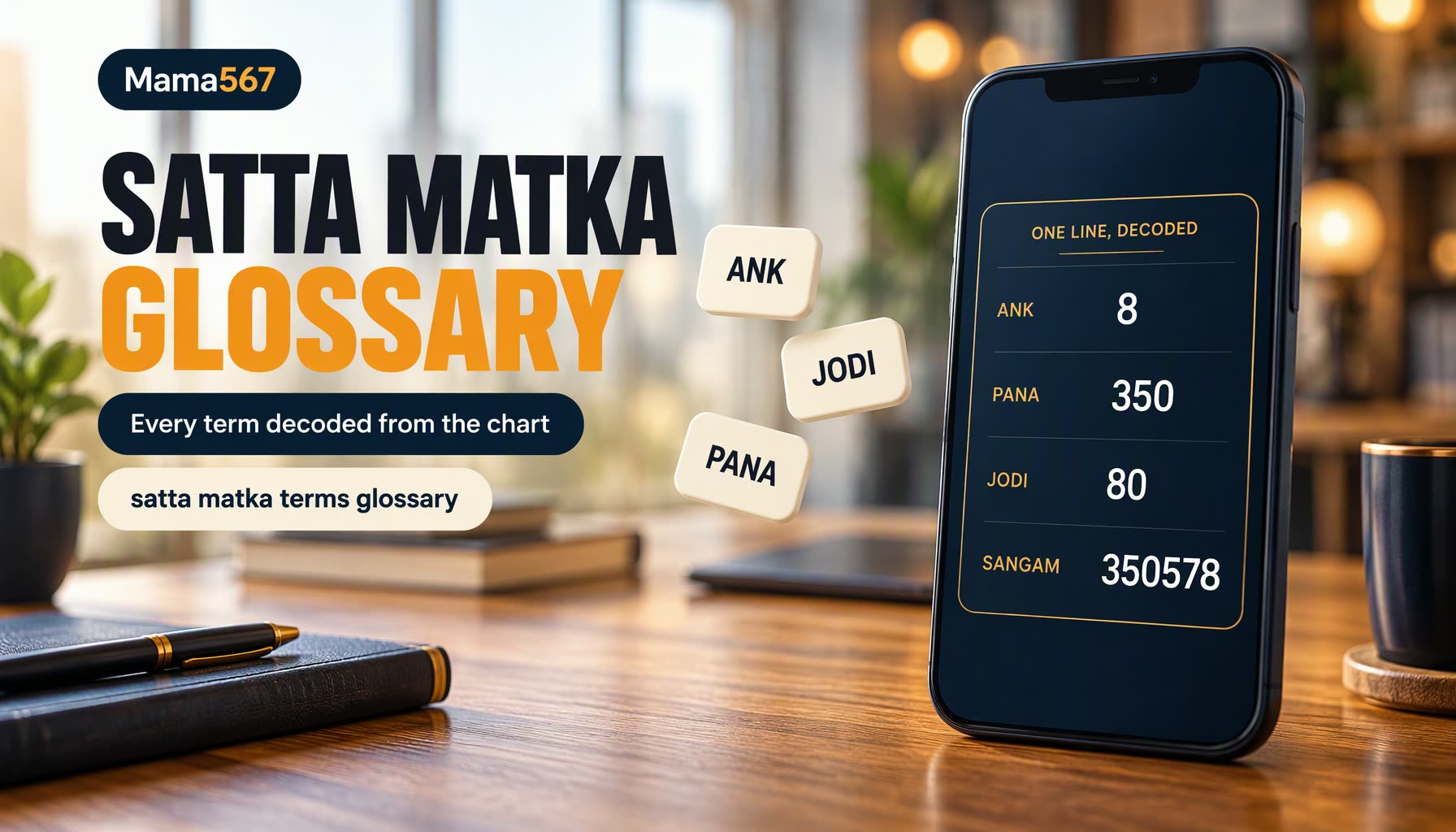
Take a real declared line from the chart snapshot — Karnataka Day, 14 September 2026 — and run every term against it:
| Term | Value | Where it comes from |
|---|---|---|
| Open pana | 350 | declared at the open |
| Open ank | 8 | 3 + 5 + 0 = 8 |
| Close pana | 578 | declared at the close |
| Close ank | 0 | 5 + 7 + 8 = 20, last digit 0 |
| Jodi | 80 | open ank, then close ank |
| Full result | 350-80-578 | the whole declared line |
| Full sangam | 350578 | open pana + close pana |
| Half sangam, open first | 3500 | open pana 350 + close ank 0 |
| Half sangam, close first | 8578 | open ank 8 + close pana 578 |
| Colour | black | neither 350 nor 578 repeats a digit |
Every derived value is arithmetic on the three declared digits. That is the test to apply to any line you doubt: if the jodi does not match the anks, or an ank does not match its pana's digit sum, the reading is wrong before the data is. Verified satta matka results turns that into a page-by-page check and is explicit about what consistency cannot prove.
The four look-alikes that cause most misreadings
| You see | It means | It does not mean |
|---|---|---|
*** or ** |
nothing declared yet | zero, or a broken page |
0 as an ank |
a real digit from a sum ending in 0 | an empty field |
| A red pana | two or three digits repeat | a likely number |
| A jodi with repeated digits | an ordinary two-digit pair | a red cell |
Two more confusions are worth naming. Pana and patti are the same object, but Single Pana and Single Digit are not: one is a three-digit shape, the other a one-digit reduction. And panel is a layout, even though the glossary lists it among pana's aliases — the page titles on this site use it to mean the chart.
Why a glossary is not a prediction tool
None of these words describes what a market will do next. A pana chart records declarations, a jodi is arithmetic on them, and a sangam is arithmetic on top of that. Learning the vocabulary makes a chart readable; it does not make the next draw calculable. The named list of patterns that are not patterns — repeats, streaks, the gambler's fallacy — is in probability in number games.
Bookmark this page for the next time a chart label does not match the guide you are reading, and keep the glossary open beside it for the site's own short definitions. The definitions above assume the page you are reading is the page you meant to open; How to verify a satta matka website is the four-check version of that assumption. If you want the terms in context rather than in a list, How to Read Satta Matka Charts walks a grid cell by cell.
The vocabulary earns its keep in two places: Random number generation explained uses these terms to ask what could have produced a declaration and how much a record can testify to, and Supreme Day and Night: What You Need to Know reads every Supreme line the archive holds, ank by ank.
For information only. Mama567 publishes results and charts, and does not offer predictions or guessing services. Satta matka is illegal in most Indian states. Adults 18+.