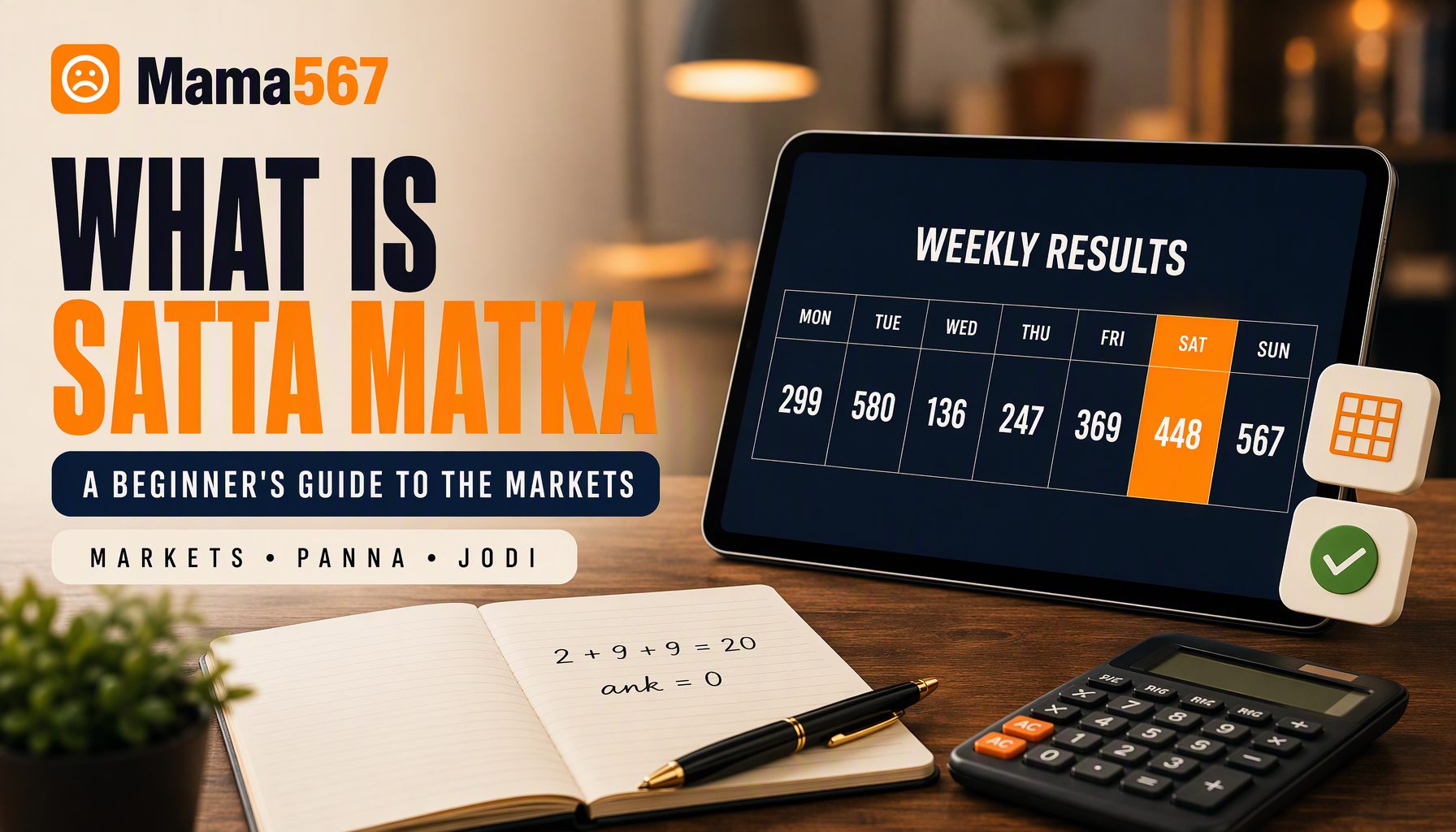
What is satta matka?
Satta matka is a number-based game that began in Mumbai in the 1960s. In every market, two three-digit numbers — an open pana and a close pana — are declared each day, and the two reduce to a two-digit pair called the jodi. The name comes from matka, the Hindi word for "earthen pot", which is exactly what the numbers were once drawn from. Today the pot is gone: results are declared digitally at fixed times, and information platforms like Mama567 publish them alongside historical charts so everything can be checked in one place.
This guide answers the question most newcomers arrive with — what is satta matka, where did it come from, and how do the modern charts work? If you already know the basics, you can jump straight to how to read the pana and jodi charts.
Satta matka at a glance
| Question | Short answer |
|---|---|
| What is it? | A number-based result game built on twice-daily declarations |
| Where did it begin? | Mumbai (then Bombay), India, in the 1960s |
| What does the name mean? | Matka = earthen pot — the container numbers were once drawn from |
| What does a result look like? | An open pana, a close pana, and the jodi made from both |
| How often does it update? | Twice a day for most markets, on a fixed schedule |
| How many markets does Mama567 track? | 19, from the morning block through Kalyan to Main Bazar |
| Does Mama567 run the game? | No — we publish results and historical charts only |
| Who is this for? | Adults 18+ reading for information |
Where the name comes from
Matka literally means "earthen pot". In the game's earliest form, numbers were written on slips of paper and pulled out of a large pot in front of a crowd, so the container itself became the name of the game. The term outlived the method: paper slips gave way to playing cards, and later to fully digital declarations — but more than sixty years on, the game is still called matka.
A brief history of satta matka
This is the short version. For the full timeline — why the cotton-rate wire stopped, what the pot era actually looked like, and how the record moved from paper ledgers to the charts on this site — see The History of Satta Matka.
Cotton rates, not numbers
The story starts with cotton. In the first half of the twentieth century Bombay was one of the world's great cotton trading ports, and the opening and closing rates of the New York Cotton Exchange were relayed to the Bombay Cotton Exchange by telegraph. Traders and onlookers began betting on whether those transmitted figures would go up or down, and on which digits the final rate would end in. For decades that rate-betting — sometimes called ankha jugar, "digit guessing" — was the game's ancestor, and it is why the whole activity is still described as satta, a Hindi word for a bet or stake.
1962: the pot era begins
In the early 1960s the telegraph link to New York rates was cut off, and the betting community needed a replacement that produced numbers on the same rhythm. Two figures from Mumbai filled that gap, and both names still shape the market list you see today:
- Kalyanji Bhagat, a Gujarat farmer settled in Mumbai, formalised the daily draw that became the Kalyan market — notable because it ran every day of the week, not just on market days.
- Ratan Khatri, working from the Worli area, popularised the format usually called the New Worli matka. His version introduced the discipline of declaring an open and a close figure for each session, which is still the backbone of every result line.
Numbers were drawn from an earthen pot in front of onlookers, which is exactly how the game got the name it has kept for sixty years.
The mill-town decades
Through the 1970s and 1980s matka spread well beyond its original neighbourhoods. Mumbai's textile-mill districts gave it a large, regular audience, and the money moving through the trade became large enough that the press started reporting monthly turnover in the tens of crores. New markets appeared with their own names, reputations and schedules — Milan, Rajdhani, Time Bazar, Main Bazar, Madhur, Sridevi — and each kept its own independent record of results, which is why a single date can show completely different numbers across markets.
From paper ledgers to digital charts
From the 1990s onward, sustained enforcement pushed the practice away from street corners. The results themselves migrated to phone lines, printed bulletins and shop blackboards, and then — as mobile data became universal — to websites and apps that publish declarations within seconds.
That is the form the game survives in today: each market declares its numbers on a fixed daily schedule, and dedicated result platforms publish those declarations alongside years of historical charts. Mama567 is one of those platforms, and it is worth being precise about what that means — we are strictly an information service. We publish results and charts. We do not run any game, accept any bets, or sell any tips.
How a satta matka result is declared
Open pana and close pana
Every market declares twice a day:
- the open result, declared earlier in the session, and
- the close result, declared later in the evening.
Each of those declarations is a three-digit number called a pana (also spelled panna), so a single day produces two panas. Nothing about the numbers is meaningful on its own — they are simply the digits the market drew.
Ank: reducing three digits to one
Each pana reduces to a single digit called its ank. The rule is mechanical: add the pana's three digits together, then keep only the last digit of that total.
- 346 → 3 + 4 + 6 = 13 → ank 3
- 128 → 1 + 2 + 8 = 11 → ank 1
- 500 → 5 + 0 + 0 = 5 → ank 5
Notice the third example: when the sum is already a single digit, that digit is the ank. And when a sum lands on a multiple of ten — say 2 + 3 + 5 = 10 — the ank is 0, not nothing. Zero is a fully valid ank.
Jodi: the number everyone quotes
Write the open ank first and the close ank second, and you have the day's jodi — a two-digit pair from 00 to 99. Because the jodi is the only number that combines both halves of the day, it is the figure people quote when they talk about a result.
Reading the full result line
A complete declaration is written as open pana – jodi – close pana. Take the line 346-31-128:
- Open pana 346 → 3 + 4 + 6 = 13 → ank 3
- Close pana 128 → 1 + 2 + 8 = 11 → ank 1
- Jodi → 31
Read left to right: three digits, two digits, three digits. If a line ever looks like it has the wrong number of digits, you are probably looking at a jodi-only chart rather than a full pana line.
Why some slots show asterisks
Before a market declares, its slot shows *** in a pana chart or ** in a jodi chart. Once the result is verified, the asterisks are replaced with the actual numbers — which is why charts appear to "fill in" around each market's timing. An asterisk is a gap, not a zero: it carries no information at all.
The full mechanics, including how bid cut-offs relate to declarations, are covered in Understanding Open & Close Results and Market Timings.
How modern digital charts work
A chart is simply a tidy history. Instead of scrolling through individual daily results, a chart lays out weeks at a glance:
- Each row is one week, with the newest week at the top.
- Each column is a weekday, Monday through Sunday.
- Each cell holds that day's result — the full open and close panas in a pana chart, or just the two-digit jodi in a jodi chart.
Pana charts and jodi charts
Every market on Mama567 has both. The pana chart keeps the full three-digit numbers, so it is the detailed view: each cell stacks the open pana above the close pana. The jodi chart condenses the same day to its two-digit pair, which makes a long run of history much quicker to scan. Neither is "the real" chart — they are the same declarations at two resolutions, and most regulars keep both open in separate tabs.
Timings: when a chart actually updates
A chart only changes when a market declares. Each market has an open bid and a close bid cut-off, and the *** placeholders are replaced the next time the site's data is refreshed — so a page can briefly show an older result even after a market has declared. Every chart page prints the date of the newest result it actually holds, and that is the number to trust. Checking a chart around a market's own timing is still when the grid is most likely to have just filled in, and two markets viewed at the same minute can be at completely different stages of the day.
Why the pages load so quickly
Result checking is time-sensitive: nobody wants a chart that arrives after the news. Every page on Mama567 — the home board, each market's pana chart, each jodi chart, and this blog — is pre-rendered as lightweight static HTML rather than assembled in your browser on every visit. Fewer scripts and less data means the chart appears fast on a mid-range phone on a mobile connection, which is exactly how most people read results.
The vocabulary in one glance
| Term | What it means | Example |
|---|---|---|
| Market (game) | A named result stream with its own schedule and history | Kalyan, Milan Day, Rajdhani Night |
| Open | The first declaration of the day | 346 |
| Close | The second declaration of the day | 128 |
| Pana (panna) | A three-digit number | 346, 500, 111 |
| Single panna | All three digits different | 346 |
| Double panna | Two digits repeated | 334 |
| Triple panna | All three digits the same | 333 |
| Ank | The single digit a pana reduces to | 346 → 3 |
| Jodi | The two-digit pair made from open ank + close ank | 31 |
| Panel | The chart board showing open and close together | See the Kalyan guide |
| Sangam | A combination pairing panas with anks across open and close | Covered in the bet-types guide |
Every term in this table also has a short plain-language definition in the glossary, and the bet categories built on them — half sangam, full sangam and the rest — are broken down in Matka Bet Types Explained. For the longer version of every word in that table — and the parts of the vocabulary this page skips, such as patti, placeholder and the two directions of a half sangam — see the satta matka terms glossary.
The markets you will see
All markets share the same open/close format — what differs is the name, the schedule and the following each has built up. On Mama567 you will find:
- Kalyan and Kalyan Night — among the most widely followed markets, day and late evening.
- Milan Day and Milan Night — a long-standing afternoon/evening pair.
- Rajdhani Day and Rajdhani Night — another popular two-slot market.
- Time Bazar — an early-afternoon market.
- Main Bazar — traditionally a late-night market.
- Sridevi and Madhur — each with morning, day or night variants, alongside Supreme, Karnataka and the morning markets.
A closer tour of the big names is in Popular Matka Markets: Kalyan, Milan & Rajdhani Explained, and each market's exact open and close bid times are shown on its card in the markets directory.
What is legal, and what is responsible?
Two questions come up immediately once someone understands the format, and both deserve straight answers rather than marketing language.
Legality. Laws covering games of chance differ widely between Indian states and between countries, and they change over time. Nothing on Mama567 is legal advice. It is your own responsibility to know and follow the rules that apply where you live, and all of our content is intended strictly for adults 18 and over.
Responsibility. A chance-based game is entertainment, not income — the mathematics of any such game does not reward regular play over time. If you do take part anywhere, set a fixed limit before you start, never chase a loss, and never borrow to play. Our full guidance is in Responsible Play: Staying Safe with Matka Results.
It is also worth saying plainly what Mama567 is not. We do not sell tips, we do not promise numbers, and no one can. Anyone claiming guaranteed results is running a scam, and we will never ask you to contact a third party for account help.
Reading results in the Mama567 app
Everything described above works identically in the Mama567 app, which is the reason most regulars install it: results and charts that fit in a pocket, with each market one tap away instead of several.
- Android — tap Download App on the Mama567 home page to get the official APK directly. Only install from the official site, and leave the phone setting that allows installs from unknown sources switched back off afterwards.
- iPhone and iPad — open mama567apps.com in Safari and use Add to Home Screen for a full-screen web app with no install step at all.
- What you get — live market board with bid timings, per-market pana and jodi charts, historical records, and support contacts.
- What it costs — nothing. Reading charts needs no registration and no payment.
If you are comparing the app against the website, the underlying data is the same and updates at the same moment; the app simply keeps your usual markets one tap away. New to navigating either one? The how-to-play guide walks through the site step by step.
Explore today's live charts
That is the whole picture: a 1960s Mumbai pastime named after a pot, now a fully digital stream of twice-daily declarations that anyone can look up. The fastest way to make it click is to read one real week of results — explore today's live charts on Mama567, with the latest results page listing each market's newest declared line, and follow along with the vocabulary above. New here? The how-to-play guide walks through the site step by step.
Before you start scanning boards, Supreme Day and Night: What You Need to Know reads one market family end to end — both windows, the Sunday test and every declared line in the archive — and Random number generation explained answers the question most newcomers ask second: where do the numbers actually come from, and what makes one unpredictable?
Play responsibly. Content on Mama567 is for information only and intended for adults 18+.