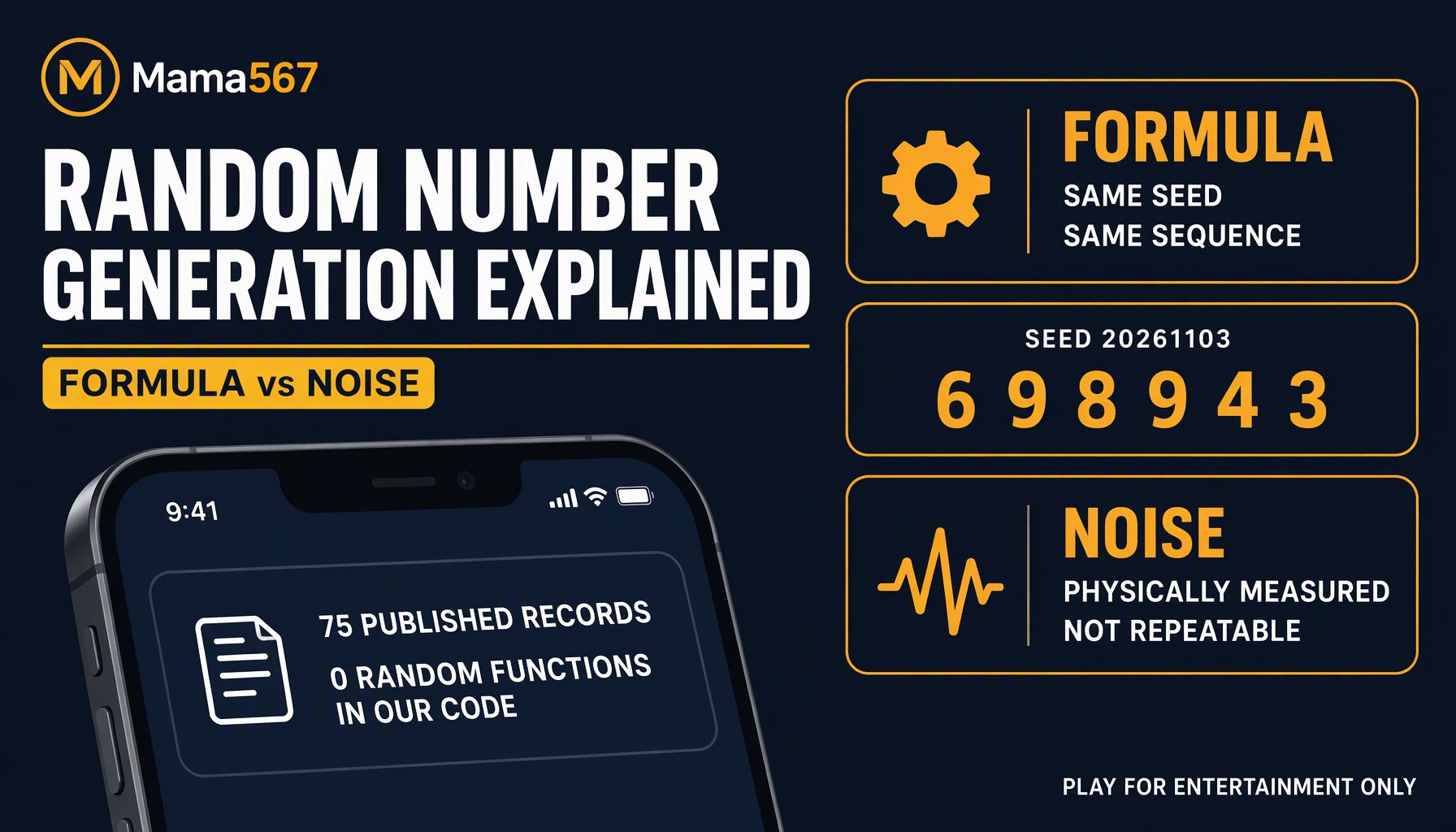
The one distinction that matters
Ask what "random" means in software and you get two answers that people mix together. One is about uniformity: does every value come up as often as its share? The other is about unpredictability: can the next value be known before it appears? A generator can be perfectly uniform and completely predictable at the same time, and that is not a corner case — it is the everyday behaviour of the code that ships in most programs.
| Formula-based (PRNG) | Hardware noise (TRNG) | Cryptographic (CSPRNG) | |
|---|---|---|---|
| Where the number comes from | Arithmetic on an internal state | A physical measurement | A formula seeded and refilled from measurements |
| Same input, same output? | Yes, always | No | No, and that is the requirement |
| Predictable if the algorithm is known? | Yes — the seed is the whole secret | No | No, even after watching its output |
| Speed | Extremely fast | Slow, and it can run dry | Fast |
| Used for | Simulations, shuffling, games, tests | Key material, draws, lotteries | Sessions, keys, anything an adversary watches |
| Fails how | A leaked seed or a recoverable state | A thin entropy source, or a bad driver | Being asked to be a TRNG |
Everything a reader needs to know about the first column follows from it being arithmetic: there is no randomness in it, only the appearance of randomness, and the appearance is bought with a single number — the seed. Change the seed, get a different sequence. Keep the seed, get the same sequence forever.
A generator you can run yourself
Here is a real one, small enough to write down. It is a linear congruential generator, the oldest family still in wide use: take the current state, multiply by 1,664,525, add 1,013,904,223, and keep only the remainder after dividing by 2³². Read the state modulo 10 and you have a "random digit".
Start it at seed 20261103 and the first ten digits are:
6 9 8 9 4 3 4 5 6 7
Run it again, on another machine, in another language, and you get 6 9 8 9 4 3 4 5 6 7. That is a formula, not a dice roll.
And watch the parity: even, odd, even, odd, even, odd, even, odd, even, odd. Every single step. That is not bad luck in a short run — the lowest bit of that state alternates by construction, because the multiplier is odd and the increment is odd, so the state flips parity each iteration and taking modulo 10 preserves parity. A fair stream of digits alternates parity about half the time; ten alternations in a row happen by chance roughly once in 512 runs. This generator does it always.
Now run it a million times and count the digits:
| Digit | 0 | 1 | 2 | 3 | 4 | 5 | 6 | 7 | 8 | 9 |
|---|---|---|---|---|---|---|---|---|---|---|
| Count in 1,000,000 | 99,650 | 99,762 | 99,524 | 100,390 | 100,679 | 100,158 | 100,065 | 100,137 | 100,082 | 99,553 |
A fair source would put every digit at 100,000 ± 300, where 300 is the ordinary spread of a count that large. The largest departure here is digit 4 at 2.3 spreads high, with digit 2 at 1.6 low. Pool all ten counts into the standard goodness-of-fit statistic and a million draws of this generator score 12.73 against a 5% bar of 16.92 — a clean pass. So the ten-bucket count, the first thing anyone reaches for, certifies this stream.
What the ten-bucket count cannot see is the shape of the sequence. Look again at the parity column above and extend it: across all one million digits there are 999,999 adjacent pairs, and not one of them has both digits the same parity. Split those pairs into the four parity classes — even-even, even-odd, odd-even, odd-odd — and a fair stream puts about 250,000 in each. This generator puts 500,000 in even-odd, 499,999 in odd-even and zero in both of the diagonal classes, which scores a chi-square of 999,999 on three degrees of freedom. That is not a marginal failure; it is a statistic that has stopped being a measurement of fit and become a measurement of how badly the model is wrong.
Same million outputs. One test passes, one test ends the generator. That is the classic failure mode of the small congruential generator, and it lives in the low bits of the state — which is precisely where a naive % 10 goes to look. It is why the professional advice is to take the high bits of a state, or use a generator someone else has stress-tested.
The famous big one, Mersenne Twister, fixes the crude defects and has a period of 2¹⁹⁹³⁷ − 1 — a number with 6,002 digits. It is the engine Python's random module is built on and the example generator in C++'s <random>. It also has a 19,968-bit state, and 624 consecutive 32-bit outputs are enough to reconstruct that state and predict every number that follows. A period so long it is astronomically improbable to repeat, paired with total predictability for anyone who has watched 624 outputs. That pairing is the whole reason "random-looking" and "secure" became two different product categories.
Where real noise comes from
A true generator measures something that is not arithmetic: thermal noise in a resistor, the timing jitter between hardware interrupts, the exact moment a keyboard event lands, in the limit the decay time of a radioactive sample. An operating system collects these into an entropy pool and serves bytes from it — getrandom() on Linux, the bcrypt primitives on Windows — and the platform APIs that hand out random bytes for security work read from that pool.
That collection step is where history's most instructive failures happened, because entropy is a resource that can run dry or be seeded thinly. Two studies in 2012 put numbers on it. The one usually cited as "Ron was wrong, Whit is right" reported, in its own abstract, that "two out of every one thousand RSA moduli that we collected offer no security" — the moduli were not broken by brute force but by noticing that two of them shared a prime factor, which makes both factorable with schoolbook arithmetic. The companion NDSS study of keys gathered from live TLS servers and SSH hosts traced a large part of the damage to Android and Chrome OS devices generating keys from an under-seeded random source at first boot. Nobody's formula was wrong in either case. The number feeding the formula was not random enough.
And in the standards world, a generator that cleared the published statistical suites was withdrawn from NIST's recommended list in 2017, several years after independent analyses had shown its design contained a structure that anyone holding one particular value could use to predict its output. Passing the tests was never the same thing as being safe — a lesson that applies to the sentence you are about to read about charts.
What a declaration is, on this site
Mama567 does not run any of the above. Grepping the site's own source code for a call to a random-number function — Math.random, getRandomValues, randomBytes — returns zero matches: nothing on the site draws a number. Results arrive as declarations from an external feed and are transcribed onto charts, exactly as the glossary describes, and the mechanics of the two numbers in a line are on understanding jodi and pana.
Which produces the distinction this article exists to make. From a player's seat, a matka number is unpredictable in a weaker and more human sense than a dice chip is: it is announced by somebody. Two properties people collapse into "random" come apart here:
- You cannot compute it in advance, because you are not in the room when it is declared.
- It was not sampled from a fair distribution by a machine, because no distribution was sampled — a person wrote a figure down.
Both make the next line unknowable to you. Only the first one is what a chart implies. And the risk that hides behind the difference is not bias but fixing: a generated number can be unfair by accident; a declared number can be chosen on purpose. That is why the site's own audit of what a reader can verify is about published records, dated data and checkable arithmetic rather than about fairness claims nobody here can substantiate.
The one thing a published line does let you do is check the plumbing: the jodi is arithmetic, so any line can be re-derived from its two panas. The information content of that check is worth stating in bits. A three-digit pana is one of 1,000 values — 9.97 bits. An open and close pair is 1,000,000 combinations — 19.93 bits. And the jodi in the middle, being fully determined by those two numbers, carries zero bits of new information. Every line here contains one declaration of twenty bits and one checksum.
Running the test on what is published, and why it proves nothing
So take the honest question — can a reader test whether these declarations are random? — and run the textbook answer, the chi-square goodness-of-fit test, against the archive Mama567 actually publishes: 75 complete declared records across 19 markets, covering 10–14 September 2026, in a snapshot dated 11 October 2026.
| Test | Statistic | Rejection bar | What the bar means | Verdict |
|---|---|---|---|---|
| Open ank over 75 records, 10 categories | 4.07 | 16.92 | one chance in twenty of a fair source landing this high | does not reject |
| Close ank, same 75 records | 8.60 | 16.92 | as above | does not reject |
| Jodi, all 100 categories | 105.00 | 123.23 | one chance in twenty at 99 degrees of freedom | does not reject |
The open ank counts are 6, 11, 7, 6, 5, 8, 7, 8, 10 and 7 for digits 0 through 9 — a spread that looks lopsided to the eye and is unremarkable to the test. Probability in number games runs the same idea on the pooled 150 anks and reaches the same conclusion, and adds the collision and streak arithmetic: the 75 records produced 50 distinct jodis where pure chance predicts 52.9.
Now the part that article does not cover, because it is the part that matters for a reader deciding how much to believe: none of those three tests had any hope of detecting a fix.
For the ank tests, with 75 draws the expected count per digit is 7.5 and the test's own spread under fairness is ±4.24. Suppose a market quietly draws one particular ank at half the fair rate — 5% instead of 10%. Work out how much that pushes the statistic up: the bias term is 75 × 0.0278 = 2.08. For fairness already averages 9.0 on its own, and the bar is 16.92. So the rigged market's average reading is 11.08, which a fair market exceeds routinely — and running the experiment 200,000 times at this exact size catches the rig 10.9% of the time. Walking the same simulation up through larger archives, the same rig trips the bar half the time at about 310 draws and nine times out of ten at about 620. The archive behind this site's charts is 75 records.
For the jodi test, the failure is of a different kind, and it is a warning about reading tables rather than about the data. Seventy-five balls in a hundred boxes leave 47 boxes empty on average; this archive left 50 empty. So half of all possible jodis are absent, and that observation says nothing except that 75 is smaller than 100. The statistic itself averages 99 under fairness, with a spread of about 14, against a 123.23 bar — an almost guaranteed pass whatever the numbers were, which is exactly what a test with no power looks like.
So: the published records are consistent with a fair process, and the sample is far too small to have established that. Anyone who reads the first sentence without the second has been sold a conclusion the arithmetic does not support — and anyone selling a "verified random" claim on the strength of a 75-row chart is selling the second sentence's absence.
The streaks you can see, in advance
Small samples are not merely uninformative, they are pattern-rich, and the patterns are countable before you look.
In this archive, two markets show the same open ank three declarations in a row. One of them is Sridevi Day, whose anks on 11, 12 and 13 September were 9, 9, 9; the other is Supreme Day and Night's night session, at 8, 8, 8 over exactly the same three dates. That looks like a discovery. But the archive is nineteen markets deep, holding between one and five declared rows apiece, and a run of three matching anks appears somewhere in an archive shaped like this about 30% of the time — the expected count is 0.38, so it is the kind of thing that shows up more often than not and is news to nobody who ran the calculation first.
The same effect covers the coincidences that attract the most attention. In the Supreme market's records, the jodi 30 was declared twice on consecutive days and the jodi 86 twice on consecutive days, and a 1 November 2026 capture of the upstream chart feed shows two lines where the open and close pana are the identical three digits — 234-99-234 and 122-55-122. With 1,000 possible panas per side, those repeats are rare individually and certain collectively: every market, every week, some coincidence is due, and it will be the one you were watching. Why historical chart records should be read carefully and how to use historical charts work through the same counting problem from the archive side, and Supreme Day and Night: What You Need to Know has the two consecutive-pair rows in context.
There is a version of this article that ends by telling you to ignore the patterns. That is not it. The useful conclusion is smaller and sturdier: a chart is a record of declarations, and no amount of reading it hands you the mechanism, the seed or the next number. The mechanism is not published because there is no generator; the seed question does not apply; and the next line is written by someone, somewhere, after you have already decided what you think it will be.
What you can actually do with this
Three practical rules, in the order they help:
- Treat any prediction claim as a claim about a generator you have never seen. If someone says a number is "computed" or "guaranteed", ask which of the two families produced it. If the answer is a formula, it is only unpredictable to you. If the answer is "the market declares it", then nobody computed anything, and the honest word for the service is guesswork with a fee.
- Check arithmetic before you check advice. A line on this site can be re-derived: add the three digits of a pana, keep the last digit, do it twice, and the two results spelled in order are the jodi. How to read satta matka charts walks the procedure; a forwarded screenshot cannot be checked at all.
- Size the stake against entertainment, not against odds you cannot verify. There is no strategy in this article, because there is no strategy available in a process nobody publishes. If you do play, treat the stake as the price of the interest the chart holds for you, set the amount before you look at a number, and stop at it. What is responsible gaming? covers the limits worth setting, including the ones that have nothing to do with money.
Random number generation explained in one line, then: uniformity can be tested, unpredictability has to be engineered, and neither of them can be inferred from a short list of numbers someone else wrote down. Play responsibly and for entertainment only — that is not a disclaimer bolted onto the end of this article, it is the only conclusion the mathematics actually supports.
For information only. Mama567 publishes declared results and charts, does not generate numbers, does not accept wagers, and offers no predictions. Satta matka is illegal in most Indian states. Adults 18+.