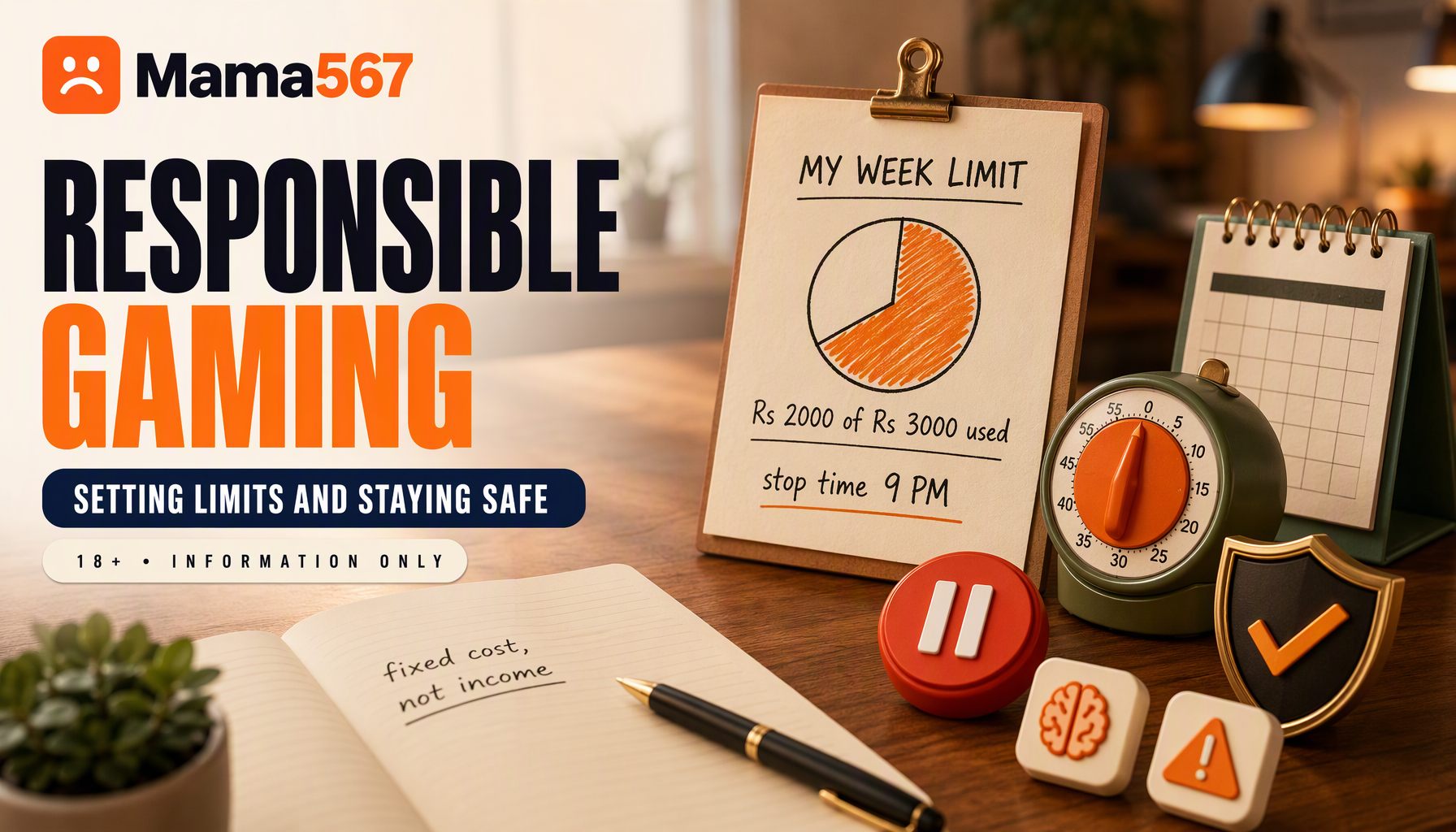
The definition, without the marketing
Responsible gaming is the practice of deciding what a game of chance may cost you — in money, in time, in attention — before you play, and then holding that decision when playing stops feeling pleasant. It is not a set of tricks that makes losing safe. It is not a way to play more. And it is not a claim that the game has become fair.
The phrase gets used two ways, and the difference matters. Operators use it as a compliance vocabulary: policies, disclaimers, a help link in a footer. Readers meet it as a practical question: what do I actually do so that this hobby stays a hobby? This page is about the second. The first is documented separately, in our editorial and data policy, terms of use and privacy policy — and the honest summary is that this website publishes charts and results, takes no money, sells no tips and runs no game.
Limit one: money, chosen while calm
A gaming budget is an entertainment budget. It is not a stake, not a float, and not a plan.
Work backwards from what you can genuinely lose. The test is not "can I afford to put this in?" — it is "what happens to my month if none of it comes back?" If the answer touches rent, groceries, school fees, an EMI or a medical bill, the number is too high, and no amount of discipline fixes it, because the problem was the number.
Then make the number physical and small:
| Instead of | Use |
|---|---|
| "I'll spend up to ₹2,000 this week" | Load a fixed amount into the wallet once, on a day you are not playing, and stop when it is empty |
| Topping up "when I'm close to a win" | A written date: the wallet gets money on the 1st, and on no other day |
| Tracking in your head | One line in a notes app: date, amount in, amount out. The record is the discipline |
| Borrowing from the household account | Money that has already left the account you spend from |
The reason a written amount beats a mental one is that a losing streak reliably produces a temporary belief that this time the maths is different. The note does not share that belief.
Limit two: time, which nobody sets
Money is the limit people discuss; time is the one that reveals the problem. A session that was twenty minutes and became three hours has already cost you something the budget did not cover, and the chart-reading habit makes it easy — a weekly grid invites one more row, then last week, then the jodi chart for a market you do not even follow.
What works is boring and specific:
- A fixed window with an alarm, not "a bit in the evening". The alarm is the decision; you are only executing it.
- Not first thing and not last thing. First-thing play sets the tone of a day; last-thing play costs sleep, and tired people overspend on everything.
- A day count. Choose which days of the week you play, and treat the others as closed. Availability is the point of a phone app; a calendar rule is the only counterweight.
- No checking in the gaps. Opening the results page every twenty minutes is not research, it is a slot machine with extra steps, and it keeps the urge warm between sessions.
Limit three: what the game is allowed to mean
This is the one that decides whether the first two hold.
A game of chance has one honest economic description: over time it returns less than it takes. That is not bad luck and not a skill gap — it is the structure, and it is why no reading of a chart improves an outcome. So the framing has to be consumption, not investment. You are buying something: a few minutes of interest, a reason to care about a number, a hobby with a vocabulary. That is a legitimate thing to pay for, in the same category as a film ticket. It is not a legitimate thing to fund from money you need back.
The test for the framing is simple. If a loss makes you angry, the framing is wrong, because anger means you considered that money yours. If a loss costs you the price of the entertainment and you shrug, the framing is right.
What responsible gaming does not mean
- It does not mean the game is safe. The game is illegal in most Indian states, and the money you stake can be lost in full. Limits reduce harm; they do not create an edge.
- It does not include a system. No budget, timer or routine makes a declaration predictable. If someone offers you one for a fee, they are describing a different product — see the fraud patterns in Responsible Play: Staying Safe with Matka Results.
- It is not a solution to a money problem. Play never has been. Debt is a reason to stop, not a reason to chase.
- It is not a badge for the operator. "Play responsibly" printed under a deposit button is marketing. The useful version is a page like this one, which tells you plainly that the app you are about to open has no built-in brakes.
What Mama567 gives you, and what it does not
We would rather state this precisely than leave you to discover it:
| On this website | In the Android app | |
|---|---|---|
| Money taken | None — no deposits, no wagers, no paid tips | A points wallet exists, with its own deposit and withdrawal rules |
| Deposit or loss caps | Not applicable | Not available |
| Timers and self-exclusion | Not applicable | Not available |
| Age gate | 18+ content, stated on every page | 18+; enforced by you, not by the software |
| Result records | Dated charts for every tracked market | The same numbers, on a phone |
That table is the whole argument for setting limits outside the software. There is no switch in the app that will stop you on the 1st of next month, and no support message that will enforce one for you. The controls that exist are the ones you build: money that has already left your spending account, a written number, an alarm, a calendar, and a person who knows.
The support channel has a different job — faults, not boundaries. If the app itself stops behaving, How to Troubleshoot Common Mama567 App Issues sets out what to check before you write in, and what to include so the report can be acted on.
What the site does commit to is on the record: results are published as declared and dated to the newest entry each chart actually holds, corrections follow a documented process, and nothing on any page is presented as a likely number. That is what makes it usable as a reference rather than a trigger — see how we source and correct data and the site FAQs.
The pre-commitment list
If you do one thing from this page, do the uncomfortable one: decide the limit on a day you are not playing, write it down, and tell someone.
- Write the monthly figure and the days you play. Date the note.
- Move the entertainment money out of your main account before you load the wallet, so a top-up costs an actual trip.
- Set the session alarm in the phone's clock, not in your head.
- Keep the note where a second person can see it. Hidden spending and hidden time are the same habit, and being known is the cheapest brake available.
- Put one rule in writing for the worst day: "if I lose the monthly figure before the 15th, the app comes off the phone until the 1st." Uninstalling is not a moral failure; it is a five-second piece of friction that lets the rational part of you catch up. Re-download steps are in the app download guide if and when you want the app back.
- Take one full day off after any session that went badly. Urgency is the thing being sold to you; a day of not deciding is the free test of whether a decision was good.
When to stop and talk to someone
Any of these, sustained over a month rather than happening once: spending or playing past the written number repeatedly, chasing losses, hiding amounts, borrowing to play, lying about time, skipping work or family obligations for a result, feeling irritable on the days you do not play, or treating a chart as something that owes you an outcome.
Free and confidential help exists, and it is not reserved for disasters. Gambling Therapy offers online support and a helpline directory covering India at gamblingtherapy.org. A doctor or licensed counsellor can assess the same situation privately. And one person you already trust is a legitimate first step — usually the fastest one, and the one people postpone longest.
If you want the longer version of that conversation — the scams that circle result pages, the account-safety rules, and the arithmetic on why no number can be predicted — it is in Responsible Play: Staying Safe with Matka Results.
Our safe play policies
Mama567 is an information platform for adults 18 and over. It publishes declared results and charts, does not accept wagers, does not sell tips or predictions, and never asks for passwords, OTPs or payment. The documents behind those statements are public: terms of use, privacy policy, editorial and data policy, and who writes this site. New to the game itself? Start with What is Satta Matka? and the glossary, where the vocabulary is defined without a promise attached to it.
Learn more about our safe play policies — the scam patterns, the account rules, and where to get help, in one place.
The mathematical version of that advice is in Random number generation explained: nothing in a generator, a chart or a streak makes one number likelier than another, so the only variables a player controls are the stake and the stopping time. For a market-level example of reading a grid without expecting a forecast, see Supreme Day and Night: What You Need to Know.
For the contact routes this site actually offers, and why no page here prints a support number, see How to contact Mama567 customer support.
Satta matka is illegal in most Indian states, and money staked can be lost in full. This page is harm-reduction information, not legal, financial or medical advice. Mama567 publishes results and charts, and does not offer predictions or guessing services. Adults 18+.