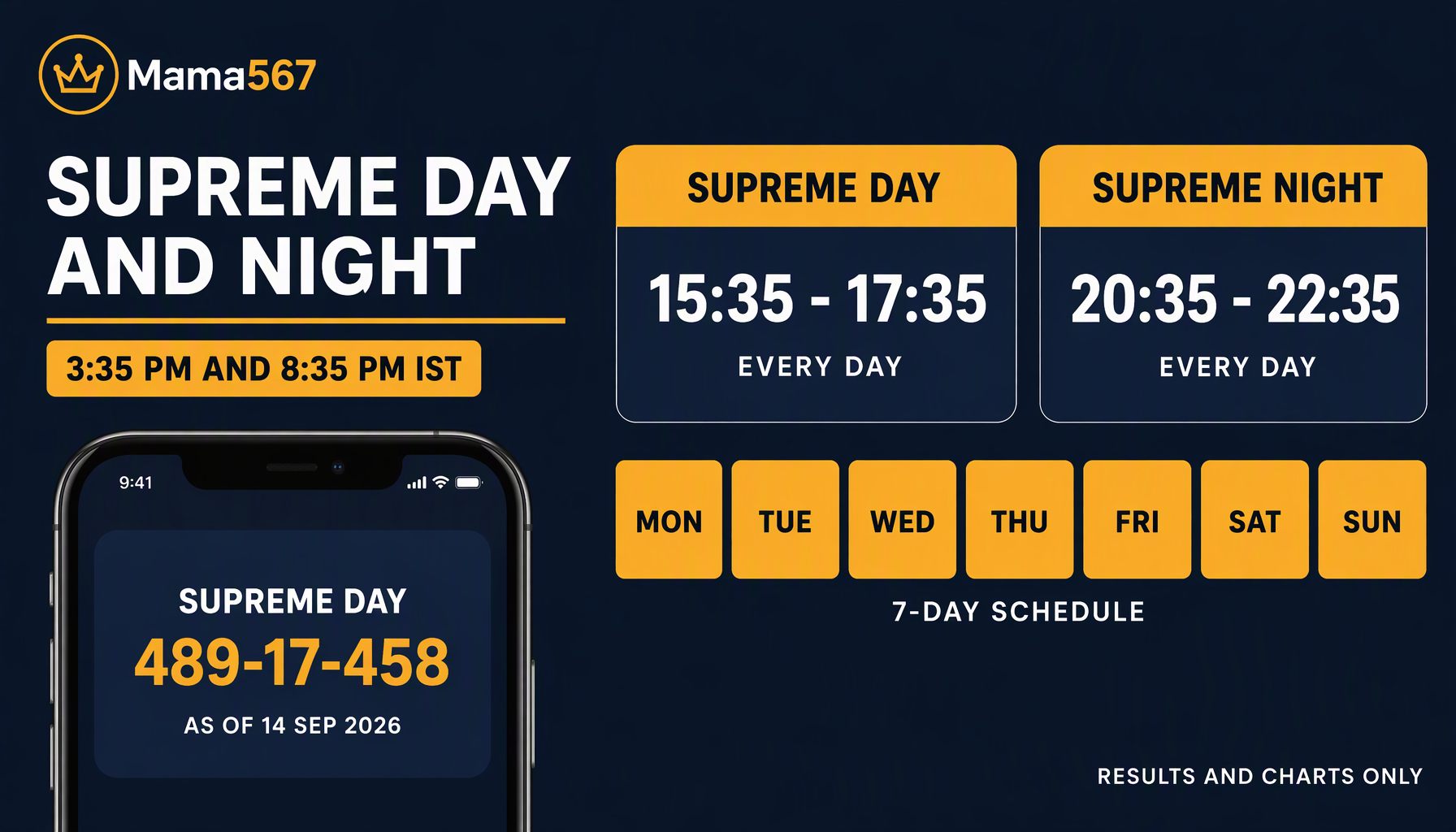
The short version
| Supreme Day | Supreme Night | |
|---|---|---|
| Open | 15:35 IST (3:35 PM) | 20:35 IST (8:35 PM) |
| Close | 17:35 IST (5:35 PM) | 22:35 IST (10:35 PM) |
| Length of window | Two hours | Two hours |
| Gap between the two windows | Three hours exactly, 17:35 to 20:35 | — |
| Draw days | Every day | Every day |
| Code in the upstream data | SUPREME_DAY |
SUPREME_NIGHT |
| Market number in the source data | 12 | 16 |
| Name printed by the feed | SUPREME DAY | SUPREME NIGHT |
| Newest line this build holds | 489-17-458, 14 Sep 2026 |
800-84-347, 13 Sep 2026 |
| Charts published here | pana and jodi | pana and jodi |
Two two-hour windows, seven days each, five hours apart on the clock, identical format. Everything people usually search for under this name — the "Supreme timing" that disagrees, the "Supreme fix", the chart that shows half-asterisks — comes from the four things below.
Supreme is the market that does not have a naming problem
Most market families on this site carry at least one label trap. Sridevi is printed as SRIDEVI by the source data while its code says STAR_TARA_MORNING, and the same feed carries four other draws with closely related names that this site does not chart.
Supreme has none of that, and that is worth knowing because it makes Supreme the useful control case when you are learning to check a market rather than believe one:
- The feed lists 32 markets. Exactly two of them contain the word Supreme:
SUPREME_DAYandSUPREME_NIGHT. There is no Supreme Morning, and no second market wearing the name. - The names the feed prints — SUPREME DAY, SUPREME NIGHT — are the names on this site's pages. Across all 19 charted markets, only one has a name that disagrees with its feed label, and it is not a Supreme one.
- The feed's own windows for both Supreme sessions were 15:35–17:35 and 20:35–22:35 on 31 October and again on 1 November 2026 — matching the table above.
Three charted markets do not agree with the feed on time, and knowing that Supreme is not among them is the point: on the 1 November capture, Kalyan is published here as 16:15–18:15 while the feed's row says 16:30–18:30, Kalyan Morning is 11:25–12:25 here against 11:50–12:50 there, and Milan Night is 21:00–23:00 here against 21:10–23:15 there. Draw days, by contrast, matched for all 19. So the field to re-check when two sources disagree is the clock, not the calendar — and the deeper habit of verifying what a page can actually substantiate is the subject of how to verify the authenticity of a satta matka website.
How each window sits inside the day
A matka market declares twice inside its window rather than once, so "15:35" is the minute the open figure belongs to and "17:35" the minute the close does. The full mechanics are in open and close results and timings. What makes the two Supreme sessions different from each other is the company they keep.
Supreme Day, 15:35–17:35, opens into a pile-up and closes into a gap:
| Around the window | What else is on the clock |
|---|---|
| At 15:35, when Supreme Day opens | Milan Day (15:05–17:05) and Rajdhani Day (15:05–17:05) are already half an hour into their windows — three markets live at once |
| At 16:15 | Kalyan opens, and four windows run together for the next 50 minutes |
| At 17:05 | Milan Day and Rajdhani Day both close, 30 minutes before Supreme Day does |
| At 17:35, when Supreme Day closes | Only Kalyan is still running; it holds the board until 18:15 |
| After 17:35 | 55 minutes with nothing opening — Karnataka Night starts at 18:30 |
The overlap arithmetic, market by market: Supreme Day shares 90 minutes with Milan Day, 90 with Rajdhani Day and 80 with Kalyan. Those three are the whole of it — no other charted market touches that window.
Supreme Night, 20:35–22:35, is the opposite shape: it opens almost on top of another market and closes in the middle of the evening's crowdest stretch.
| Around the window | What else is on the clock |
|---|---|
| At 20:35, when Supreme Night opens | Madhur Night started at 20:30, so two windows are live and they share 115 of the 120 minutes |
| At 21:00 | Milan Night opens — three live |
| At 21:30 | Kalyan Night and Rajdhani Night both open — five live |
| At 21:50 | Main Bazar opens — six windows overlapping while Supreme Night is still running |
| At 22:35, when Supreme Night closes | Four markets are still declaring: Milan Night, Kalyan Night, Rajdhani Night and Main Bazar |
| After 22:35 | Nothing opens. Main Bazar, which started at 21:50, is the last window of the day and runs to 23:55 |
So a Supreme Night close lands in the noisiest quarter-hour of the schedule, with four other declarations arriving around it. If that is the part of the day you find unreadable, the Milan Day vs Milan Night comparison shows how a six-day market behaves in the same band, and the markets directory prints every window and draw-day set on one page.
The Sunday test, run on the archive instead of the claim
"Every day" is a claim every results site makes. It is also checkable, because a seven-day market has to produce a Sunday line and a six-day market must not.
Sunday 13 September 2026 sits in the middle of the archive this site publishes. Running it across all 19 markets:
| Schedule | Markets | Sunday 13 Sep cell |
|---|---|---|
| Seven-day | 10 markets, including Supreme Day and Supreme Night | Filled in all ten |
| Six-day | 6 markets — Time Bazar, Milan Day, Milan Night, Madhur Night, Rajdhani Day, Kalyan | Absent in all six |
| Five-day | 3 markets — Kalyan Night, Rajdhani Night, Main Bazar | Absent in all three |
Both Supreme lines for that Sunday are ordinary-looking declarations:
- Supreme Day:
148-30-578— open pana 148, close pana 578. - Supreme Night:
800-84-347— open pana 800, close pana 347.
The split is exact, with no exceptions in either direction, which is what makes it a test rather than a sample of marketing copy. Note what it does not do: it does not prove the schedule for the other six days of the week, and it does not survive as evidence indefinitely — it is a property of the dated archive this build was generated from, not a live check.
Reading every Supreme line this site holds
The committed archive carries five Supreme Day lines and four Supreme Night lines, covering 10–14 September and 10–13 September respectively. All nine are complete, and each is re-derived below: add the three digits of a pana, keep the last digit of the total, and the two results in order spell the jodi.
| Date | Supreme Day line | Open ank | Close ank | Jodi check |
|---|---|---|---|---|
| Thu 10 Sep 2026 | 125-82-345 |
1+2+5 = 8 | 3+4+5 = 12 → 2 | 82 ✓ |
| Fri 11 Sep 2026 | 377-71-560 |
3+7+7 = 17 → 7 | 5+6+0 = 11 → 1 | 71 ✓ |
| Sat 12 Sep 2026 | 139-30-190 |
1+3+9 = 13 → 3 | 1+9+0 = 10 → 0 | 30 ✓ |
| Sun 13 Sep 2026 | 148-30-578 |
1+4+8 = 13 → 3 | 5+7+8 = 20 → 0 | 30 ✓ |
| Mon 14 Sep 2026 | 489-17-458 |
4+8+9 = 21 → 1 | 4+5+8 = 17 → 7 | 17 ✓ |
| Date | Supreme Night line | Open ank | Close ank | Jodi check |
|---|---|---|---|---|
| Thu 10 Sep 2026 | 158-47-359 |
1+5+8 = 14 → 4 | 3+5+9 = 17 → 7 | 47 ✓ |
| Fri 11 Sep 2026 | 369-86-169 |
3+6+9 = 18 → 8 | 1+6+9 = 16 → 6 | 86 ✓ |
| Sat 12 Sep 2026 | 260-86-123 |
2+6+0 = 8 | 1+2+3 = 6 | 86 ✓ |
| Sun 13 Sep 2026 | 800-84-347 |
8+0+0 = 8 | 3+4+7 = 14 → 4 | 84 ✓ |
Three things fall out of reading all nine lines this way:
- A red pana is a formatting fact, not an event.
377repeats a 7 and800repeats a 0, so both colour on the chart. Their jodis — 71 and 84 — do not, and cannot: a jodi is two digits and the red rule needs a repeat inside the number being coloured. - Zero is a live digit.
148and139both sum to 13 → ank 3, and their close panas578and190both end in an ank of 0. That is why the jodi reads30and not3: a trailing zero is the pair, and dropping it is how a hand-copied chart turns into a wrong jodi. - Nine rows is a record, not a profile. Two of those rows can be reduced to arithmetic, and none of them constrains the tenth.
The pairs that look like a pattern
Two lines in that table repeat a jodi on back-to-back days: Supreme Day produced 30 on 12 and 13 September, and Supreme Night produced 86 on 11 and 12 September. And across 11, 12 and 13 September, Supreme Night's open ank was 8 three times in a row — from 369, 260 and 800, three panas with nothing in common except that their digits add to something ending in 8.
That is exactly the shape a tipster sells. It is also the shape chance makes: with 100 possible jodis and a handful of draws, repeats are the expected texture, and the number of places a three-in-a-row could appear across nineteen markets is large enough that seeing one somewhere is closer to likely than remarkable. The count is in random number generation explained, which runs the standard test on this same 75-record archive and shows how blind that test is at this size — and the named list of reading errors is in common mistakes when reading matka results.
What the Supreme grids actually hold
Each chart page lays out the calendar weeks that actually hold a declared line, Monday to Sunday, newest week first, and prints the date of the newest result it holds. That layout rule is why the two Supreme pages do not even have the same number of cells:
| Page | As-of date it prints | Week rows drawn | Day cells | Filled | Empty |
|---|---|---|---|---|---|
| Supreme Day pana | 2026-09-14 | 14/09–20/09 and 07/09–13/09 | 14 | 5 | 9, shown as ***-**-*** |
| Supreme Day jodi | 2026-09-14 | the same two rows | 14 | 5 | 9, shown as ** |
| Supreme Night pana | 2026-09-13 | 07/09–13/09 only | 7 | 4 | 3 |
| Supreme Night jodi | 2026-09-13 | 07/09–13/09 only | 7 | 4 | 3 |
Supreme Day's newest line, 14 September, is the Monday that opens a fresh week, so its page carries that week and the one before it. Supreme Night's newest line, 13 September, is the Sunday that closes a week, so there is no later week to draw and the grid stops at seven cells.
The one-day difference between the two Supreme pages is not a market that skipped a draw: the Day line for 14 September exists in the archive and the Night line for that date does not. Anything a page holds ends where its data ended. And the empty cells are the site's honesty mechanism: an asterisk row means not published here yet, and the convention is spelled out in satta matka terms glossary.
For a fuller walk through the layout of a page like this, including what each stacked line in a pana cell is, see how to read satta matka pana and jodi charts and the jodi and pana primer.
Live board versus chart page: the gap you can measure
The two Supreme sessions are the clearest place on this site to see the freshness split, because the numbers moved while we were checking.
The chart pages above are built from a committed snapshot generated on 11 October 2026 and hold nothing after 14 September. On 1 November 2026 the same upstream endpoint this site reads returned 25 rows for Supreme Day and 24 for Supreme Night, running through 31 October — and the five September rows it still shows are identical, line for line, to the five this site publishes. Nothing contradicts the archive; the archive is simply not current.
Two lessons from that comparison, both checkable:
- The gap is twenty rows wide, and it is invisible on the chart page. A
/results-today/or chart page will tell you it holds 14 September. The homepage board is the only surface here that polls the feed while you watch, and even it prints no clock. Why browser cache can show older chart information and how to check live satta matka results cover the surfaces one by one. - The upstream feed is not an archive. Those 25 rows arrive as two blocks — 10 to 14 September, then 12 to 31 October — with the twenty-seven days between them absent. A page that promises "Supreme full history chart" is not reading that endpoint, and a page that shows a continuous daily strip is filling gaps from somewhere else. Why historical chart records should be read carefully is the general version of that warning.
Where to track Supreme declarations
- Supreme Day pana chart — open, jodi and close for each declared day.
- Supreme Day jodi chart — the pair alone.
- Supreme Night pana chart — the 20:35 session in full.
- Supreme Night jodi chart — its jodi column on its own.
- Latest declared results by market — the newest line held for all 19 markets, with its date and draw days.
- Markets and timings and the charts index — every window, code and draw-day set in one place.
- New to the notation? What is Satta Matka? and bet types explained come before this guide, not after it.
- Satta matka terms glossary — every word used above, including ank, pana, jodi and red.
Mama567 records declared results for these two markets. It takes no wagers, sells no tips, and presents no Supreme number as likelier than another; satta matka is illegal in most Indian states, and nothing above is advice. 18+ only.
For information only. Mama567 publishes results and charts and does not offer predictions or guessing services. Adults 18+.