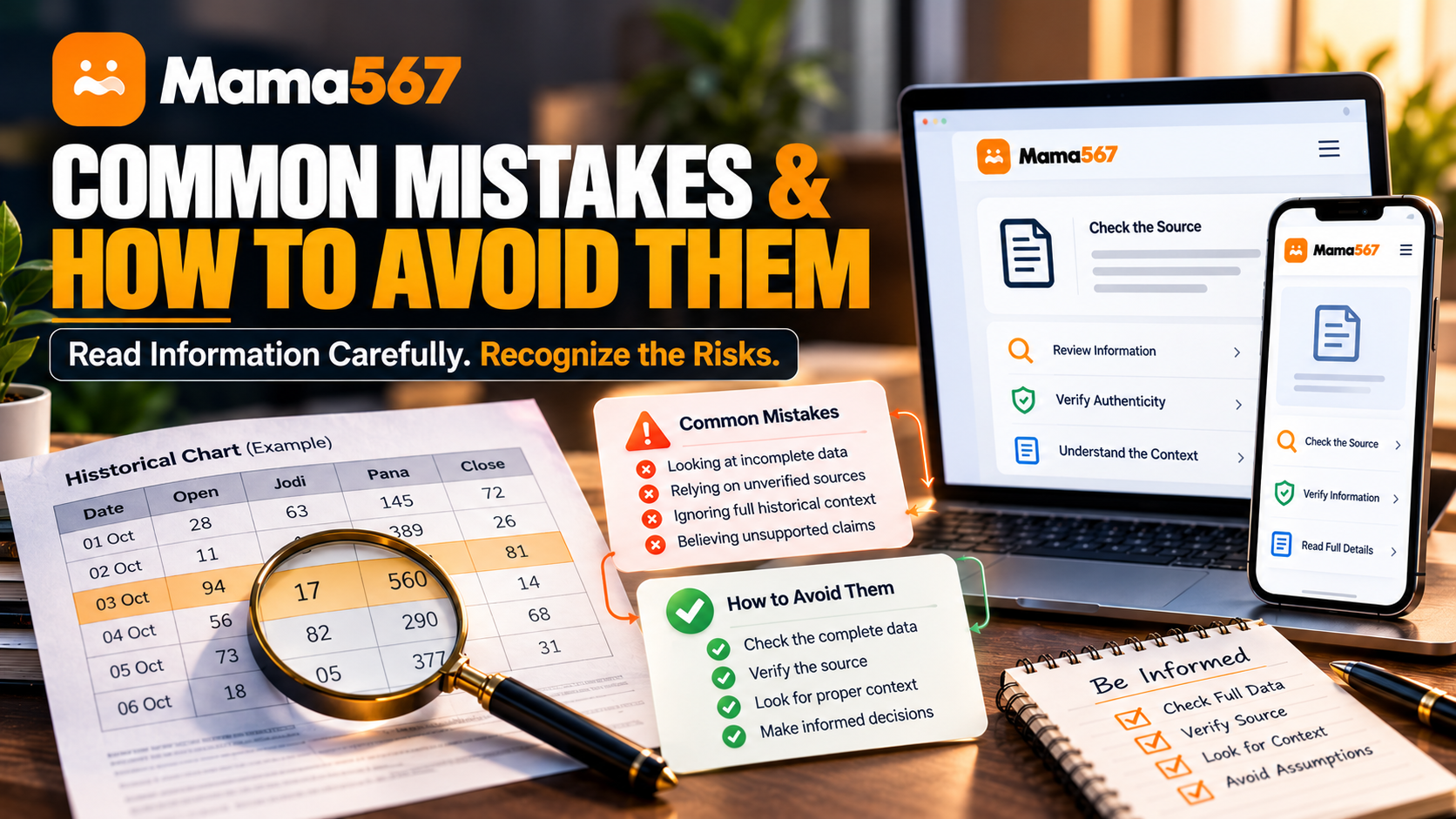
Historical result archives, weekly panel charts, and number tables are frequently consulted by individuals seeking to review past declarations or understand how different markets operate. However, raw numerical data without proper context is easily misinterpreted. Online forums, social messaging channels, and opportunistic websites often exploit these misunderstandings by presenting ordinary historical records as predictive formulas or by promoting fraudulent schemes.
Reading historical charts requires an analytical approach that separates factual records from subjective assumptions. Misinterpreting column headings, confusing scheduled non-operating days with missing results, or falling for claims of "fixed" numbers can lead to poor judgment, compromised personal privacy, and significant financial loss.
This editorial guide examines the most common mistakes when reading Matka results, explains how to evaluate historical records accurately, outlines the warning signs of online impersonation scams, and reinforces essential principles of digital safety and risk awareness.
For foundational definitions of market records, readers can review our guides on How to Read Satta Matka Charts, Understanding Jodi and Pana, and Open and Close Timings.
Treating Historical Patterns as Predictions
Perhaps the most widespread mistake people make when reviewing historical number grids is believing that past sequences reveal future outcomes. Observers frequently spend hours analyzing weekly jodi tables, tracking digit frequencies, and searching for repeating diagonal lines or symmetry across previous weeks.
This tendency stems from a well-documented cognitive bias known as the gambler's fallacy—the mistaken belief that if an event has occurred frequently in the past, it is less likely to happen in the future (or conversely, that an event that has not occurred recently is "due" to appear).
In any genuine game of chance:
- Draws Are Independent: Each draw has no mechanical memory of preceding rounds. The declaration of a particular single digit (ank) or three-digit panel (pana) yesterday does not alter the mathematical probability of that same number being selected today.
- Patterns Are Descriptive, Not Predictive: A historical chart functions identically to an archival ledger or weather almanac; it records what occurred on a given date under specific market conditions. It provides historical documentation, not a forecasting mechanism.
- Randomness Naturally Clusters: Random sequences often exhibit clusters of repeating digits or apparent streaks that look deliberate to the human eye. Finding a temporary pattern in past records is a normal mathematical characteristic of random distributions, not evidence of a predictable cycle.
Treating historical records as a predictive formula encourages unrealistic expectations and dangerous financial risks. Charts should be consulted strictly for retrospective verification, never as a tool for forecasting.
Misreading Chart Labels and Numerical Records
Historical satta matka records follow standardized structural conventions, but readers unfamiliar with the terminology frequently misread the data columns. A standard panel chart typically displays three distinct components for every draw:
- Open Pana (Open Patti): A three-digit combination representing the opening declaration (for example,
145). - Jodi (Bracket): A two-digit number displayed in the center column (for example,
63). - Close Pana (Close Patti): A three-digit combination representing the closing declaration (for example,
567).
Common Interpretive Errors
- Confusing the Pana with the Jodi: Readers sometimes mistake the three-digit pana for the primary result, or fail to understand how the jodi is derived. As explained in our Jodi and Pana guide, the two-digit jodi is constructed using the unit sum of the open pana followed by the unit sum of the close pana. Misreading the columns leads to incorrect assumptions about historical outcomes.
- Overlooking Date and Market Discrepancies: Different markets operate on different schedules and time zones across India. Looking up results for Milan Day while referencing Kalyan timings or comparing a morning draw against an evening archive causes significant confusion. Every chart on Mama567 explicitly prints the market title, the specific date of the record, and the latest "as-of" timestamp.
- Ignoring Weekly Layout Structures: Standard panel charts are structured in weekly grids from Monday through Sunday. Failing to check the day header can cause readers to attribute a Wednesday result to a Tuesday, distorting their review of historical records.
Confusing Missing Information with a Confirmed Result
Another frequent error occurs when readers encounter an empty cell or an unpopulated row on a chart page and assume that the platform has failed or that an undisclosed result is being concealed.
In reality, unpopulated fields on legitimate archival platforms like Mama567 occur for clear operational reasons:
1. Scheduled Non-Operating Days
Not all markets operate seven days a week. Several prominent markets run exclusively on business days (Monday through Friday) and do not declare results on weekends. For example:
- Kalyan Night, Rajdhani Night, and Main Bazar operate Monday to Friday only.
- Saturday and Sunday cells for these markets are intentionally blank.
Assuming a missing weekend number indicates an error reflects a failure to understand the market's published operating calendar.
2. Scheduled Batch Updates vs Real-Time Feeds
As detailed in the platform's Editorial & Data Policy, Mama567 builds and regenerates its charts on a scheduled deployment cycle rather than through unverified, continuous scraping.
- If a draw concludes at 09:30 PM, the newly declared pana may not appear on the static chart until the subsequent scheduled rebuild completes.
- Incomplete cells mean that a result has not yet been verified through the operator's official data feed. Legitimate publishers display blank cells rather than guessing or inserting unverified rumors from third-party chat rooms.
| Scenario | What the Reader Observes | What It Actually Means |
|---|---|---|
| Weekend Non-Operating Day | Blank cell on Saturday or Sunday for Kalyan Night | Normal operation: The market does not run weekend draws. |
| Pending Declaration | Empty cell 10 minutes after close time | Processing window: The official result is awaiting feed verification and static site rebuild. |
| Stale Timestamp | Top banner shows "as of yesterday" | Freshness indicator: The page honestly states the date of the newest record it actually holds. |
| Third-Party Discrepancy | Social media channel shows a number before the official site | Unverified claim: Unofficial channels often post speculative numbers that contradict official feeds. |
Believing Claims of Guaranteed Results
The internet is saturated with individuals and anonymous channels promising "100% fixed matka numbers," "VIP leak jodis," or "sure shot predictions." Believing these claims is one of the most financially damaging mistakes a reader can make.
Why "Guaranteed Results" Are Impossible
Satta matka is mathematically structured around random selection. Legitimate market operators do not release predetermined numbers in advance. Any entity claiming to possess inside knowledge or advance "leaks" is operating an advance-fee fraud scheme.
How the Scam Operates
- The Teaser: Scammers post edited screenshots or fabricated testimonials on social platforms (YouTube, Facebook, Instagram) claiming that their paid members received yesterday's winning number.
- The Advance Fee: The operator demands an upfront payment—frequently through UPI, cryptocurrency, or gift cards—under the guise of a "registration fee," "booking charge," or "VIP group membership."
- The Disappearing Act: Once funds are transferred, the fraudster either blocks the victim immediately or demands additional payments for "verification" or "manager approval." No valid prediction is ever provided.
As documented in our Payment Information Safety Guide, Mama567 does not sell tips, does not run paid prediction groups, and will never contact users to solicit money. Any unsolicited message claiming to represent the platform is fraudulent.
Trusting Unofficial Links or Impersonation Accounts
As platforms grow in visibility, rogue operators frequently create counterfeit websites designed to confuse visitors. These clone websites often mimic the visual branding, color schemes, and logo of the authentic platform while introducing harmful elements.
The Risks of Clone Platforms
- Credential Harvesting: Phishing pages present fake login portals intended to steal mobile numbers, passwords, and banking details.
- Malicious APK Distribution: Rogue domains offer modified Android installation packages (
.apkfiles) embedded with spyware, adware, or trojans that can monitor device keystrokes and read private messages. - Aggressive Advertising and Redirects: Counterfeit sites often bombard visitors with deceptive pop-ups, adult advertisements, and automated redirects to unregulated gambling portals.
How to Verify the Authentic Mama567 Platform
- Check the Address Bar: The authentic website URL is strictly
https://mama567apps.com/. Be alert to minor spelling variations (such as replacing letters with numbers or altering top-level domains to.xyzor.live). - Inspect Website Functionality: The legitimate Mama567 website has no user login forms, no subscription fees, and no pop-up advertisements. If a page prompts you to enter banking passwords or download unexpected software files, leave immediately.
- Review App Integrity: As noted in our App Download Guide, the official Android APK has a fixed file size of 5,758,251 bytes. Modified packages from third-party app repositories carry altered file hashes and should never be installed.
Ignoring the Financial and Personal Risks of Gambling
Many people focus exclusively on the mechanics of number charts while completely ignoring the serious personal, financial, and legal risks associated with gambling.
1. The Trap of "Chasing Losses"
When individuals experience financial loss, a common psychological reaction is the urge to continue risking money in an attempt to recover what was lost. Known as "chasing losses," this behavior frequently transforms minor financial setbacks into catastrophic debt. Probability dictates that increasing exposure to a game with a negative expected value compounds losses rather than eliminating them.
2. Legal Realities in India
Gambling laws in India are established primarily at the state level under the Public Gambling Act, 1867, and state-specific enactments, supplemented by central digital oversight from the Ministry of Electronics and Information Technology (MeitY) and the Press Information Bureau (PIB).
Under Indian law, satta matka is classified as an illegal game of chance in the overwhelming majority of states and Union Territories. Engaging in betting or wagering exposes participants to legal penalties, financial seizure, and prosecution. Viewing historical charts for informational reference is distinct from gambling participation, but readers must never assume that reading about a market makes wagering on it lawful.
3. Seeking Help for Gambling Harm
Gambling can be addictive and lead to severe emotional distress, relationship strain, and financial devastation. If you or someone you know is struggling with compulsive gambling behaviors:
- Acknowledge the problem early before debts escalate.
- Cease all gambling activities immediately; do not attempt to win back lost money.
- Seek free, professional, and confidential counseling through international helplines such as Gambling Therapy.
Our dedicated Responsible Play and Safety Guide outlines further strategies for recognizing the warning signs of problematic behavior.
Sharing Personal Information Without Checking the Destination
Digital privacy is an essential component of modern online safety. A frequent mistake made by internet users is volunteering sensitive personal information to unverified contacts.
Rules for Protecting Your Information
- Never Disclose Authentication Codes: Under no circumstances should you share a One-Time Password (OTP), UPI security PIN, ATM PIN, or banking password with anyone on a phone call or chat app. Legitimate technical staff will never ask for your security credentials.
- Do Not Transmit Identity Documents: Avoid sending photographs of government identity cards (such as Aadhaar, PAN, or voter ID) or bank account statements through WhatsApp or Telegram to individuals claiming to represent platform verification teams.
- Verify Official Support Channels: Mama567 publishes verified contact details directly on its About Us page and website footer (such as WhatsApp/telephone contact
8955936867). The platform operates no anonymous Telegram help desks.
If you receive an unsolicited message claiming that your account is locked, that you have won a cash prize, or that immediate payment is required to unlock results, treat it as a cyber threat. Suspicious cyber incidents can be formally reported through India's National Cyber Crime Reporting Portal at cybercrime.gov.in.
What to Do When Information Appears Incorrect
Even carefully compiled data archives can occasionally experience discrepancies, delayed feed updates, or temporary typographical errors. When an entry on a chart appears incorrect, readers should follow a structured verification process rather than making assumptions:
- Check the Page Freshener Date: Every chart page on Mama567 displays an "as-of" date indicating the newest result held in the dataset. If the date has not advanced to today, the page reflects yesterday's data snapshot and has not yet completed its daily rebuild.
- Preserve Objective Evidence: If you suspect a factual discrepancy between the displayed record and the market operator's official declaration, take a clear screenshot of the page, copy the full URL, and note the date and time of your observation.
- Report Through Verified Channels: Send the factual observation, including the URL and screenshot, to the support contact listed on the About Us page or site footer.
- Allow for Scheduled Corrections: Confirmed data discrepancies are investigated against official market feeds and updated during the next automated site deployment cycle.
Two guides make that process concrete. Supreme Day and Night: What You Need to Know compares a Supreme chart page's own as-of date with what the same source returned on 1 November 2026, and Random number generation explained covers the mistake this list does not include — treating a chart as evidence about how a number was produced.
By approaching market records with critical thinking, verifying URLs carefully, and recognizing the inherent risks of games of chance, readers can navigate online information safely and avoid costly errors.
Frequently Asked Questions
Why do historical Matka charts show blank or empty cells?
Blank cells generally indicate that a market did not hold a draw on that day (for example, Kalyan Night, Rajdhani Night, and Main Bazar operate Monday through Friday only), or that the declared result had not yet been recorded at the time of the scheduled page rebuild.
Can past Matka chart patterns predict future numbers?
No. Mathematical probability confirms that independent draws have no memory. Past winning numbers, sequences, or frequencies do not influence future outcomes, and treating chart patterns as predictive tools is an example of the gambler's fallacy.
How can I tell if a website claiming to publish Matka results is genuine?
Check the exact domain name in your browser's address bar to ensure it matches the verified address (such as mama567apps.com). Look for transparent editorial policies, dated result records, the absence of aggressive payment demands, and valid HTTPS certificates without security warnings.
The long form of that answer, with the certificate fields, response headers, timestamp split and rate endpoint checked on Mama567 itself, is in How to verify a satta matka website.
What should a mistake-conscious reader do if someone offers "fixed" or "guaranteed" Matka results?
Treat the offer as an attempted financial fraud. Satta matka outcomes are random and cannot be legitimately leaked or guaranteed. Never transfer money, pay subscription fees, or share private contact details with individuals offering "sure shot" numbers on messaging platforms.
What are the legal restrictions on satta matka in India?
Under Indian law, gambling is regulated primarily at the state level under Public Gambling Acts and contemporary digital gaming frameworks. Satta matka is illegal in the vast majority of Indian states and Union Territories, and is strictly restricted to adults aged 18 and over wherever exceptions exist.
Where can someone find support for gambling-related harm?
Free, confidential, and professional assistance is available internationally through organizations such as Gambling Therapy at gamblingtherapy.org. If you or someone you know is experiencing distress or financial harm from gambling, seek support immediately.