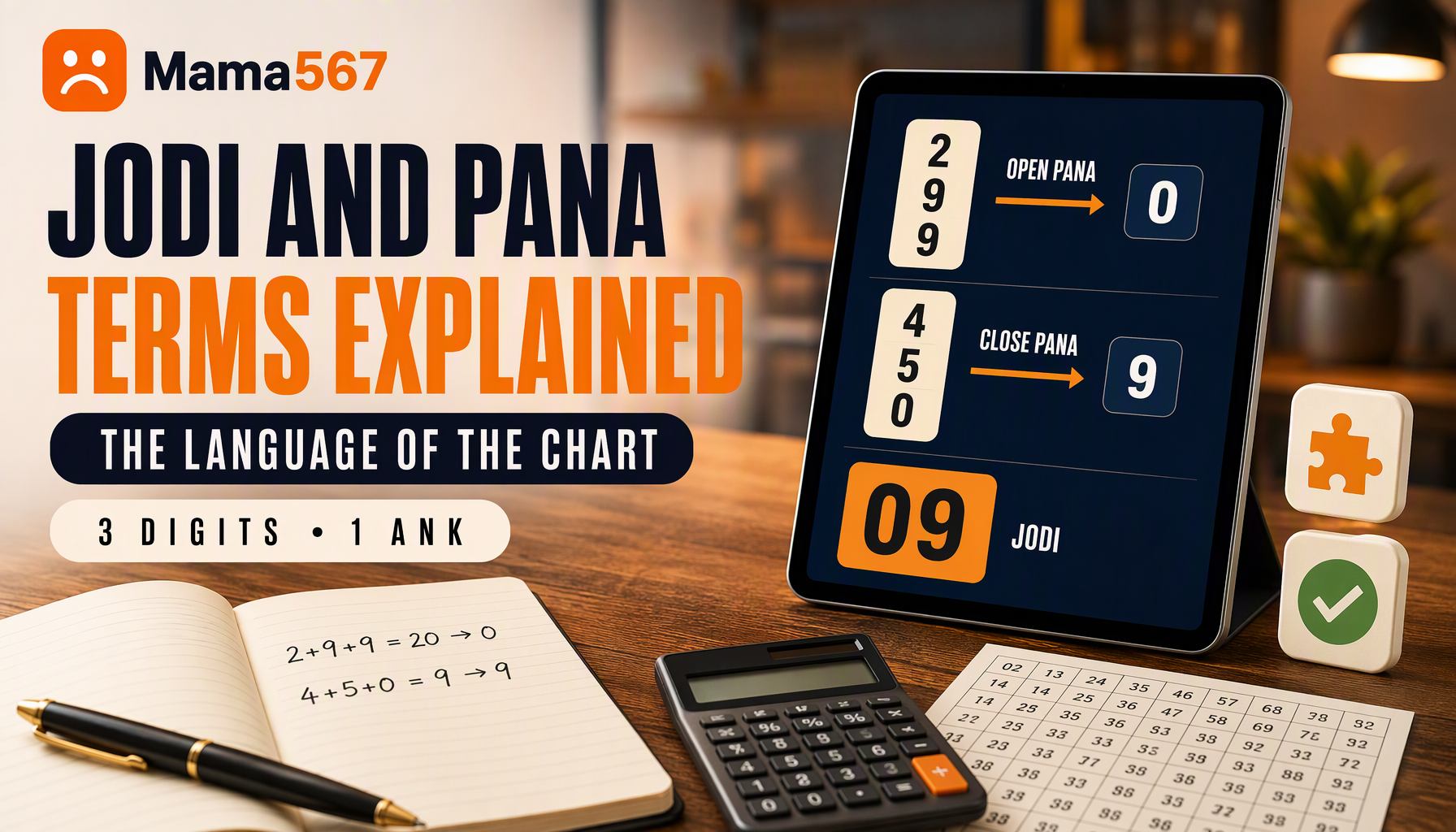
Two words cause most of the confusion for anyone new to a satta matka chart: pana and jodi. Almost the rest of the vocabulary — ank, patti, single digit, sangam — is built on top of them, and both describe something you can see in a single cell. This guide defines each term in plain language, shows exactly how the numbers relate, and works through real declarations from Mama567 charts so you can check the arithmetic yourself.
If you want the wider picture first, What is Satta Matka? explains where the game came from; if you already know the layout and need speed, jump to How to Read a Kalyan Panel Chart.
The three numbers on one result line
A declared day is normally written as three groups of digits with hyphens between them. Here is a real Kalyan declaration from a Monday on the Kalyan pana chart:
299-00-136
| Part | Value | Name |
|---|---|---|
| First | 299 | Open pana |
| Middle | 00 | Jodi |
| Last | 136 | Close pana |
Everything on this page is a matter of reading those three groups correctly: two three-digit numbers at the ends, and one two-digit code in the middle that comes out of the other two.
What is a pana?
A pana is a three-digit declared number — any of the 1,000 values from 000 to 999. Each market day produces two of them:
- the open pana, declared at the market's opening declaration;
- the close pana, declared later, after the close-bid cut-off.
On a pana chart the two sit in the same cell, and the cell holds three lines: the open pana, the jodi derived from both, and the close pana. Order is fixed — open always comes first, which is why the same two panas can never be read the other way round.
You will meet four spellings for this word: pana, panna, panel and patti. They are the same thing. The drift is simply what happens to a spoken vocabulary copied by hand across regions and decades. Mama567 articles write pana, while the chart data feeding those same pages labels the values openPatti and closePatti, so you will see both inside one product. The glossary lists the variants under a single entry so nobody has to guess.
What is an ank?
An ank is the single digit a pana reduces to. The rule is mechanical:
- Add the pana's three digits.
- Keep only the last digit of that total.
| Pana | Digit sum | Ank |
|---|---|---|
| 299 | 2 + 9 + 9 = 20 | 0 |
| 136 | 1 + 3 + 6 = 10 | 0 |
| 350 | 3 + 5 + 0 = 8 | 8 |
| 578 | 5 + 7 + 8 = 20 | 0 |
Because a three-digit pana's digits sum to at most 27, the ank is always one digit — never two — and there are only ten possible anks, 0 through 9. That is why "single digit" and "ank" describe the same object: one of ten values, read out of a three-digit number.
The step beginners most often skip is the second one. 2 + 9 + 9 = 20, and the ank is 0, not 20. If your total is two digits, reduce it again by keeping its last digit.
What is a jodi?
A jodi (also written yodi, and meaning "pair") is the two-digit code made from the two anks of a day: open ank first, close ank second.
Take the line above. The open pana 299 reduces to ank 0; the close pana 136 reduces to ank 0; so the jodi is 00.
Jodi is not an arithmetic sum and not a number you add to anything. It is a pair written in a fixed order, which means:
- There are 100 possible jodis, 00 through 99, because each half has ten options.
- Order matters. Anks 8 and 0 make jodi 80; anks 0 and 8 make 08. They are different jodis, and reversing which pana is open and which is close is the most common reading error on a chart.
- The jodi is derived, never declared separately. A market declares two panas; the jodi is what follows from them, which is why the pana chart and the jodi chart can never disagree.
That last point has a consequence beyond reading: it means a published row can be audited by anyone with a pencil. Add the digits of each pana, keep the last digit of each total, and you have reproduced the jodi yourself. Verified satta matka results puts that arithmetic to use as the first of three checks on a chart, and is honest about the one thing it cannot prove.
Five declared days, worked end to end
These are real declarations from the Karnataka Day market for 10–14 September 2026, taken from its pana chart. Work down the columns and each jodi falls out of the two panas beside it.
| Date | Open pana | Digit sum → ank | Close pana | Digit sum → ank | Jodi |
|---|---|---|---|---|---|
| 10 Sep | 556 | 5 + 5 + 6 = 16 → 6 | 680 | 6 + 8 + 0 = 14 → 4 | 64 |
| 11 Sep | 588 | 5 + 8 + 8 = 21 → 1 | 250 | 2 + 5 + 0 = 7 → 7 | 17 |
| 12 Sep | 140 | 1 + 4 + 0 = 5 | 580 | 5 + 8 + 0 = 13 → 3 | 53 |
| 13 Sep | 119 | 1 + 1 + 9 = 11 → 1 | 450 | 4 + 5 + 0 = 9 | 19 |
| 14 Sep | 350 | 3 + 5 + 0 = 8 | 578 | 5 + 7 + 8 = 20 → 0 | 80 |
Every published record on the site obeys this rule — the check across the current chart snapshot matches on all 75 complete records. That makes the jodi a useful self-test: if your arithmetic disagrees with the chart, the mistake is in the reading, not in the data.
Single, double and triple pana
The same three-digit number can be described by its shape — whether digits repeat. This is where the word patti is most often used.
| Shape | Rule | Examples | Colour on a Mama567 pana chart |
|---|---|---|---|
| Single pana | All three digits different | 346, 136 | black |
| Double pana | One digit appears twice | 299, 336, 343 | red |
| Triple pana | All three digits the same | 111, 777 | red |
Two details are worth knowing, because most guides get them wrong:
- Position does not matter. 343 has no adjacent pair but repeats the digit 3, so it is still a double and still prints red. The rule reads the digits, not their neighbours.
- The colour applies to panas only. Jodi values on a Mama567 chart are printed in the normal colour — the red highlight exists to mark repeated digits inside a three-digit pana.
Red is a reading aid in a crowded grid, nothing more. It carries no information about what a market will declare next, and treating a red cell as "hot" is where chart reading stops being reading. The betting formats built on these shapes — and how they are described — are covered in Matka Bet Types Explained.
Jodi versus pana: the difference in one line
| Pana | Jodi | |
|---|---|---|
| Digits | Three | Two |
| Comes from | A declaration by the market | The two panas of the same day |
| Possible values | 1,000 (000–999) | 100 (00–99) |
| Order-sensitive | Within itself, no | Yes — open ank first |
| Shown on | Pana charts | Jodi charts, and the middle line of a pana cell |
Where to see these terms in action
- Live results — the results board lists each market's newest declaration in the full
open-jodi-closeline. - Pana charts — one cell per day with open pana, jodi and close pana stacked, so you can practise the reduction on real numbers.
- Jodi charts — the same weeks condensed to the two-digit pair, which is where long runs are easier to scan.
- Markets — the markets directory shows timings and draw days, since a market only fills its chart on the days it declares.
- One market, end to end — the Time Bazar timing and chart guide reduces every one of that market's 17 feed records with the digit-sum rule shown line by line, which is the fastest way to practise the reduction on a complete small dataset rather than on scattered cells.
- Glossary — short definitions of every term above, including sangam, cut and placeholder.
- Four spellings of one word — pana, panna, patti and panel name the same three-digit number on different surfaces of this site, and the priced names on the rate card do not match the names used in the definitions. Understanding “Single Digit” and “Double Patti” game formats works through the drift, including the ordering rule that makes
350a correctly written pana.
Common mix-ups when reading jodi and pana
- Calling the jodi a sum. It is a pair of digits written in order, not the result of adding anything.
- Keeping the whole digit total. 3 + 5 + 0 = 8 is an ank; 2 + 9 + 9 = 20 is not — reduce it to 0.
- Swapping open and close. Top line is open, bottom is close; reversing them reverses every jodi you write.
- Confusing pana with patti. Same object, different word — and different spelling, depending on the source.
- Reading
***as a zero. An undeclared slot is a gap, not a number, and it has no ank and no jodi. - Assuming a double pana is rare. Doubles turn up regularly; colour exists to help you find them, not to flag something unusual.
- Waiting for a sangam result. No market declares one. A half or full sangam is a pairing of numbers already printed on the line, so it exists the moment the close arrives — half sangam vs full sangam derives both readings from real chart lines.
What this vocabulary does — and does not — give you
Knowing that 299 reduces to 0, and that a day's two anks form its jodi, gives you one thing: the ability to read a chart accurately. That is genuinely worth having, because most arguments about a result come from someone reading the wrong line.
It gives you nothing else. A jodi is arithmetic on numbers already declared; it has no relationship to the next declaration, and no pattern of panas — red, double, repeated, missing — changes what a market draws tomorrow. Outcomes are not predictable from past records, and anyone selling numbers derived from a chart is selling something arithmetic does not support.
Satta matka is illegal in most Indian states, and everything on Mama567 is published for information only, for readers aged 18 and over. We record and display declared results; we do not run a game, take bets, or offer tips or predictions. If you follow markets as a hobby, treat the time and any money as entertainment you can afford to lose, set a hard limit before you start, and stop when you reach it. Responsible Play and Safety has practical guardrails and where to get help.
Keep the terms beside the chart
The fastest way to make pana, ank and jodi second nature is to reduce a few real cells each day and check yourself against the jodi chart. The Mama567 Android app keeps both charts one tap apart, with the same data and the same update moment as the website — handy as a reference while you learn the vocabulary. iPhone and iPad users can open the site in Safari and choose Add to Home Screen for the same experience.
Then put the terms to work: read your first full week on the Kalyan chart, and keep the open and close timings guide to understand when each cell fills in.
For the contact routes this site actually offers, and why no page here prints a support number, see How to contact Mama567 customer support.
Two pieces take that arithmetic further. Random number generation explained works out what a declared line is actually worth as information — 19.93 bits for the two panas, and none at all in the jodi between them — and Supreme Day and Night: What You Need to Know reduces all nine Supreme records this site publishes, including the two consecutive-day pairs that look like a signal.
For information only. Mama567 publishes results and charts, and does not offer predictions or guessing services. Adults 18+.