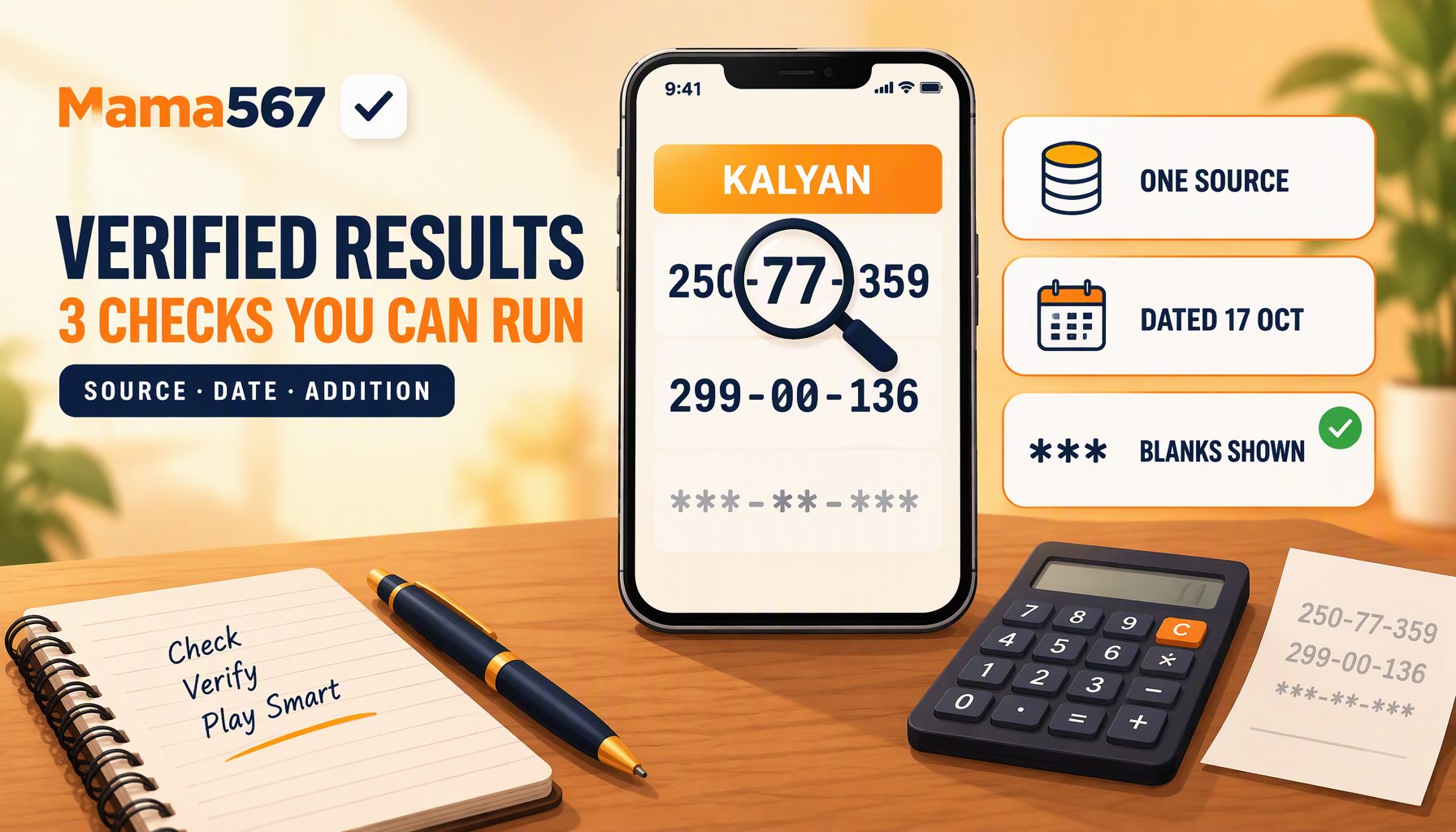
Verified satta matka results are an arithmetic problem, not a certificate
There is no authority in this game that signs a result. No body issues a certificate, no registrar countersigns a declaration, and nothing arrives with a seal you can inspect. That makes "verified" a word people use loosely, and it is worth being precise about it, because the honest version is stronger than the loose one.
A satta matka result is three numbers that have to agree with each other: an open pana, the jodi between them, and a close pana. Because they must agree, a result can be checked rather than believed. Add in a dated source and you have the only kind of verification available here, which is: provenance, a date, and internal consistency. Anything that skips one of those three is asking for trust instead of earning it.
| What has to be true | What it looks like on Mama567 | How you check it yourself |
|---|---|---|
| The numbers came from a named source | One feed, published at api.mama567apps.com, and the pages say so in the editorial and data policy |
Read the source out of the code path or the policy, not out of an advertisement |
| The source is dated | Every chart page prints the newest result it holds, and the dataset carries a capture timestamp | Compare the as-of line on the page with the date column in the data |
| The row adds up | Open pana, jodi and close pana satisfy the ank rule on every declared row | Do the addition on the row, or script it across the dataset |
| Absence is visible | Undeclared days render as ***-**-***, not as guesses |
Count the blanks against the number of records published |
Check 1 — the arithmetic, and exactly what it cannot prove
Take a real row the feed returned today: Kalyan, 17 October 2026, 250-77-359.
- Open pana
250— 2 + 5 + 0 = 7, so the open ank is 7. That is the first digit of the jodi. - Close pana
359— 3 + 5 + 9 = 17, and the ank is the last digit, 7. That is the second digit. - The jodi is therefore
77, and the answer for the day, the ank of the jodi, is 14 → 4.
Run that over the whole live set rather than one row, and today it holds: across the 19 charted markets the feed returned 202 dated rows, of which 195 satisfy the rule end to end and 7 carry an open pana with a star where the close pana should be — declarations still in progress, not broken data. Zero rows break the rule.
On the site's own pages the same convention is visible. The pana charts print a pana in red when it repeats a digit — 550, 777, 299 — which is the pattern players scan for. Of the 154 pana cells published across the 19 charts today, 34 are red and every one of them genuinely repeats a digit, and none of the other 120 do. The colour coding is derived from the number, so it is checkable too rather than decorative.
Here is the limit, and it is the part most result websites leave out: arithmetic catches laziness, not forgery. Anyone determined to invent a row can do the addition first. Internal consistency tells you the number is not a typo or a scrap of noise. It cannot tell you the market declared it. That is why the other two checks matter more.
Check 2 — the page against the source
Mama567 is built so this comparison is possible, and it is worth running rather than reading about.
The site reads two endpoints: /markets for the live board and /markets/{id}/charts for a market's history. The chart pages, though, are not built by calling that API while you watch. They are built from a committed snapshot file, and that file is published in its own right at /data/chart-snapshot.json — 8,423 bytes, 1,587 of them once compressed, served as application/json with cross-origin reads allowed, so you can fetch it from a script and diff it against anything.
Measured today, the two agree:
- The published pages and the live feed share 79 dated results. All 79 match the feed character for character, and there are 0 disagreements.
- The snapshot holds exactly 19 markets, and those 19 keys are exactly the 19 markets the site charts — no extra market quietly in the data, no charted market without data.
- The file deployed on the domain, the file in the repository and the file inside the build are the same file: identical SHA-256.
And the generator has a rule that is unusual enough to be worth stating. When the snapshot is refreshed it fetches every market, and if any market's request fails, it prints "Refusing to write a snapshot with holes" and exits without writing. Half a chart set cannot reach a build. A page either holds the complete fetch or the site does not ship it.
The honest caveat on this check is the one the policy already makes: this is one source, not two. The feed is the operator's own, and Mama567 does not cross-check it against a second provider or an archive. The claim is traceability, not corroboration — which is why a site that copied numbers from other result sites would be weaker here, not stronger, because you could no longer name the thing to diff against.
Check 3 — the blanks
The cheapest test of a results page is how it behaves when it has nothing.
Across the 19 pana charts on this site today there are 224 day cells. 79 carry a declared result. 145 are blank. Not missing, not hidden — rendered as *** for a pana and ** for a jodi, because the code's empty cell is literally three stars and a row with nothing sourced never becomes a number. The 79 is exactly the number of records in the published dataset, so the blanks are what is left over after real data, not invented data filling the gap.
Two decisions follow the same logic and are both visible in the open:
- Five market pages were deleted rather than filled. Surya Morning, the three Balaji markets and the old Sridevi page were removed from the site because nothing sources them. A page with no data is a page with a false promise on it.
- The FAQ copy was rewritten when it turned out to be hollow. Earlier versions of these pages claimed "real-time" and "verified" accuracy in every answer, at a time when the pages shipped no numbers at all. Those lines were deleted, not softened. If a page now says a table is empty, it is because the sourcing is empty.
A chart that is always full is a chart that is sometimes invented. This one is two-thirds blank, and that is the proof.
One blank deserves its own explanation rather than a share of this count: the Time Bazar timing and chart guide shows that market's Sunday column empty in every week of its snapshot, because Time Bazar draws Monday to Saturday and its own record set — 17 complete lines, none on a Sunday — agrees with the schedule. A blank cell that a market's stated draw days explain is a correct cell; a blank that arrives on a draw day is a sourcing gap. The two look identical in a screenshot, which is precisely why the draw days belong beside the numbers.
Why "zero-delay results" is the wrong thing to ask for
Instant results sounds like the trust feature. It is actually the least trustworthy promise a results site can make, because you cannot check it and the site usually cannot keep it.
Run the same numbers again today and you can see the difference between the two things people merge into one:
- The homepage board polls the feed every fifteen seconds. It moves while you watch. At 11:03 IST this morning it listed 28 market rows, of which 4 had a declared open pana and none had a declared close — every row on the board still had a star in it. That is a live page telling the truth about a morning that had not declared much.
- The chart pages and the latest results page are a different animal, and the page says so in its own first paragraph: it is not a live feed; the results are baked in when the site is rebuilt, so the date column is what you should trust. The snapshot behind them was captured on 11 October at 17:12 UTC and its newest record is dated 14 September, while the feed already holds 123 dated results that are not on the pages yet — the newest Kalyan row in the API is 17 October against 14 September on the chart.
That gap is not a scandal; it is plumbing, and it is the price of the check above. A page built from a dated, published, self-consistent snapshot can be audited after the fact. A page that streams whatever the server said at the second you looked cannot be audited at all, because there is no artefact left to compare. The site's own about page puts it the way you should read it: if the date looks stale, trust it — it is the honest answer.
There is also a limit on the source side worth knowing before you blame a website. The build asks each market for up to 105 records, and today the largest single response was 14. The feed exposes a recent window, not a full history, which is why the older weeks on these charts are thin. Fewer rows, shown honestly, beats a long chart of mixed provenance.
What this site will not promise you
Trust is mostly a list of things a source refuses to say, so here is ours.
- No warranty of accuracy. The terms state plainly that no result, chart or timing is warranted as accurate or complete, and that the site should not be relied on for financial decisions of any kind. That sentence is not decoration; it is the reason the as-of date exists.
- No authority over the market itself. Timings printed here are transcriptions from the feed on the day the file was written. Measured today, seventeen of the nineteen open and close windows agree exactly with what the feed reports. The other two are the standing reminder that a printed cutoff is a copy of a decision, never the decision — when a printed time and an actual declaration disagree, the declaration wins and the page is corrected on the next rebuild.
- Not every market you see is a market this site charts. The live board currently lists more markets than have chart pages, and the markets page is the list of the ones that do.
- No numbers before they exist. No tips, no predictions, no advance results, no "sure" anything. This site publishes what a market has already declared, and the footer says so on every page: Mama567 does not accept wagers or sell predictions.
Tells that a "results" site is not one
Each of these is checkable in seconds, which is the point of listing them.
- It sells the thing it claims only to report. A site that publishes "verified results" and also takes money for them has a reason for the number to say whatever it says.
- Its charts are never blank. Full history on every market, back years, with no gaps, means someone is generating rows. Compare it against a page that shows you its blanks and its record count.
- It has no dated as-of line. If nothing on the page states which declaration is the newest one it holds, freshness is a mood rather than a claim.
- It offers to send you results. This is the oldest scam shape around this game and it is covered properly in how to check live satta matka results. Nobody here sends you tomorrow's declaration, because nobody has it.
- Its download link is not the site's own file. The app should come from the same domain as the charts, and the package name is how you confirm what you installed — see the APK installation guide.
- It asks for an OTP, a UTR, an "activation" or a deposit to release a number. A result is public information. Anything that gates it is not a result. The promotional-offers safety guide walks through the shapes this takes.
- It says "verified" and publishes no method. This is the one Mama567 was guilty of itself a few months ago, which is why this post exists. A word with nothing checkable behind it is branding.
What to actually trust, then
Not a brand. A method you can repeat, ideally in under a minute:
- Do the addition on the row you care about. Open pana digits, last digit of the sum, first digit of the jodi; same for the close. If that fails, stop trusting the page entirely.
- Read the as-of date before you read the numbers. It tells you which declaration is the newest one this page is willing to stand behind.
- Fetch the dataset if you rely on a market.
/data/chart-snapshot.jsonis small, dated and readable by a script, so a weekly check costs a few kilobytes. On a phone, this is the page worth keeping in a tab rather than re-downloading — the mobile navigation guide covers what actually spends your data. - Keep the chart you check. If you are reading a market regularly, the pana and jodi pages for it are printable and permanent; a forwarded screenshot has no source and no date.
- Read history for what it can actually carry. A chart is worth opening for the record, not for the forecast. How to Use Historical Charts to Understand Market Patterns counts the complete records this site's charts really hold, and works out how many declarations it would take before a frequency gap stops being noise — the same traceable, do-it-yourself standard applied to the archive rather than to a single row.
- Know what each field is called. A pana, a jodi and an ank are three different objects with three different arithmetics; the satta matka terms glossary defines each one and shows the check that ties them together on a single declared line.
- Check the host before the row. Arithmetic can only vouch for a number if the page that printed it is the page you meant to visit; How to verify a satta matka website runs that check on the certificate, the dated data and the person named as responsible.
"Trust only the official platform" is the wrong final advice for a results site, including this one. The right advice is: trust the copy of a number you can trace, date and add up. Mama567 publishes the source, the timestamp and the gaps precisely so that you never have to take the last step on faith — and if you ever find a row that does not survive that test, the editorial and data policy explains how to report it and when the fix lands.
For the contact routes this site actually offers, and why no page here prints a support number, see How to contact Mama567 customer support.
Before any of that can be pushed to you: on this platform the alerting capability exists only in the Android package, and the census of what the browser side ships — zero service workers, zero manifests, zero uses of the Push API — is in How to Set Up Notifications for Live Market Declarations.
The same three checks, applied to a whole platform instead of a single row — including how much of its own dated archive each of its surfaces is willing to publish — are measured in The evolution of digital satta matka platforms in India.
Results published on this site are declared numbers reproduced for reference only. Mama567 does not run, endorse or take bets on any market, and publishes no prediction of any future declaration. Satta matka is illegal in most Indian states. 18+ only.