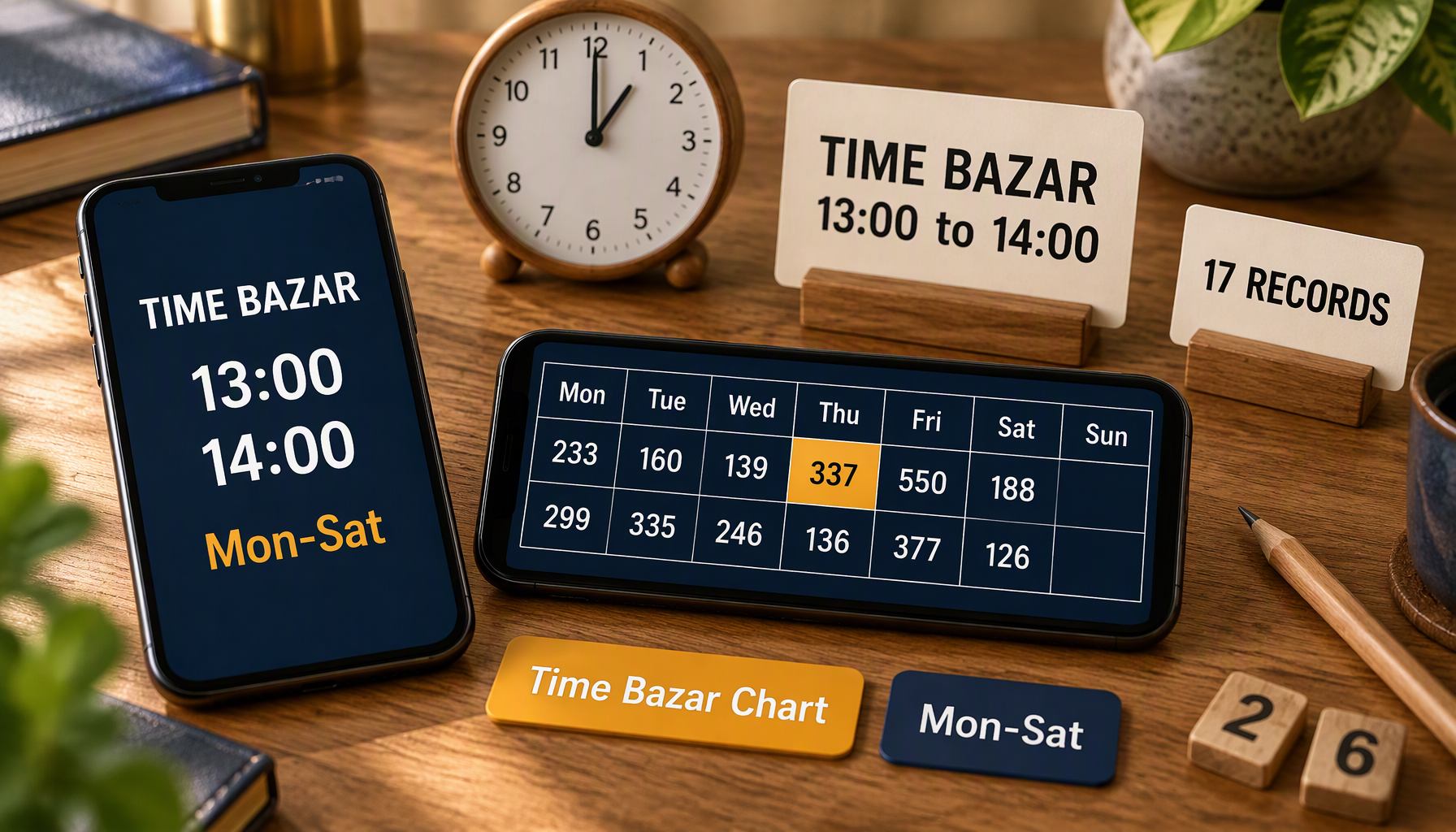
The short version
| What | Measured value | Where it was read |
|---|---|---|
| Upstream code and id | TIME_BAZAR, id 9 |
/api/markets, 27 Oct 2026 |
| Open / close | 13:00 / 14:00 IST | feed row and this site's market table — they agree exactly |
| Draw days | Mon, Tue, Wed, Thu, Fri, Sat | both sources |
| Window length | 60 minutes | arithmetic on the two times |
| Other charted windows it overlaps | 1 (Madhur Day, 30 minutes) | all 19 windows in src/data/markets.ts |
| Complete records in the feed | 17 | /api/markets/9/charts?recordsPerMarket=105, 27 Oct 2026 |
| Records dated on a Sunday | 0 | those 17 rows |
| Date span of those rows | 10 Sep – 26 Oct 2026 | same |
| Rows that fail the ank rule | 0 of 17 | recomputed digit-by-digit |
| Lines on this site's Time Bazar charts | 4, newest 14 Sep 2026 | dist/pana/time-bazar, dist/jodi/time-bazar |
Time Bazar is the easiest market on this site to describe honestly, and that is worth saying out loud: the two clocks agree, the schedule matches the data, and the arithmetic needs no exceptions. It is also the market where the site's own weakness shows most sharply — the feed held a 26 October line while the chart pages stop at 14 September.
13:00 to 14:00, read from two clocks
Most schedule pages on the internet recite a table. This one can compare two independent tables, because the site ships its own market definitions and also talks to an upstream feed.
src/data/markets.ts declares Time Bazar at openTimeIST: '13:00', closeTimeIST: '14:00', active days MON,TUE,WED,THU,FRI,SAT. Queried on the morning of 27 October 2026, the live endpoint returned the row {id: 9, code: "TIME_BAZAR", name: "TIME BAZAR"} with openTimeIST: "13:00:00", closeTimeIST: "14:00:00" and activeDays: "MON,TUE,WED,THU,FRI,SAT". Same hours, same days, same id.
That agreement is not the norm on this site, and it is worth measuring rather than assuming. All 19 charted markets were compared field-by-field against the same feed response: 16 of 19 agree exactly on open, close and draw days. Three do not, and this site has named them in earlier guides — Kalyan Morning (charted 11:25–12:25, feed now 11:50–12:50), Kalyan (charted 16:15–18:15, feed 16:30–18:30) and Milan Night (charted 21:00–23:00, feed 21:10–23:15). Time Bazar is not on that list.
One consequence of the one-hour window is worth stating because it changes how a reader should use the page: a complete Time Bazar line cannot exist before 14:00 IST. The jodi is not an independent draw — it is computed from both panas — so until the close pana is declared there is nothing to verify. If a site offers you a "Time Bazar result" at 13:20, it is offering half a line or an invention.
The solo half hour
Position on the clock is the most useful thing a timing page can give, and it is pure arithmetic on the 19 windows this site charts.
Starting from the end of the morning block: Madhur Morning closes at 12:35. The next window to open anywhere on the site is Time Bazar at 13:00 — so the site goes dark for 25 minutes, 12:35 to 13:00, and Time Bazar reopens it.
| Time | Charted windows open on a Monday | Charted windows open on a Sunday |
|---|---|---|
| 12:30 | Madhur Morning | Madhur Morning |
| 12:35–13:00 | none | none |
| 13:00 | Time Bazar only | none |
| 13:30 | Time Bazar, Madhur Day | Madhur Day |
| 14:00–14:30 | Madhur Day | Madhur Day |
| 14:30–15:05 | none | none |
| 15:05 | Milan Day, Rajdhani Day | none |
Three facts fall out of that table, and each is checkable against markets and timings:
- 13:00 to 13:30 belongs to Time Bazar alone. For those thirty minutes it is the only live window on the site — the same kind of finding the Madhur schedule guide reports for 20:30 in the evening.
- Time Bazar has exactly one neighbour, and the overlap is its last 30 minutes. Nothing else charted is open between 13:00 and 14:00.
- The afternoon is bracketed by dead air. Twenty-five minutes before it opens, thirty-five minutes after Madhur Day closes it at 14:30, and the next windows (Milan Day and Rajdhani Day) do not start until 15:05. Time Bazar is not part of a continuous afternoon stream; it is a discrete hour with silence either side.
That shape matters for anyone cross-checking a Time Bazar line against another market: there is no second market declaring in the same half hour that could be confused with it, which cannot be said about the 21:30 cluster, where five windows are live at once and six from 21:50.
The Sunday test, run on 17 records
This is the single most useful thing to know about a Time Bazar chart, and it needs no interpretation — only a calendar.
The feed returned 17 complete records on 27 October 2026, spanning 10 September to 26 October. Counted by weekday: Monday 4, Tuesday 2, Wednesday 2, Thursday 3, Friday 3, Saturday 3, Sunday 0.
Seven Sundays fall inside that date span — 13, 20 and 27 September, 4, 11, 18 and 25 October — and not one of them produced a record. Three of the seven are the interesting ones, because they sit between two declared days rather than inside a gap:
| Date | Weekday | Time Bazar |
|---|---|---|
| 12 Sep 2026 | Saturday | 389-04-257 declared |
| 13 Sep 2026 | Sunday | no line |
| 14 Sep 2026 | Monday | 158-45-889 declared |
| 17 Oct 2026 | Saturday | 126-95-159 declared |
| 18 Oct 2026 | Sunday | no line |
| 19 Oct 2026 | Monday | 233-89-379 declared |
| 24 Oct 2026 | Saturday | 188-74-220 declared |
| 25 Oct 2026 | Sunday | no line |
| 26 Oct 2026 | Monday | 226-04-130 declared |
Three times the record set goes Saturday → (nothing) → Monday, and three times the missing day is a Sunday. That is the Mon–Sat schedule showing itself in data rather than in a table someone typed in.
The same two weeks also demonstrate the opposite: 12–17 October and 19–24 October are complete. All twelve Monday-to-Saturday days in those two weeks declared, with no gap. So the empty stretches in this record set (15 September to 11 October holds nothing) are the feed's own retention, not the market skipping days — a distinction how to check live results tells readers to make before they conclude anything about a missing number.
Reading a Time Bazar line, digit by digit
Every line is one declaration written open pana - jodi - close pana. Add the three digits of each pana, keep the last digit of each total, and write the two results in open-then-close order. These are real Time Bazar rows from the feed, measured 27 October 2026:
| Date | Weekday | Line | Open sum → ank | Close sum → ank | Jodi |
|---|---|---|---|---|---|
| Mon 26 Oct 2026 | MON | 226-04-130 |
2+2+6 = 10 → 0 | 1+3+0 = 4 | 04 ✓ |
| Sat 24 Oct 2026 | SAT | 188-74-220 |
1+8+8 = 17 → 7 | 2+2+0 = 4 | 74 ✓ |
| Thu 22 Oct 2026 | THU | 337-30-299 |
3+3+7 = 13 → 3 | 2+9+9 = 20 → 0 | 30 ✓ |
| Tue 20 Oct 2026 | TUE | 160-78-567 |
1+6+0 = 7 | 5+6+7 = 18 → 8 | 78 ✓ |
| Thu 15 Oct 2026 | THU | 136-01-399 |
1+3+6 = 10 → 0 | 3+9+9 = 21 → 1 | 01 ✓ |
| Mon 14 Sep 2026 | MON | 158-45-889 |
1+5+8 = 14 → 4 | 8+8+9 = 25 → 5 | 45 ✓ |
| Thu 10 Sep 2026 | THU | 280-08-369 |
2+8+0 = 10 → 0 | 3+6+9 = 18 → 8 | 08 ✓ |
Four things are worth taking from those rows, all of them visible in the table:
- A sum of exactly 10 gives ank 0, not 10 and not 1.
226→ 0,136→ 0,280→ 0. Three of these seven lines have an open ank of zero, so this is not an edge case — it is a fifth of the sample. - The ank is not the first digit.
158gives ank 4, not 1. The eye reaches for the leading digit; the arithmetic says otherwise. 08and01are real pairs, with a leading zero. Dropping it turns280-08-369into280-8-369and quietly destroys the line.- All 17 records pass. Not 16 of 17: the rule has no exception anywhere in this market's data, which is the baseline against which a wrong number can be detected. Understanding Jodi and Pana teaches the rule; the check above is how you use it as a test rather than as trivia.
Colour follows the same rule as everywhere else on the site — a pana is red when two of its three digits match, and a jodi never is. Across these 17 lines there are 34 pana cells, of which 13 are red.
Repeats that are arithmetic, not signals
Seventeen records is enough to produce coincidences, and Time Bazar's are worth working through precisely because each one has a non-mysterious explanation.
567closes two different lines, and both carry jodi78. 16 October reads377-78-567; 20 October reads160-78-567. Different open panas, identical close, identical pair — and the reason is one line of arithmetic: 3+7+7 = 17 → 7, and 1+6+0 = 7. Different numbers, same ank, so the jodi has to match.188appears on consecutive days on opposite sides. It opens the 24 October line (188-74-220) and closes the 23 October one (550-07-188).299appears twice, twelve days apart — closing337-30-299on 22 October and opening299-03-580on 12 October.04recurs after 44 days — 12 September (389-04-257) and 26 October (226-04-130), the oldest and newest records in the set.- No line repeats, and no line has the same pana open and close. That is a useful contrast with the Madhur guide, which found 12 such lines across 409 records; in Time Bazar's 17 there are none. When open and close panas are identical, the jodi must be a doubled digit, because both sides sum to the same ank — so the absence here simply says no line in this small set does that.
Thirty-one distinct panas appear across 34 cells, and 15 distinct jodis across 17 lines. Repetition at that density is unremarkable: a pana is one of a thousand possibilities, and drawing 34 of them will collide.
What 17 records can prove — which is very little
A chart invites pattern-reading, so it is worth running the actual test on this market's own numbers and reporting the result. The method and the reason it matters are set out in How to Use Historical Charts to Understand Market Patterns; this is that method applied to one small market.
Seventeen lines give two ank digits each, so there are 34 ank observations. Counted by digit, they fall:
| Ank | 0 | 1 | 2 | 3 | 4 | 5 | 6 | 7 | 8 | 9 |
|---|---|---|---|---|---|---|---|---|---|---|
| Observed | 7 | 2 | 1 | 3 | 5 | 3 | 1 | 4 | 5 | 3 |
If every ank were equally likely, each cell would hold 3.4 observations, and the spread of a single count would be about √(34 × 0.1 × 0.9) ≈ 1.75. Read against that number, the extremes are 7 at +2.1 deviations and 1 at −1.4 each — larger ratios than the site-wide test found, and just as unremarkable, because the yardstick shrank with the sample. A chi-square goodness-of-fit test across the ten cells returns 9.53 on nine degrees of freedom, about p = 0.39; the 5 per cent threshold for nine degrees of freedom is 16.92, so this is not close to a rejection.
The same arithmetic on pana shapes: 13 red panas of 34 is 38.2 per cent against an expected 28 per cent — a gap of +1.33 standard deviations, again well inside noise. (The expected share is 280 of every 1,000 combinations: 270 with exactly one repeated digit plus 10 triples. There are no triples in these 34 cells.)
Here is the part that decides how much of this page you should trust. From the same normal approximation, if an ank really were biased — 12 per cent instead of 10 — then at 34 observations the deviation would show up at 0.39 standard deviations. It would take about 901 ank observations to see that same bias at 2.0 deviations, which is the figure the site-wide guide works through. Time Bazar's charts hold 34. That is under 4 per cent of what a real bias needs to become visible at all.
So the honest reading is not "the digits look fair". It is: this sample cannot distinguish fairness from a subtle bias, in either direction. That is a statement about the sample, not a reassurance — and it is exactly why no number on any Time Bazar chart here is presented as likelier than another.
What this site's Time Bazar pages actually hold
Both chart pages exist and are consistent with each other:
| Page | Week rows | Declared cells | Blank cells | Newest date printed |
|---|---|---|---|---|
| Time Bazar pana | 2 | 4 of 14 | 10 | 14 Sep 2026 |
| Time Bazar jodi | 2 | 4 of 14 | 10 | 14 Sep 2026 |
The grids run newest week first. The 14–20 September row carries one line, on Monday the 14th (158-45-889); the 7–13 September row carries Thursday, Friday and Saturday — 10, 11 and 12 September — and its Sunday cell is blank. That blank is the schedule, proven above. The other nine blanks are snapshot gaps: this site's committed data stops at 14 September.
Which is where the honest complaint lives. The feed held 13 complete Time Bazar records that these pages do not show, including a 26 October line, while the charts' newest result is 14 September — a 42-day gap between what the upstream endpoint carries for this market and what this site publishes for it. Both chart pages say so on their face: the meta description reads "current as of 2026-09-14" and the page prints "The newest result in the table below is 2026-09-14: 158-45-889."
The reason is architectural, and it is the same one Why Mobile Optimization Matters for Live Result Platforms measures from the other side. Chart pages are rendered at build time from a committed snapshot, so the numbers you came for are already in the HTML before any script runs — no spinner, no client-side fetch, and no risk that a chart you bookmarked changes under you. The cost is staleness: those pages update when the site is rebuilt, not when the market declares. Verified satta matka results explains why the site prefers that trade — a dated archive you can check over a live page you cannot.
The rate card, and the numbers that did not move
Rates are published per bet type, not per market, so Time Bazar prices off the same card as every other market here. Read from the rate endpoint on 27 October 2026:
| Bet shape | Published as | Rate | Stake range |
|---|---|---|---|
| Single digit (ank) | Single Digit | 9.5 | 10 – 100,000 |
| Two-digit pair | Jodi Digit | 95 | 10 – 50,000 |
| Three-digit pana, all digits different | Single Patti | 150 | 10 – 25,000 |
| Three-digit pana, two digits the same | Double Patti | 300 | 10 – 15,000 |
| Three-digit pana, all three the same | Triple Patti | 1000 | 10 – 5,000 |
| One pana paired with one ank | Half Sangam | 1000 | 10 – 5,000 |
| Open pana paired with close pana | Full Sangam | 10000 | 10 – 2,000 |
That card is identical to the one measured on 24 October 2026 and reported in the Madhur schedule guide — all seven rates and every stake minimum and maximum unchanged across those three days. It is worth recording, because the same endpoint had moved in the window before that: between 14 and 24 October, Single Digit went from 10 to 9.5 and Jodi Digit from 100 to 95. The game rates guide documents that change; this page's contribution is simply the next dated reading of the same endpoint, so the two can be told apart later.
Two reading habits apply to any card, and both are worked in the rates guide: "1 ka 9.5" quotes the total returned, stake included, while "8.5 to 1" quotes profit only — the same transaction described two ways; and the stakes run backwards to the payout, with the 10,000 row capped at 2,000 and the 9.5 row allowed up to 100,000.
Mama567 publishes results. It takes no wager on Time Bazar or on any other market, and this table describes what a market pays, not what anything is worth.
"View today's Time Bazar declaration"
The calendar line behind this page asks a reader to view today's Time Bazar declaration, and the truthful answer is more specific than a slogan: one surface here can do that, and it is not this page.
The homepage board polls the results feed every fifteen seconds while it stays open, so on a Monday-to-Saturday afternoon it can carry a same-day Time Bazar line — though not before roughly 14:00 IST, when the close pana makes the line complete. Everything else — the pana and jodi charts, Latest results by market and the charts index — renders from the committed snapshot, and for Time Bazar that snapshot stops at 14 September 2026. When this page was written, at 09:27 IST on 27 October, the feed's newest Time Bazar row was 26 October and today's had not been declared yet, because the window opens at 13:00.
A page that promised "today's result" while printing a September date would be the sort of results site this series exists to argue against. So the claim stays out of the conclusion and the specific instruction stays in: for a same-day line, use the board; for a dated line you can check with arithmetic, use the chart.
Checking a Time Bazar line yourself
Three checks, none of which require trusting this page:
- Add. Sum the three digits of each pana, keep the last digit of each total, and compare against the pair printed between them. All 17 records measured here pass; any line that fails did not come from this data.
- Check the day before the number. If a Time Bazar cell is blank and the date is a Sunday, the chart is correct and the schedule is doing its job. If the date is a weekday, it is a snapshot gap — a different fact, and one the page's printed "as of" date will confirm.
- Compare across surfaces. The pana chart, the jodi chart, the market's row on Latest results by market and its entry in the charts index are all built from one dataset, and that board row prints the draw days beside the line — Time Bazar's reads "Mon, Tue, Wed, Thu, Fri, Sat". A disagreement between those four would be a build defect, not a difference of opinion.
Where to track Time Bazar
- Time Bazar pana chart — open, jodi and close stacked per day, with the newest date printed on the page.
- Time Bazar jodi chart — the pair alone, one per day.
- Latest results by market — the newest line held for all 19 markets, with date and draw days.
- Markets and timings and the charts index — every window in one place.
- To read the format properly: How to read satta matka charts, Understanding Jodi and Pana, and the full timetable in open and close results and timings. For the market family this market sits in, see popular matka markets; for what a small chart can and cannot prove, historical charts and statistical power.
- Understanding “Single Digit” and “Double Patti” game formats — the ordering convention and the 220-versus-1,000 reconciliation behind the shape counts quoted on this page.
Mama567 records declared results. It takes no wagers, sells no tips, publishes no "Time Bazar sure number" or advance result on this page or anywhere else, and presents no number as likelier than another; satta matka is illegal in most Indian states, and nothing above is advice. 18+ only.
For the contact routes this site actually offers, and why no page here prints a support number, see How to contact Mama567 customer support.
A timing chart is also the argument against turning every alert on: across the registry the platform publishes roughly sixty declarations a day, and only one of its three notification channels carries any of them. The count is in How to Set Up Notifications for Live Market Declarations.
For information only. Mama567 publishes results and charts, and does not offer predictions or guessing services. Adults 18+.