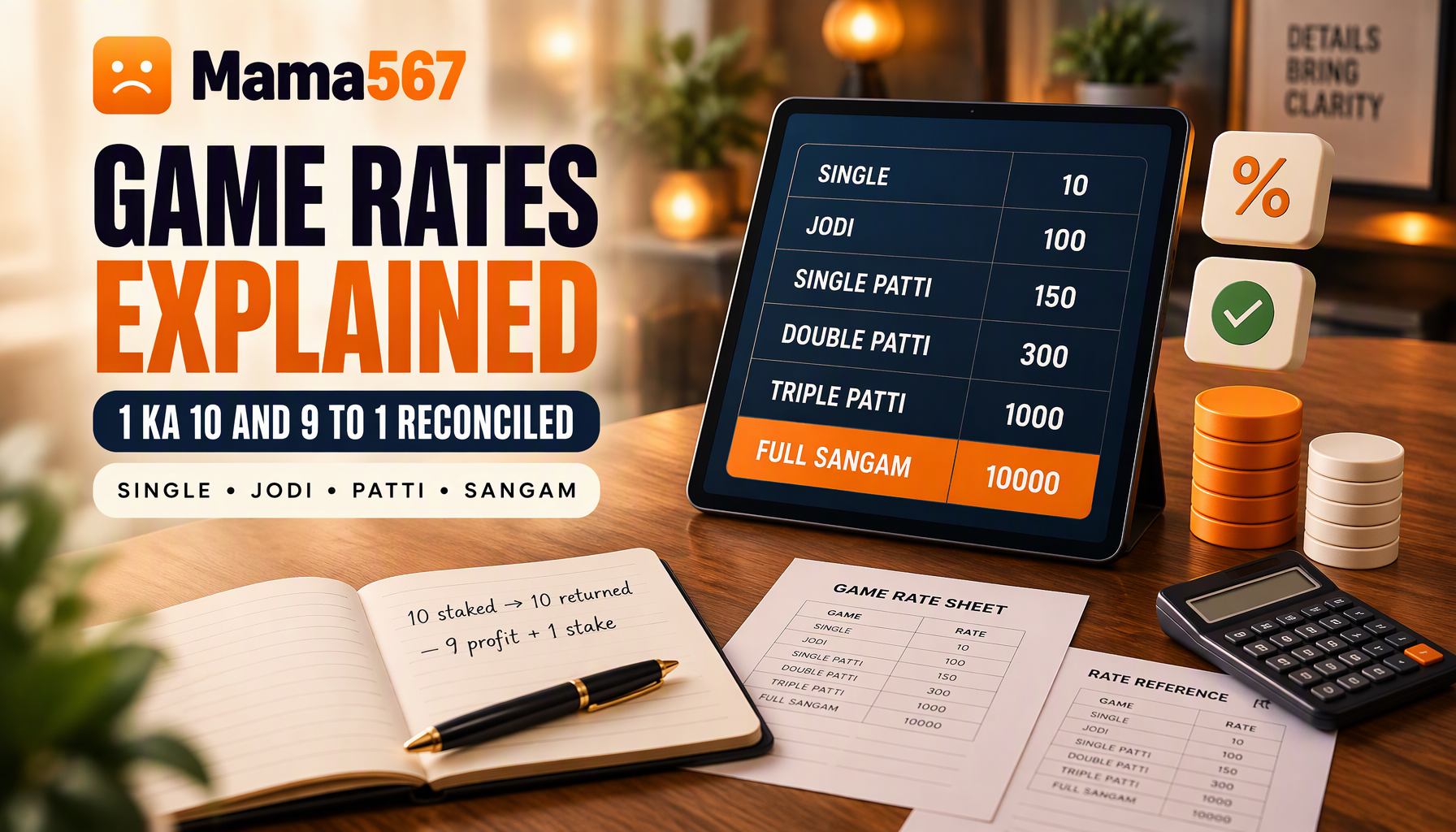
A satta matka rate is a published multiplier: the number a market attaches to one unit staked on one bet shape, from 10 for a single digit up to 10,000 for pairing both of a day's full panas. Rates are where the game's vocabulary and its arithmetic meet, and they are also where the most common misunderstanding lives — a rate looks like a promise about likelihood, and it is not one.
Mama567 publishes the rates its market feed reports, in the same way it publishes declared results: as information about how those markets are running. It does not operate a market, set a rate, hold a stake or settle a bet. This guide reads the numbers on the homepage and explains what each one does and does not say.
The seven rows the feed publishes
These are the values returned by the rate endpoint on 14 October 2026, exactly as published — the same figures the homepage Game Rates section renders:
| Bet shape | Published as | Rate | Stake range |
|---|---|---|---|
| Single digit (ank) | Single Digit | 10 | 10 – 100,000 |
| Two-digit pair | Jodi Digit | 100 | 10 – 50,000 |
| Three-digit pana, all digits different | Single Patti | 150 | 10 – 25,000 |
| Three-digit pana, two digits the same | Double Patti | 300 | 10 – 15,000 |
| Three-digit pana, all three the same | Triple Patti | 1000 | 10 – 5,000 |
| One pana paired with one ank | Half Sangam | 1000 | 10 – 5,000 |
| Open pana paired with close pana | Full Sangam | 10000 | 10 – 2,000 |
Read the columns separately, because they answer different questions. The rate is the multiplier. The stake range is the market's own limit for that shape — and notice which way it moves: the 10,000 row caps at 2,000 while the 10 row runs to 100,000. A market that priced rare shapes generously would not restrict them to the smallest stakes in the table.
A dated note, added 24 October 2026. Re-reading the same endpoint, two of the seven rows have moved: Single Digit now publishes 9.5 (was 10) and Jodi Digit 95 (was 100). Every other rate and every stake range above is unchanged. The table above stays as measured on 14 October rather than being silently overwritten — that is what a dated measurement means — and the movement is itself the lesson: a rate card is the market's own configuration, it changes on the market's timetable, and only the homepage Game Rates section shows the values in force right now. What the two new figures do to the "1 ka X" arithmetic is worked through in the Madhur schedule guide, which caught the change.
A second dated note, added 27 October 2026. The same endpoint was read again for the Time Bazar timing and chart guide, and all seven rates and every stake range are unchanged from the 24 October reading: Single Digit 9.5, Jodi Digit 95, Single Patti 150, Double Patti 300, Triple Patti 1000, Half Sangam 1000, Full Sangam 10000, minimum 10 throughout, maximums from 100,000 down to 2,000. Nothing to report is still a measurement, so it is recorded rather than skipped — the card moved between 14 and 24 October and held between 24 and 27, and only dated readings like these two make that distinction knowable later.
"1 ka 10" and "9 to 1" are the same transaction
Two conventions describe payouts in this game, and mixing them up is the single easiest way to misread a rate table.
- The total-return convention, written "1 Rs ka 10 Rs", quotes everything that comes back — the stake included.
- The profit-odds convention, written "9 to 1" or "9:1", quotes only the winnings, on top of a stake that is returned separately.
They agree: nine profit plus one unit of your own stake is ten total. So a rate card reading 10, 100, 150, 300, 1000 is the same ladder a guide might describe as "9/1 up to 999/1" — provided you keep the conventions apart. Here is the whole table at a 10-rupee stake, which is pure multiplication and nothing else:
| Shape | Rate | Total returned on a 10 stake | Profit portion |
|---|---|---|---|
| Single digit | 10 | 100 | 90 |
| Jodi | 100 | 1,000 | 900 |
| Single patti | 150 | 1,500 | 1,400 |
| Double patti | 300 | 3,000 | 2,900 |
| Triple patti | 1000 | 10,000 | 9,900 |
| Full sangam | 10000 | 100,000 | 99,900 |
When you compare two operators, or a rate card against an article, ask first which convention is in use. A "99 times your money!" claim is usually the profit column of an ordinary 100 rate, and a rate that looks weak under one convention can be the same number as one that looks strong under the other.
Why the ladder climbs the way it does
The order is not arbitrary: each row is more specific than the one below it. The vocabulary itself is defined in matka bet types explained and in the glossary; what matters here is how specificity maps onto numbers.
- A single ank names one digit. Ten digits exist, so it is the loosest row — and the lowest rate.
- A jodi names an ordered pair. The pair is derived from the two panas — reduce each pana's digits, keep the last digit of each total, open first (worked in full here) — and 100 pairs exist, from 00 to 99. A hundred times the specificity, a hundred times the rate.
- A patti names a whole three-digit pana, and the three rows split it by shape: all digits different, two the same, or all three the same. The shapes are not equally common, which is why single, double and triple patti sit at 150, 300 and 1000 rather than at one number.
- A sangam pairs two things at once — half sangam one pana with an ank, full sangam the open pana with the close pana. It is the most specific description of a day in the vocabulary, and it carries the largest figure on the card. Half sangam vs full sangam puts those two rows against the tickets that express the same claim, which is where the ladder's structure becomes legible.
So far, so readable. The trap is the next sentence, which the table invites you to write yourself.
What a rate does not tell you
A multiplier says what a market pays. It does not say how often it pays, and the two are different quantities with a name for the gap between them. Turning 150 or 1000 into a likelihood requires a denominator — how many equally possible outcomes exist for that shape — and that is exactly where the conventions disagree.
Two counting models are in circulation. One treats every written triple from 000 to 999 as a possibility, giving 1,000 combinations, of which 720 have three distinct digits, 270 have exactly two and 10 are triples. The other recognises only "ascending" panas — 220 of them — on the theory that a drawn pana is always written in order.
The records on this site settle it for the data they contain — though not in the way an earlier version of this paragraph said they did.
A dated correction, added 28 October 2026. This post previously claimed that of the 154 pana observations published on the site, 40 are not in ascending order, and offered 350, 450, 140, 580 and 250 as proof that the ascending-only model is a convention the declarations ignore. That reading was wrong, and the cause was a missing convention rather than bad counting. The app documents its own ordering rule in the rules quiz it ships: 0 is the highest digit and is written after 9, so 1-2-0 and 3-7-0 are in order, and pattis are "recorded in non-descending order". Measured against that rule instead of plain digit order, all 154 observations are canonically ordered — none fails. The relationship between the two sets is exact: the 40 that fail plain order are the same 40 that contain a zero. No pana with a zero passes a plain comparison, and no pana without one fails it. 350 and 580 were never declarations written out of order; they are declarations written to a rule the plain comparison does not know about. Understanding "Single Digit" and "Double Patti" game formats works the convention through from the app's own shipped text.
The correction changes what the data says about the two models, and the honest version is that they are not rival sample spaces at all. They are the same space counted at two stages: 1,000 possibilities are drawn, and 220 canonical forms are how a draw is written down. Each single pana stands for 6 arrangements, each double for 3, each triple for 1 — 120×6 + 90×3 + 10×1 = 1,000 exactly. So a draw uniform over 1,000 can only ever be recorded inside the 220, and the two counts cannot disagree.
What the published records do settle is which space the draw runs over. The observed shape split — 120 single, 33 double, 1 triple across those 154 records — is 78/21/1 percent, close to the 1,000-combination model's 72/27/1 and nowhere near the 220 model's 55/41/5. Reordering digits cannot change whether they repeat, so that split is unaffected by the recording convention; it is evidence about the draw, and the draw is the wider one.
That still does not license a house-edge figure, and it is worth being plain about why: the sample is small, the shape of a real draw is not something this site can observe, and a margin claim needs a probability it can defend rather than a rate card's implied one. The site's own treatment of that arithmetic — probability against odds against payout — is in understanding matka odds and probability, which reaches the conclusion the rate ladder cannot: a payout multiplier is a commercial parameter, not a statistical one.
What can be said without any arithmetic at all: the rarer the shape, the bigger the number beside it, and the more often it loses. A 10,000 row is not a better position than a 10 row — it is a far less likely event with a larger headline.
Where rates appear on Mama567, and how current they are
The homepage carries a Game Rates section beside the market board, rendering each published row in the "1 RS KA 1000 Rs" form. It reads the same feed as the results board and refreshes with it, so the figures on that page are the figures the market was publishing when you loaded it.
That is the honest limit of the claim. Rates belong to the operators; they can change without notice, and nothing on this site fixes them in place. This guide therefore carries its date in the frontmatter and repeats it above: 14 October 2026. If you are comparing this table against a screenshot from a chat group, the screenshot has no date, and the dated page is the reference — the same rule that applies to forwarded results, set out in the editorial and data policy.
Reading one row end to end
Take the Double Patti line: rate 300, stake 10 to 15,000.
- Shape first. A double patti is a pana with exactly two of its three digits the same —
588and556are both in the current records;578is not. - Specificity second. You have named a full three-digit number and constrained its shape, which is a narrower claim than an ank.
- Rate third. 300 is what the market pays per unit on that claim, total-return, per the convention above.
- Then stop. Anything further — how often it hits, what that implies about value — is a probability question, and the rate card does not answer it. Neither does any chart: how to read satta matka charts covers what a grid of past declarations can honestly support, which is a description of what already happened.
The transparent version of the whole subject
Rates are the least honest part of this game's marketing, because a big multiplier is the easiest number to quote and the hardest to put in front of a reader. So the straight version:
- The multipliers above are real and published, and they are the market's, not this site's.
- Nobody can tell you which number will come up. Not from a chart, not from a rate, not from a tipster — and responsible gaming covers the scams that claim otherwise.
- The game is illegal in most Indian states, is for adults 18 and over, and treating any of these figures as an income plan is how small losses become large ones.
For the contact routes this site actually offers, and why no page here prints a support number, see How to contact Mama567 customer support. The rate endpoint is also one of four checks in How to verify a satta matka website — the one that shows why a captured table needs its date, and why the homepage card prints the multiplier without the stake limits.
See the current figures for yourself in the Game Rates section on our homepage — they are read live from the market feed, alongside the results board. Information only, 18+; Mama567 publishes declared results and does not accept wagers of any kind.