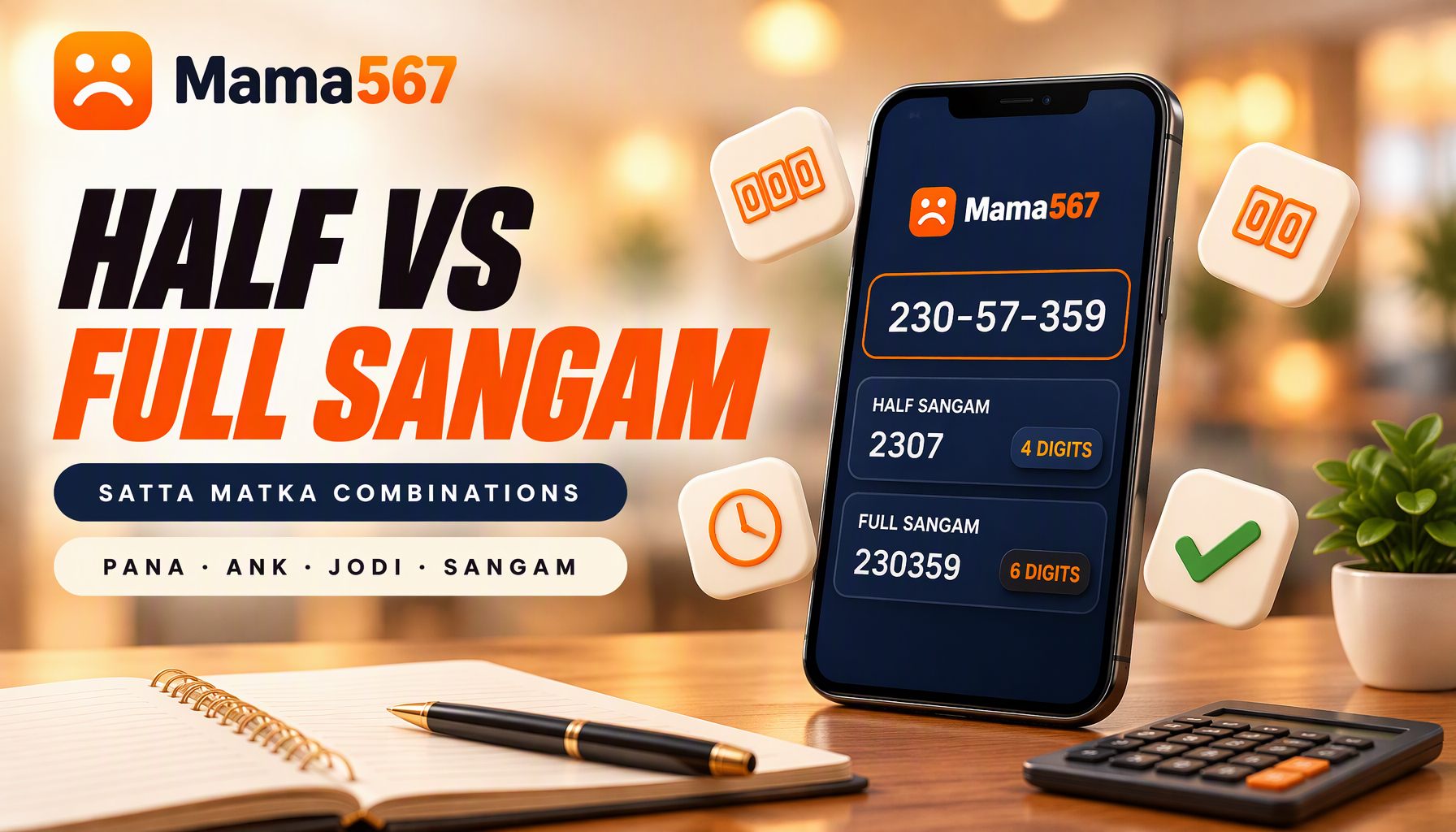
A sangam is not a third kind of result. It is a pairing of two of the numbers a market has already declared: a half sangam joins one three-digit pana with the ank — the single digit — of the opposite side of the day, which gives a four-digit reading, and a full sangam joins the open pana to the close pana, which gives six digits. "Half" and "full" describe how much of the day one string names, not two different games and not two levels of difficulty.
Mama567 publishes declared results, so everything below is worked from numbers that are on this site's own charts. The underlying vocabulary is defined in understanding jodi and pana and in matka bet types explained; the multiplier side is in understanding game rates. This guide is about the pairing itself, and about the three things people most often get wrong with it: that it is declared as its own number, that a four-digit sangam is unambiguous, and that its direction does not matter.
The short version: one pair of numbers, two lengths
| Reading | Digits | Built from | Exists once | Published rate |
|---|---|---|---|---|
| Half sangam A | 4 | open pana + close ank | the close is declared | 1000 |
| Half sangam B | 4 | open ank + close pana | the close is declared | 1000 |
| Full sangam | 6 | open pana + close pana | the close is declared | 10000 |
Three rows, and the fourth column is the one most guides leave out: all three readings need both halves of the day. A sangam is not something you can start reading at the open.
A sangam is never declared — you derive it
Here is the fact that settles most confusion about this term. A market record in the feed Mama567 reads carries openPatti, jodi, closePatti and the combined fullResult string. There is no sangam field. The site's charts currently hold 79 records across 19 markets, and not one of them is labelled a sangam — the pairing is arithmetic you perform on a declared line.
Work it once on a real Milan Day line, 230-57-359:
| Step | Arithmetic | Value |
|---|---|---|
| Open pana | printed on the chart | 230 |
| Close pana | printed on the chart | 359 |
| Open ank | 2 + 3 + 0 = 5 | 5 |
| Close ank | 3 + 5 + 9 = 17, keep the last digit | 7 |
| Half sangam A | pana 230 + close ank 7 | 2307 |
| Half sangam B | open ank 5 + pana 359 | 5359 |
| Full sangam | pana 230 + pana 359 | 230359 |
The ank rule — add the pana's three digits, keep the last digit of the total — is the same one that produces the jodi, worked through in how to read satta matka pana and jodi charts. Nothing about a sangam needs a new rule; it only needs the two you already know.
Because it is derived, a sangam can also be unfinished rather than wrong. Four of the site's 79 records are days whose close had not been declared when the snapshot was captured, and they print exactly that: 226-0*-*** on the Sridevi Day chart, 123-6*-*** on Karnataka Day, 100-1*-*** on Milan Morning, 238-3*-*** on Main Bazar. Each has a real open pana and no second half. The Sridevi market guide reads that same row in full — an asterisk is a declaration that has not arrived, not a zero.
Half sangam has two directions, and they are different numbers
One declared line yields two four-digit readings, and which one a person means is not self-evident. Across the 75 fully declared lines on this site, that is 150 half-sangam readings, and the two directions behave differently: the open-pana-plus-close-ank set contains 74 distinct strings (one repeats), while the open-ank-plus-close-pana set contains all 75 distinct.
Worse for clarity: three four-digit strings appear in both sets, so the bare number tells you nothing about how it was built.
| String | As a half A (open pana + close ank) | As a half B (open ank + close pana) |
|---|---|---|
| 1250 | Milan Morning 125-80-550 — pana 125, close ank 0 |
Karnataka Day 588-17-250 — open ank 1, pana 250 |
| 1249 | Milan Morning 124-79-469 — pana 124, close ank 9 |
Kalyan 560-15-249 — open ank 1, pana 249 |
| 1360 | Milan Morning 136-00-127 — pana 136, close ank 0 |
Madhur Day 669-19-360 — open ank 1, pana 360 |
So when you see a four-digit sangam quoted in a chat, the missing half of the message is which side the pana came from. The six-digit reading does not have this problem: open first, close second, one order, no ambiguity.
Half sangam vs full sangam on two real charts
The cleanest way to feel the difference is a pair of lines on this site that share three of their four digits and diverge on the fourth. Milan Day on Saturday 12 September and Rajdhani Day on Monday 14 September:
| Milan Day, Sat 2026-09-12 | Rajdhani Day, Mon 2026-09-14 | |
|---|---|---|
| Declared line | 230-57-359 |
230-57-124 |
| Open pana | 230 | 230 |
| Close pana | 359 | 124 |
| Close ank | 7 | 7 |
| Jodi | 57 | 57 |
| Half sangam A | 2307 | 2307 |
| Half sangam B | 5359 | 5124 |
| Full sangam | 230359 | 230124 |
Two different markets, two different dates, the same open pana, the same jodi and the same half sangam — and two different full sangams. The 359 and the 124 are different numbers that happen to reduce to the same ank (3 + 5 + 9 = 17 → 7, and 1 + 2 + 4 = 7), which is exactly how a day can look identical at four digits and different at six. Both markets run the same 15:05–17:05 IST window, Monday to Saturday, so this is not a case of a timing mismatch; it is what specificity costs. That difference in specificity is also the only honest explanation for why the two rows on the rate card sit at 1000 and 10000.
The line where both halves match
One declared line on the site has the same pana on both sides: Madhur Day on 11 September, 290-11-290. Its full sangam is 290290 — six digits that double back on themselves.
It is worth dwelling on, because it exposes a assumption people make backwards. Even with identical panas, the two half readings are not the same number: pana 290 with close ank 1 gives 2901, while open ank 1 with pana 290 gives 1290. Direction is a property of the reading, not of the day. The jodi, by contrast, is 11 — a double, since both sides reduce to 1.
A full sangam already contains the jodi
Every fully declared line on this site obeys one rule without exception: all 75 of them, and zero failures. Take the two printed panas, reduce each to its ank, write open first and close second, and you get the jodi the market declared. That is not a coincidence to be explained; it is arithmetic.
Two consequences follow, and both are useful:
- A full sangam is the complete line. If you know 230359 you already know 57, so a reading that pairs a pana with the jodi buys you no extra information. Some older guides define sangam against the jodi for that reason, and the glossary entry used to word it loosely — this site's rate card has no such row, because the feed's two sangam rows are pana-with-ank and pana-with-pana.
- The jodi is not a hidden third input. If you are checking someone's claimed sangam for a date, one of the three printed numbers is enough to test the other two, which is the same cross-check the editorial and data policy recommends for forwarded results.
What the published rates actually price
The two sangam rows, exactly as the feed returned them on 19 October 2026:
| Row | Display name | Multiplier | Minimum stake | Maximum stake |
|---|---|---|---|---|
HALF_SANGAM |
Half Sangam | 1000 | 10 | 5,000 |
FULL_SANGAM |
Full Sangam | 10000 | 10 | 2,000 |
The homepage renders these as "1 RS KA 1000 Rs" and "1 RS KA 10000 Rs" in its Game Rates section, live from the same feed as the board.
Now put one of those rows beside the tickets that express the same claim, using the Milan Day line from earlier. Note what the two routes have in common: they win in exactly the same situations, because both require 230 to be the open pana and 359 to be the close pana.
| Same Milan Day claim, expressed two ways | Units staked | Return if it wins |
|---|---|---|
| Half sangam A, one ticket | 1 | 1,000 |
| Single Patti on 230 + Single Digit on close ank 7 | 2 | 150 + 10 = 160 |
| Full sangam, one ticket | 1 | 10,000 |
| Single Patti on 230 + Single Patti on 359 | 2 | 150 + 150 = 300 |
Same event, two prices: 1,000 against 160, and 10,000 against 300. Per unit staked that is 1,000 against 80, and 10,000 against 150. Whatever the odds of the event itself turn out to be — and the rate card does not state them — the gap between a bundle and its parts is where a market's margin has to live. That is the arithmetic a rate ladder is really showing you, and it is the point the game-rates guide makes across the whole card.
Two details make the picture sharper rather than simpler. First, the pana rows split by shape, so the parts get more expensive as they get rarer: on Madhur Day's 14 September line 777-14-239, 777 is a triple panna (published at 1000) and 239 a single panna (150), so the two-ticket route returns 1,150 rather than 300. The sangam rows have no shape split at all — bundling absorbs the distinction. Second, the caps run the opposite way to the multipliers: the 10,000 row tops out at 2,000 per bet while the modest 150 row runs to 25,000. The most generous headline on the card is the one a market will least allow.
When a sangam starts to exist
Because every reading needs both halves, the interesting question for a reader is not what a sangam is but when one can be written — and that is a timetable question.
- Madhur Day draws 13:30–14:30 IST daily. Its open pana is real for roughly an hour, and until the close arrives its day is a half sangam in the literal sense: one pana, no pairing.
- Milan Day and Rajdhani Day both run 15:05–17:05 IST, Monday to Saturday, so the pair of lines compared above reach their six-digit form only in that final stretch of the afternoon. The Rajdhani market guide walks through both of that market's sessions, including why its night draw ends a day earlier in the week than its afternoon one.
- Sridevi Day and Sridevi Night hold 11:30–12:30 and 19:05–20:05 IST; the full schedule for both is laid out in the Sridevi market guide, and open, close and timings covers all nineteen markets.
One caution about freshness, because this site runs on two clocks. The homepage board polls the live feed every fifteen seconds; the charts and the latest results page are built from a committed snapshot stamped 2026-10-11. If a number is not yet on a chart, it may simply be that the snapshot has not been rebuilt — which is the difference between "not declared" and ***.
What a sangam does not tell you
A sangam is a description of a completed day, and it is worth listing what it does not carry:
- No probability. Turning 1000 or 10000 into a chance requires a sample space, and the two figures in circulation for panas — 1,000 and 220 — are the same space counted at two stages: 1,000 triples are drawn, and 220 canonical forms are how a draw is written down, with digits non-descending and 0 ranked as the highest digit.
120×6 + 90×3 + 10×1 = 1,000exactly. Every one of the 154 pana observations on this site is canonically ordered under that rule, and their shape split matches the wider 1,000-outcome draw — so a chance is quoted from 1,000 and a 220 figure is read as a recording count, not a denominator. Understanding "Single Digit" and "Double Patti" game formats works the convention through from the app's own text. (This bullet corrected 28 October 2026: an earlier version said 40 of the 154 observations were not in ascending order, which measured the declarations against plain digit order instead of the app's documented 0-highest rule. They are the same 40 that contain a zero.) Even with the right sample space, quoting an edge is not licensed here: Matka odds and probability and probability in number games work through why the multiplier and the likelihood are separate questions. - No pattern. A full sangam repeating, or a half sangam shared between two markets as 2307 is here, is arithmetic meeting arithmetic. Nothing about a past pairing bears on the next declaration.
- No colour meaning. Red on a Mama567 pana chart fires when any two of a pana's three digits match, which happens on at least one side of 27 of these 75 lines and on both sides of five. Those lines are sangams exactly like the others; the highlight is a reading aid, and it is a convention of this chart, not a property of the pairing.
- No product. There is no sangam page, sangam chart or sangam filter on this site, because the feed has no such field to chart. Reading a sangam here means reading
open-jodi-closeand doing two additions.
Where to read the pairings yourself
- Every declared line — the latest results page lists each market's newest open pana, jodi and close pana, which is every sangam in this guide's format.
- Weekly grids — each market's pana chart, such as Milan Day, Rajdhani Day and Madhur Day, prints both panas plus the jodi, one cell per day; the jodi charts condense the same weeks to the pair.
- Timings — the markets directory gives every window and draw day, which is what tells you whether a pairing can exist yet.
- Definitions — the glossary carries the short form of sangam, ank, pana and the rest.
- The rest of the vocabulary — the satta matka terms glossary puts ank, jodi, patti, placeholder and both sangams in one A–Z list, each with the arithmetic that produces it.
- The multipliers — the Game Rates section on the homepage reads the live feed, so the 1000 and 10000 rows are whatever the market was publishing when you loaded it.
Take any line from the results page and write its three readings before you look at the answer — half A, half B, full. It takes about ten seconds, and it is the whole of what this term means.
For information only. Mama567 publishes declared results and charts; it does not accept wagers, settle bets or sell tips, and the rates quoted here belong to the markets. Satta matka is illegal in most Indian states and this material is for adults 18+.