The short version
| Rajdhani Day | Rajdhani Night | |
|---|---|---|
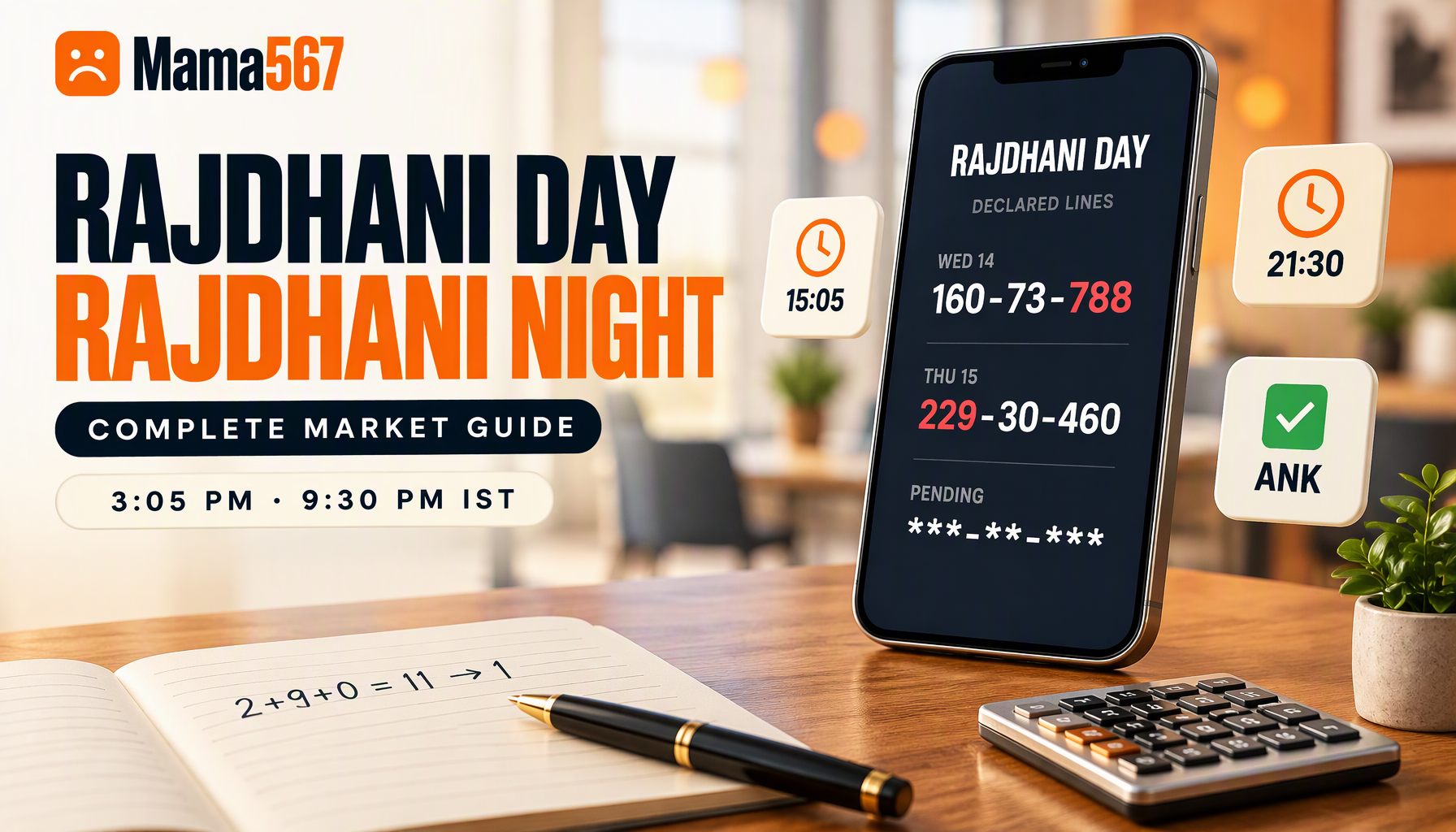
| Open | 15:05 IST (3:05 PM) | 21:30 IST (9:30 PM) |
| Close | 17:05 IST (5:05 PM) | 23:45 IST (11:45 PM) |
| Length of window | Two hours | Two hours fifteen minutes |
| Draw days | Monday to Saturday | Monday to Friday |
| Code in the upstream data | RAJDHANI_DAY (id 11) |
RAJDHANI_NIGHT (id 19) |
| Lines on this site's chart today | 4, newest 14 Sep 2026 | 2, newest 11 Sep 2026 |
| Complete records in the feed when measured 23 Oct 2026 | 15 | 11 |
| Charts published here | pana and jodi | pana and jodi |
Everything that confuses people about a rajdhani day and night chart search — the two different closing times, the Saturday that is missing, the blank evening cell — comes out of the four rows above. Nothing about these sessions requires folklore.
First, the name: "Rajdhani" has exactly two referents
Some market names on this site are ambiguous. Sridevi is the worst case: the same upstream feed carries six draws under closely related Sridevi and Star Tara labels, and only two of them are charted here, which is why two people can quote different "Sridevi timings" and both be right about different markets.
Rajdhani is the opposite case, and it is worth saying so plainly because it makes this pair easier to trust. The results feed was queried on 23 October 2026 at 17:40 IST and returned 32 market rows. Exactly two of them carry the word RAJDHANI: RAJDHANI_DAY at 15:05–17:05 and RAJDHANI_NIGHT at 21:30–23:45. There is no third Rajdhani, no Rajdhani Morning, and no code that maps to a Rajdhani display name by surprise. If a page somewhere shows a "Rajdhani result" from a window other than those two, it is describing a different market under a borrowed name.
That said, the feed does carry markets this site deliberately does not chart — OLD_MAIN_MUMBAI and RATAN_KHATRI among them — so "it is in the feed" and "it is in the charts index" are still different statements. The 19 charted markets are listed with their windows on the markets directory.
The two sessions do not keep the same week
This is the single most common reading error in a Rajdhani grid, and the data settles it without any interpretation.
| Session | Draw days per the schedule | Weekday distribution of its declared records | Sunday rows | Saturday rows |
|---|---|---|---|---|
| Rajdhani Day | Mon, Tue, Wed, Thu, Fri, Sat | Thu 3, Fri 3, Sat 2, Mon 3, Tue 2, Wed 2 | 0 | 2 |
| Rajdhani Night | Mon, Tue, Wed, Thu, Fri | Thu 3, Mon 2, Tue 2, Wed 2, Fri 2 | 0 | 0 |
Fifteen afternoon records and eleven evening ones were counted from the feed on the same date, and not one of the 26 falls on a day the market does not run. 18 October 2026 was a Sunday and both sessions are blank. 17 October was a Saturday: the Day session declared 147-23-139, the Night session did not declare at all.
So a Saturday gap on the Night chart is not missing data, and a Sunday gap on either is not a deleted result. It is the schedule, and it is the fastest way to tell an honest blank from a broken page — a test that generalises to every market in How to check live Satta Matka results.
Reading a Rajdhani Day line, digit by digit
Every line is one declaration written open pana - jodi - close pana. The jodi is not a third draw: add the three digits of each pana, keep the last digit of each total, and write the two results in open-then-close order.
These are declared Rajdhani Day rows taken from the results feed on 23 October 2026:
| Date | Line | Open sum → ank | Close sum → ank | Jodi | Red patti |
|---|---|---|---|---|---|
| Mon 12 Oct 2026 | 560-11-137 |
5+6+0 = 11 → 1 | 1+3+7 = 11 → 1 | 11 ✓ | none |
| Tue 13 Oct 2026 | 177-57-278 |
1+7+7 = 15 → 5 | 2+7+8 = 17 → 7 | 57 ✓ | 177 (open) |
| Wed 14 Oct 2026 | 160-73-788 |
1+6+0 = 7 | 7+8+8 = 23 → 3 | 73 ✓ | 788 (close) |
| Thu 15 Oct 2026 | 229-30-460 |
2+2+9 = 13 → 3 | 4+6+0 = 10 → 0 | 30 ✓ | 229 (open) |
| Thu 22 Oct 2026 | 250-78-350 |
2+5+0 = 7 | 3+5+0 = 8 | 78 ✓ | none |
| Fri 23 Oct 2026 | 368-76-367 |
3+6+8 = 17 → 7 | 3+6+7 = 16 → 6 | 76 ✓ | none |
Four things worth taking from those rows:
- The pana is not the ank.
560gives ank 1, not 5 and not 6. This is where almost every misread jodi comes from, because the eye wants the pair to be the first two digits of the number. It isn't; it is the last digit of a sum. - A zero ank is a real digit.
229-30-460: the close pana sums to 10, so its ank is 0 and the jodi ends in 0. Writing3instead of30quietly destroys the line. - Two panas can be neighbours and still be different draws. On 23 October the open was
368and the close367— one apart, neither red, and their anks (7 and 6) do not resemble either number. - Red is a formatting convention, not a value.
177,229colour because two of their three digits match;788colours on the close side. The jodi in the middle never colours, because it only has two digits. The rule is written out in how to read pana and jodi charts.
Reading a Rajdhani Night line
| Date | Line | Open sum → ank | Close sum → ank | Jodi | Red patti |
|---|---|---|---|---|---|
| Thu 10 Sep 2026 | 112-43-779 |
1+1+2 = 4 | 7+7+9 = 23 → 3 | 43 ✓ | both: 112 and 779 |
| Fri 11 Sep 2026 | 445-33-689 |
4+4+5 = 13 → 3 | 6+8+9 = 23 → 3 | 33 ✓ | 445 (open) |
| Tue 13 Oct 2026 | 290-11-669 |
2+9+0 = 11 → 1 | 6+6+9 = 21 → 1 | 11 ✓ | 669 (close) |
| Mon 19 Oct 2026 | 690-55-230 |
6+9+0 = 15 → 5 | 2+3+0 = 5 | 55 ✓ | none |
| Wed 21 Oct 2026 | 168-50-677 |
1+6+8 = 15 → 5 | 6+7+7 = 20 → 0 | 50 ✓ | 677 (close) |
| Thu 22 Oct 2026 | 560-16-169 |
5+6+0 = 11 → 1 | 1+6+9 = 16 → 6 | 16 ✓ | none |
445-33-689 and 690-55-230 show the two double-jodis in this set. Both anks are equal, so the pair reads 33 or 55 — and neither of those is coloured red, even though 445 beside the first one is. A jodi of matching digits and a red pana are completely unrelated conditions on this site; conflating them is a mistake people carry over from other charts.
112-43-779 is the one line where both panas colour at once, which is why it is the most-quoted row in this market family: it makes the colour rule and the jodi rule visible in a single line without any extra explanation.
The same jodi on the same day is not the same event
On 20 October 2026 both Rajdhani sessions declared the same jodi:
| Session | Line declared on 20 Oct 2026 | Panas | Jodi |
|---|---|---|---|
| Rajdhani Day | 490-31-380 |
490 and 380 | 31 |
| Rajdhani Night | 346-31-137 |
346 and 137 | 31 |
Different opens, different closes, same pair. Nothing passes from the afternoon draw to the evening one.
Across all 26 Rajdhani records measured on 23 October, there are 23 distinct jodis: 11, 31 and 57 appear twice each. The same number appears as a pana in both sessions five times (137, 160, 230, 290, 560) out of 30 distinct Day panas and 22 distinct Night ones. Notably, 560 opens on 12 October as a Day record with jodi 11, and again on 22 October as a Night record with jodi 16. Same three digits, two different anks — because the number alone never determines the pair; its digits do, and the close pana is half the calculation.
This is the honest version of what a repeat means here: it is a coincidence with a checkable arithmetic explanation, and it is not a signal. The fuller treatment — including what a chi-square test on this site's own published records showed — is in probability in number games.
What this site's Rajdhani pages actually hold
The four chart pages for this market pair print a small, dated amount of data, and they say so on the page:
| Page | Week rows | Declared cells | Newest date printed on the page |
|---|---|---|---|
| Rajdhani Day pana | 2 | 4 of 14 | 2026-09-14 |
| Rajdhani Day jodi | 2 | 4 of 14 | 2026-09-14 |
| Rajdhani Night pana | 1 | 2 of 7 | 2026-09-11 |
| Rajdhani Night jodi | 1 | 2 of 7 | 2026-09-11 |
The four Day lines currently shown are 330-61-290 (Thu 10 Sep), 129-29-450 (Fri 11 Sep), 170-83-599 (Sat 12 Sep) and 230-57-124 (Mon 14 Sep). The two Night lines are 112-43-779 and 445-33-689. All six appear verbatim inside the feed's larger set, so the site is showing a subset rather than a different version of the truth.
The gap between 4 and 15 is structural and worth understanding before you screenshot anything. The homepage board polls the feed every 15 seconds, while these chart pages, /results-today/ and the charts index are rendered from a committed snapshot and change only when the site is rebuilt. Verified satta matka results explains why that design was chosen; the practical consequence for Rajdhani Day is that its chart currently shows four lines while the feed holds eleven more recent declarations that have not been built into the page yet.
What "historical context" can honestly mean here
Rajdhani is one of the market families the site's own history of satta matka describes as keeping "their own independent record of results" — which is precisely why the same date shows different numbers across markets. Beyond that framing, there is no dated origin for Rajdhani in anything this project can verify: not in the market definitions, not in the results API, and not in the published copy. So this page does not offer one. A founding year for a market family cannot be sourced here, and inventing one would be the kind of confident-sounding number this site has spent a series teaching readers to check.
What the archive can support is a measured history, and it has a surprise in it. Every dated record the feed returns for any of its 32 markets falls into one of two clusters: 79 rows dated between 9 and 14 September 2026, and 318 rows running from Monday 12 October 2026 to the day of measurement. Between 15 September and 11 October inclusive — 27 days — the feed holds nothing at all, for any market. Rajdhani Day's own share is 4 September rows and 11 October ones; Rajdhani Night's is 2 and 9.
That hole is a property of the upstream data, not of these two markets. It also puts a hard ceiling on any claim of the form "Rajdhani always ends in a 7" or "look at this market's history": what is available is 15 and 11 declarations plus a five-day sample from September. Enough to read the format. Nowhere near enough to describe a market, which is why no page on this site claims a trend for either session.
Where Rajdhani sits on the clock
Both windows overlap other markets, and the overlaps explain most "my result appeared late" impressions.
Rajdhani Day, 15:05–17:05:
| Market | Window | Overlap with Rajdhani Day |
|---|---|---|
| Milan Day | 15:05–17:05 | 120 minutes — the entire window, identical open and close times |
| Supreme Day | 15:35–17:35 | 90 minutes |
| Kalyan | 16:15–18:15 | 50 minutes |
The afternoon session shares its opening minute exactly with Milan Day. Two markets, one clock, different numbers — the case for matching markets by code rather than by caption.
Rajdhani Night, 21:30–23:45:
| Market | Window | Overlap with Rajdhani Night |
|---|---|---|
| Kalyan Night | 21:30–23:30 | 120 minutes — the same open minute, then it closes a quarter early |
| Main Bazar | 21:50–23:55 | 115 minutes |
| Milan Night | 21:00–23:00 | 90 minutes |
| Supreme Night | 20:35–22:35 | 65 minutes |
| Madhur Night | 20:30–22:30 | 60 minutes |
Counted from the market definitions, six of the nineteen charted windows are open at once from 21:50 until Madhur Night closes at 22:30 — the densest stretch of the Matka evening, with Rajdhani Night running through all of it. After 23:00 only Kalyan Night, Rajdhani Night and Main Bazar remain; from 23:45, when Rajdhani Night finishes, the final ten minutes belong to Main Bazar alone. If a close reaches a page a little after 23:45, that is the schedule rather than a delay — the fuller timing model is in open and close results and market timings.
What the badge on a Rajdhani card is telling you
At 17:40 IST on 23 October the live board labelled Rajdhani Day "Betting is Closed for Today" with a declared line, and Rajdhani Night "Betting is Running Now" with ***-**-***. That combination looks contradictory and is not: the label describes whether the session is still open to be entered, not whether its numbers exist yet. The evening draw is enterable from 21:30, and the figures arrive later.
Read the badge as schedule state and the asterisks as declaration state. A half-filled cell — 226-0*-***, the pattern Sridevi's chart documents — means the open pana exists and its ank has therefore been calculated, while the close side has not been drawn. The same arithmetic applies to any Rajdhani afternoon; there is no separate Rajdhani convention.
Checking a Rajdhani line yourself
Three checks, all of which take seconds and none of which require trusting this page:
- Add. Sum the three digits of each pana, keep the last digit, and compare against the two digits printed between them. Every one of the 26 records measured here passes, and any line that fails is not from this data.
- Compare across surfaces. The market's chart page,
/results-today/and its entry on the charts index are built from one dataset, so a disagreement between them would be a build defect rather than a difference of opinion. - Check the day, not just the number. If a Saturday appears on a Rajdhani Night grid, that row contradicts the schedule printed at the top of the page. Draw days are the cheapest consistency test available on any results site.
Where to track Rajdhani declarations
- View the latest Rajdhani panel chart — Day — open, jodi and close stacked per day.
- Rajdhani Night pana chart — the 21:30 session in full.
- Rajdhani Day jodi chart and Rajdhani Night jodi chart — the pair alone, one line per day.
- Latest results by market — the newest line held for all 19 markets, with its date.
- Markets and timings and the charts index — every window and draw-day set in one place.
- Understanding “Single Digit” and “Double Patti” game formats — the conventions behind the
330-61-290line checked above, including why both of its panas are correctly ordered and neither looks it. - The evolution of digital satta matka platforms in India — why this market's blank cells are a schedule while the gap in the published archive is a decision: the registry counts 32 markets and this site charts 19, and the archive behind the chart holds dated rows the page does not print.
- New to the format? Start with Understanding Jodi and Pana, the glossary, and bet types explained; the rates attached to each bet type are per bet type and not per market, as the game rates guide sets out.
Mama567 records declared results. It takes no wagers, sells no tips, and presents no number as likelier than another; satta matka is illegal in most Indian states, and nothing above is advice. 18+ only.
For information only. Mama567 publishes results and charts, and does not offer predictions or guessing services. Adults 18+.