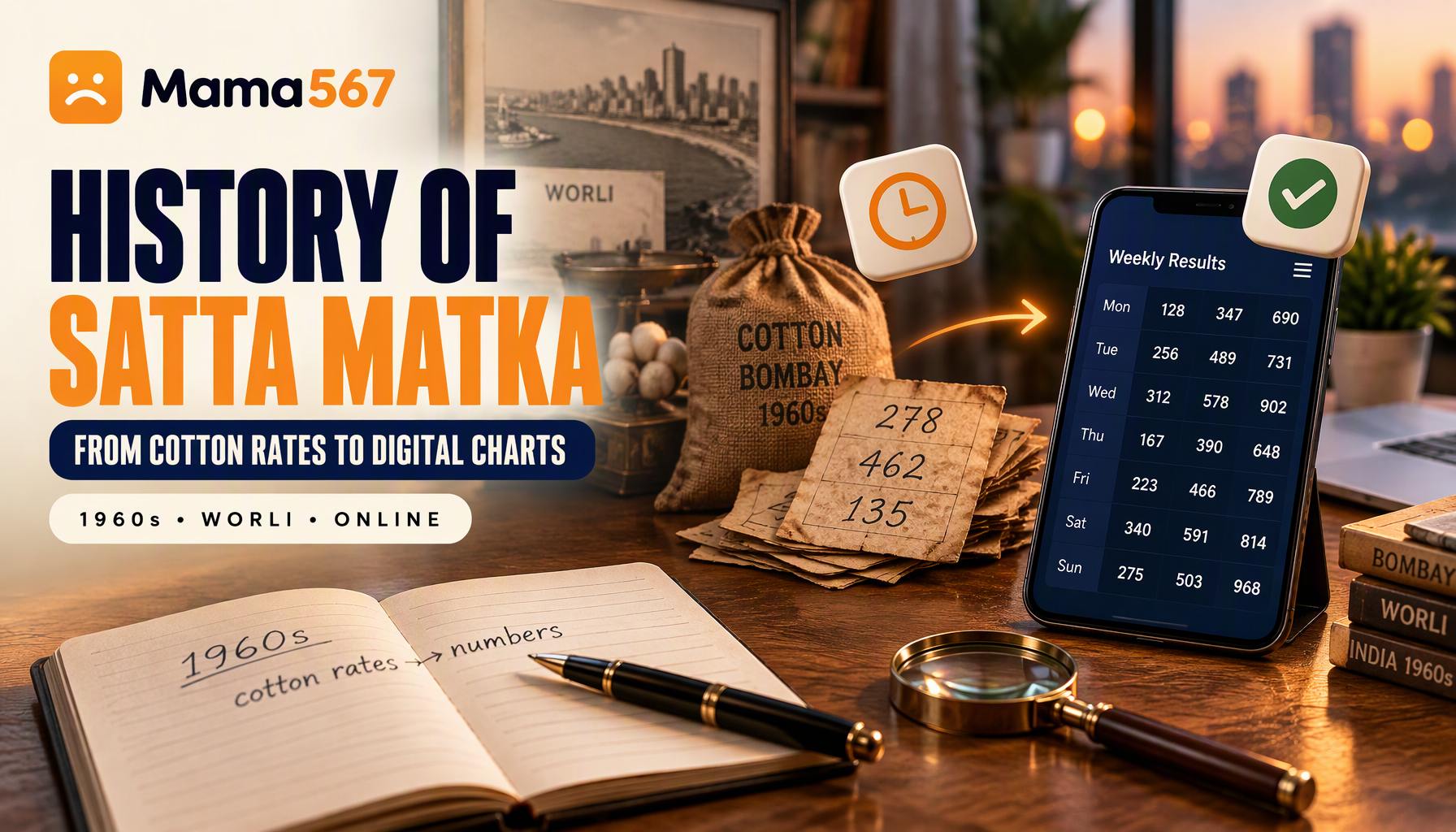
The history of satta matka is really the history of one question: where do the two numbers of the day come from? The answer has changed four times in about eighty years — a rate wire from New York, slips of paper in an earthen pot, a deck of playing cards, and now a digital declaration published on a schedule. The mechanism changed completely. The shape of the result did not: two three-digit numbers a day, an open and a close, and a two-digit jodi made from them.
If you are new to the vocabulary, Understanding Jodi and Pana defines those words; this post is about how the game got here.
The whole timeline at a glance
| Era | How the numbers were produced | What it left behind |
|---|---|---|
| First half of the 1900s | Betting on the opening and closing cotton rates wired from New York to Bombay | The word satta (a bet), and the habit of reading two figures per day |
| 1961 | The New York Cotton Exchange stops the practice | A supply problem: the game needed a new source of numbers |
| 1962 | Kalyanji Bhagat starts the Worli draw — slips in a matka | The market that carries his name, Kalyan, and the pot that names the game |
| 1964 | Ratan Khatri introduces the New Worli matka | The open-and-close discipline every result line still uses |
| Later decades | Three figures drawn from a pack of playing cards | The name matka survives the object |
| 1970s–1990s | Mill-town bookies, paper ledgers, market-by-market records | Separate, independent histories per market |
| 2000s–today | Digital declarations published at fixed times | Online charts, and information platforms such as Mama567 |
Before the pot: cotton, not cards
The story starts with an actual commodity. In the first half of the twentieth century Bombay was one of the world's great cotton trading ports, and the opening and closing rates of the New York Cotton Exchange were relayed to the Bombay Cotton Exchange by wire. Traders and onlookers began betting on whether those transmitted figures would rise or fall, and on which digits the final rate would end in.
That earliest form was known as ankada jugar — digit guessing, also written ankha jugar — and it is the reason the whole activity is still described as satta, a Hindi word for a bet or stake. Note what is already there, before any pot exists: two declared figures per session, and an audience that reads them as numbers rather than as prices.
1961: the wire goes quiet
In 1961 the New York Cotton Exchange stopped the practice of transmitting its rates in the form the Bombay trade had been betting on. That removed the game's supply of numbers outright.
The replacement had to satisfy the same rhythm: two figures a day, produced in a way nobody in the room could openly rig, at predictable times. Writing numbers on slips of paper and drawing them from an earthen matka did exactly that — and the container gave the game the name it has kept ever since, long after the container itself disappeared.
1962 and 1964: two draws that set the pattern
Two figures from Mumbai shaped what came next, and both names still sit in the market list you see today.
- Kalyanji Bhagat started the Worli matka in 1962. His draw became associated with a market that runs every day of the week rather than only on trading days — which is why Kalyan, carrying his first name, is still the most-followed market on the charts index.
- Ratan Khatri introduced the New Worli matka in 1964, and with it the discipline of declaring an open figure and a close figure for each session.
That second detail is the one people underestimate. Almost every guide, chart and argument about results today is downstream of it: the fixed open-then-close order is why a result line reads 299-00-136, why a jodi has a direction, and why two markets can publish different numbers for the same date. Understanding Open & Close Results and Market Timings covers how the two declarations work now.
From pot to pack of cards
The slips-in-a-pot method did not last. Drawing from a stack of slips was slow and awkward to verify, and the game moved to drawing three figures from a pack of playing cards, whose values reduced to digits just as easily.
The name stayed. That is worth knowing the first time you see it on a chart page: matka refers to an object that has not been used by anyone in decades, kept in the vocabulary the way "rolling" survives in a game played on a screen.
The mill-town decades
Through the 1970s, 1980s and into the 1990s matka spread well beyond its original neighbourhoods. Mumbai's textile-mill districts gave it a large, regular audience, and the trade grew to a scale the press could not ignore: by 1995 there were reported to be more than 2,000 big and medium-time bookies operating in the city.
Two things came out of this period that still matter for anyone reading charts:
- Separate market histories. Milan, Rajdhani, Time Bazar, Main Bazar, Madhur and Sridevi each kept their own independent record of results. That is why a single date shows completely different numbers across markets, and why the markets directory lists each one with its own timings and draw days.
- Paper ledgers. Results were written down by hand per market, per day, and copied onward. The weekly grid format used online today is a direct descendant of those ledgers — one row per week, one column per day.
The legal squeeze
None of this was lawful. Number betting of this kind is illegal in India, and because gambling is a state subject, the specific statutes and penalties vary by state; the Public Gambling Act 1867 and state-level laws sit underneath most of them. Enforcement through the 1990s and 2000s reduced the physical trade sharply — from those reported thousands of bookies to a small fraction — and much of the audience drifted toward online formats and instant lotteries.
So the honest framing of this history is not nostalgic. The game's own record includes prohibition, enforcement and a steep decline in its physical form, and satta matka remains illegal in most Indian states. Everything on Mama567 is published for information only, for readers aged 18 and over, and Responsible Play and Safety sets out the guardrails we expect readers to take seriously.
From ledgers to digital charts
The last change is the one you can see on this site. Declarations moved from hands and paper to numbers published digitally at fixed times, and the record moved from copied ledgers to pages that update when a market declares.
What did not change is the structure inherited from 1964:
- A market declares an open pana and a close pana — three digits each.
- Each pana reduces to a single-digit ank.
- The two anks, open first, form the day's jodi.
- The declaration is recorded in a weekly grid, newest week at the top.
That is the entire modern result, and it is the same four steps a 1960s ledger recorded. Learn them once on How to Read Satta Matka Pana & Jodi Charts, and every market on the site reads the same way.
The change is in distribution and evidence, not in arithmetic. A reader today can open the Kalyan pana chart and check a declaration from a specific date against the jodi chart for the same day — a cross-check no ledger reader could do without shuffling papers. And unlike a hand-copied ledger, a published chart can be stamped with the date of the newest result it actually holds, which is why every Mama567 chart prints its own freshness line rather than asking you to assume it is current. See the editorial and data policy for how results reach these pages.
What the history does not contain
Two things people look for in this story and should not find:
- A method. No era of matka — wire, pot, cards or digital — produced numbers that could be anticipated. The mechanisms were chosen precisely because nobody in the room could steer them, and the modern declarations are no more predictable. Anyone offering a lineage of "old market secrets" is selling arithmetic that does not exist.
- A legitimacy. The game's history in India runs through prohibition, not acceptance. Describing where the vocabulary came from is not an argument that it is safe, legal, or beatable.
What the history does explain is the vocabulary. Terms like matka, satta, open, close and ank are fossils of mechanisms that no longer exist, and knowing that makes them easier to learn — the glossary lists each one beside what you can observe on a chart today.
Where to see the modern form of the game
The best way to understand sixty years of change is to look at what it produced: a market-by-market record that anyone can read.
- Check today's updated market charts — every market's pana and jodi board in one place.
- The latest results page shows each market's newest declared line in the full
open-jodi-closeformat. - Popular Matka Markets explains how the markets that grew out of these decades differ in timings and rhythm.
- The evolution of digital satta matka platforms in India picks the story up where the documented record stops, and measures the modern form on one live platform instead of narrating it: the market registry behind these pages, the archive its API really serves, and how deep each of its three surfaces publishes.
- New to the numbers themselves? Start with What is Satta Matka?.
A note on the dates. The specific years in this post — the 1961 end of the cotton-rate transmissions, the 1962 Worli draw, the 1964 New Worli format and the 1995 estimate of bookies operating in Mumbai — follow the widely cited account in Wikipedia's article on matka gambling. Matka's early history was transmitted by word of mouth and press reporting rather than records, so treat the decade-level framing as firmer than any individual year. Mama567's own chart data, by contrast, is only ever published from the declared results described in our data policy.
For information only. Mama567 publishes results and charts, and does not offer predictions or guessing services. Adults 18+.