The short version
- The website publishes the price of these formats and defines none of them. "Single Digit" appears on six pages of the built site and "Double Patti" on three; on every one of them it sits beside a multiplier. The How to Play guide contains no occurrence of the word "patti" at all.
- The API is named for rules and returns prices.
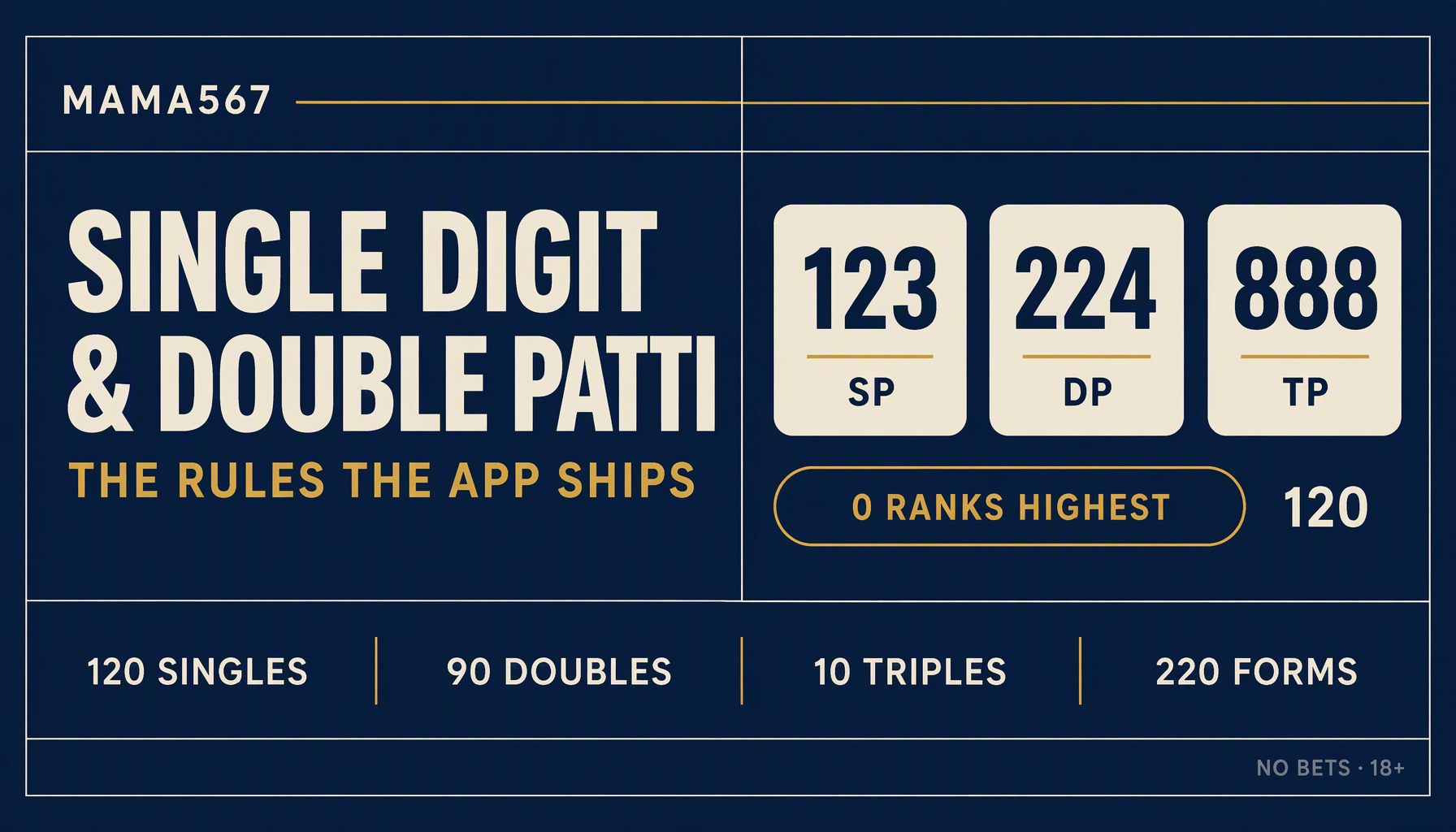
/api/markets/game-rulesanswers 404. The only thing underneath it is/api/markets/game-rules/rates, which returned 879 bytes and seven rows on 28 October 2026 — a display name, a multiplier and a stake range per row. No rules. - The app ships the definitions. Its game-selection screen carries fifteen labelled entries, its patti table lists 120 singles, 90 doubles and 10 triples, and a sixty-two question rules quiz across nine categories states the ordering conventions in plain text.
- "Single Digit" is an ank — one digit, the units column of a pana's digit sum. "Double Patti" is a shape — three digits, exactly two alike — recorded in non-descending order under a rule that ranks 0 above 9.
- 220 and 1,000 are one space counted twice:
120×6 + 90×3 + 10×1 = 1,000exactly. The draw is the thousand; the list is the two hundred and twenty. - The published multipliers track that structure: 9.5 against a fair 10, 95 against 100, 150 against 166.67, 300 against 333.33, 1,000 against 1,000.
What the site says, measured
The honest starting point is that a reader searching for single digit and double patti rules lands on pages that quote numbers. Measured across the 94 routed pages built before this guide existed:
| Term | Pages it appears on | What it is doing there |
|---|---|---|
| Single Digit | 6 | named in a rate table or a worked payout |
| Double Patti | 3 | named in a rate table |
| Triple Patti | 3 | named in a rate table |
| Half Sangam | 7 | named in a rate table or a worked reading |
The glossary gets closer, but it writes the shapes as pana — single pana, double pana, triple pana — and lists "patti" as an alternative spelling of pana rather than as the name of a priced game. So the vocabulary a reader meets on a rate card and the vocabulary a reader meets in the definitions do not line up, and the two pages that ought to answer the question, How to Play and the glossary, never use the priced term.
That gap is not a copy-editing oversight. It is the predictable result of a site whose numbers arrive from a server: the words "Double Patti" on a Mama567 page are a rendering of display_name in a JSON row, and nothing in the response carries a definition.
Where the definitions actually are
The Android package this site links — public/mama567.apk, 5,758,251 bytes, SHA-256 beginning 39d41929 — contains a web bundle, and inside that bundle the rules are written down. Three files carry almost all of it.
The game list. GameSelectionScreen defines fifteen selectable entries. Each carries a display title, a gameType matching the rate endpoint, and a bulk flag:
| Label in the app | gameType sent to the rate API |
Bulk variant |
|---|---|---|
| Single Digits | SINGLE |
a separate "Single Digit Bulk" entry |
| Jodi Digit | JODI |
a separate "Jodi Digit Bulk" entry |
| Single Pana | SINGLE_PATTI |
a separate "Single Pana Bulk" entry |
| Double Pana | DOUBLE_PATTI |
a separate "Double Pana Bulk" entry |
| Triple Pana | TRIPLE_PATTI |
none |
| Half Sangam | HALF_SANGAM |
none |
| Full Sangam | FULL_SANGAM |
none |
The remaining four are convenience games mapped onto the same types: SP Motor and Two Digit Panel both post as SINGLE_PATTI, DP Motor posts as DOUBLE_PATTI, Group Jodi posts as JODI.
Read that table twice, because it is where the naming drift lives. The rate API says SINGLE_PATTI and displays "Single Patti"; the app's own screen says Single Pana; the site's glossary says pana; the chart pages say panna. Four spellings, one object. A search for "double patti rules" fails not because rules do not exist but because the pages that hold them use a different word from the pages that hold the price.
The patti table. A 1,499-byte module holds the canonical lists: singles generated from the digit set with a comparator that scores 0 as ten, doubles as a literal array, triples as the ten repdigits. Counting them gives 120 singles, 90 doubles, 10 triples — 220 rows. Grouping the singles by digit sum produces something worth stating precisely: exactly twelve single pattis for each of the ten anks, including 0 and 5.
The quiz. QuizScreen holds 62 questions in nine categories — Digit Arithmetic 12, Patti Classification 10, Cut Digit Math 9, Bracket Theory 7, Jodi Calculation 7, Historical Trivia 5, Market Structure 5, Sangam Calculations 3, Permutations 4. This is the only document in the whole ecosystem, site or app, that states the conventions in prose. It is a study aid, not a rulebook, and it is quoted here because it is shipped, versioned and checkable.
"Single Digit" is an ank, and the zero changes nothing
The quiz's first question is the definition: "In 3-digit Patti addition, if the Open Patti is 1-3-7, what is the resulting Single Digit (Ank)?" — answer 1, explained as "Sum = 1 + 3 + 7 = 11. In traditional digit calculation, only the unit digit (last digit) is taken, which is 1."
So a Single Digit bet is not a bet on a number between 100 and 999. It is a bet on one of ten digits, and the pana is only the route to it. That is why the same pana can be a single patti and produce the single digit 8: the first is a shape, the second is a reduction.
The app also teaches a convention that trips people up: "What is the single digit derived from the Patti 2-8-0 (note: 0 counts as 10 in summation)?" — answer 0, worked as 2 + 8 + 10 = 20. Treat 0 as zero and you get 10. Both roads end at the same units digit, and they must: counting a zero as ten adds exactly ten to the sum for each zero present, and adding ten never moves the last digit. The convention is real for ordering, where it decides whether a pana is written correctly, and inert for reduction, where it cannot change an answer.
Take a line the charts publish: Rajdhani Day, 10 September 2026, 330-61-290. Open pana 330 → 3 + 3 + 0 = 6. Close pana 290 → 2 + 9 + 0 = 11 → 1. Jodi 61, exactly as the record reads. Now look at the two panas: 330 and 290 both fail a plain ascending sort, and both are in perfect order once 0 outranks 9.
"Double Patti" is a shape plus a recording rule
The classification questions are unambiguous:
- "Which of the following is an example of a Double Patti (DP)?" — options 123, 224, 777, 568. Explanation: "A Double Patti (DP) contains exactly two identical digits and one distinct digit (e.g., 224 or 115)."
- "Which of the following is classified as a Single Patti (SP)?" — 123, with "three strictly distinct, non-repeating digits in ascending order (e.g., 123, 248, 369)."
- "Which of these combinations is NOT a Single Patti?" — 339, because "339 has repeating digits (3 and 3), making it a Double Patti."
- "Which of the following is a valid ascending Double Patti?" — options 414, 144, 441, 141. Explanation: "Pattis are conventionally recorded in non-descending order: 144."
That last one is the whole format in four words. Three of the four options are the same multiset of digits — 1, 4, 4 — and only one is a valid patti. The shape is necessary but not sufficient; the order is part of the number. Which is why the ordering rule matters:
"In traditional patti ordering, which digit is considered the highest in ascending order?" — 0, explained as: "0 comes after 9 and is ordered as the highest digit (e.g., 1-2-0, 3-7-0)."
The app enforces this rather than merely teaching it. The entry validation string on the double-pana screen is "Please select or enter a valid 3-digit Double Pana." — and the list it validates against is the 90-row table, in which 144 appears and 441 does not.
Two things follow, and both are checkable on this site. First, the published charts never show a pana written backwards: across the 154 observations the nineteen charts hold, 0 fail the 0-highest ordering. Second, the shape categories are mutually exclusive and jointly exhaustive — single, double or triple, every time — which is what makes the count in the next section arithmetic rather than opinion.
120, 90, 10 — and the quiz's one hedge
The three counts are elementary and the shipped lists match the algebra:
| Category | Count | Why |
|---|---|---|
| Single patti | 120 | choose any 3 of 10 digits, one ascending writing each: C(10,3) = 120 |
| Double patti | 90 | 10 choices for the repeated digit × 9 for the odd one out |
| Triple patti | 10 | 000 through 999, one per digit |
| Recorded forms | 220 | 120 + 90 + 10 |
The quiz agrees on the triples — "How many total possible Triple Patti combinations exist (from 000 to 999)?" — 10, listed one by one. It defines the shape too: "Which of the following numbers represents a "Triple Patti" (TP)?" — 888, because "A Triple Patti (TP) consists of three identical digits (such as 111, 555, 777, or 888)." It hedges once, and the hedge is contradicted by the app's own data: "How many unique Single Patti combinations exist for any single digit sum on average?" — 12, "approximately 12 … with some variations for 0 and 5." There are no variations in the shipped table. Grouping its 120 singles by digit-sum ank gives twelve for every ank, 0 and 5 included. The generator's own structure explains why: adding one to every digit of a valid single patti rotates the ank by three, and since three and ten share no factor, the ten groups must be the same size.
The same combination logic runs through the motor games. "What is an SP Motor?" — "A set of selected digits combined to form all possible unique Single Pattis … automatically generates all valid ascending Single Patti combinations among them." Four chosen digits make C(4,3) = 4 single pattis; five make 10. A motor is a combination generator pointed at the 120-row list, which is further evidence that the app treats the 220 forms as the thing a player selects.
One space, counted twice
Here is where two Mama567 guides appeared to disagree, and where the app's own text turns out to settle it. The bet types guide writes that every pana is one of a thousand equal possibilities. The odds and probability guide works from 220 valid combinations. Both numbers are in the app, and they are not rivals:
120 singles × 6 arrangements = 720
 90 doubles × 3 arrangements = 270
 10 triples × 1 arrangement  =  10
                               1,000
A single patti such as 248 is one writing of six written triples (248, 284, 428, 482, 824, 842). A double such as 244 covers three. A triple covers one. So a draw uniform over the thousand lands on each form with probability 6/1,000, 3/1,000 or 1/1,000 — and every outcome, however drawn, is recorded somewhere inside the 220. The thousand is the draw. The 220 is the filing cabinet.
The app says so itself, in passing: "Which patti category has the rarest probability of occurring?" — Triple Patti, "only 10 combinations out of 1000 total 3-digit combinations (1% probability)." The denominator in the shipped text is 1,000, not 220.
This site's own records agree, and correcting an earlier reading of them is what made this page worth writing. The game rates guide previously reported that 40 of the 154 published pana observations were not in ascending order, and offered 350, 450, 140, 580 and 250 as proof that the declarations ignored the ascending convention. Re-measured against the rule the app documents, the finding inverts and becomes much more interesting:
- 0 of 154 observations fail the 0-highest ordering.
- 40 of 154 fail plain digit order — and those 40 are precisely the 40 that contain a zero. No pana with a zero passes a plain comparison; no pana without one fails it.
Those five named numbers are not irregularities. They are 3-5-0, 4-5-0, 1-4-0, 5-8-0, 2-5-0: correctly filed panas whose highest digit happens to be the one a naive sort puts first. What the records do settle is the shape of the draw. The split across those 154 observations is 120 singles, 33 doubles, 1 triple — 78/21/1 percent, close to the thousand-outcome model's 72/27/1 and far from the 220-equal model's 55/41/5. Reordering digits cannot change whether they repeat, so that split is evidence about the draw and not the writing. The historical charts guide measures the same thing from the other end: 118/31/1 of the 150 complete records, and 32 red panas, which is every double and every triple.
What the prices say
Read from /api/markets/game-rules/rates on 28 October 2026:
| Format | What it is | Rate | Stake range |
|---|---|---|---|
| Single Digit | one ank, 0–9 | 9.5 | 10 – 100,000 |
| Jodi Digit | one two-digit pair | 95 | 10 – 50,000 |
| Single Patti | 3 distinct digits, ascending | 150 | 10 – 25,000 |
| Double Patti | exactly 2 digits alike | 300 | 10 – 15,000 |
| Triple Patti | all 3 digits alike | 1000 | 10 – 5,000 |
| Half Sangam | a pana paired with the opposite ank | 1000 | 10 – 5,000 |
| Full Sangam | open pana paired with close pana | 10000 | 10 – 2,000 |
Two structural things, then one arithmetic thing. Structurally: the minimum is 10 on every row, and the ceiling falls monotonically with the multiplier — 100,000 down to 2,000. A market that believed rare shapes were underpriced would not restrict stakes to a fortieth of the ceiling it sets for the commonest one.
Arithmetically, the form model makes a fair price computable, and the published numbers sit under it in a suspiciously tidy way:
| Format | Chance per draw | Fair price | Published | Published ÷ fair |
|---|---|---|---|---|
| Single Digit | 100/1,000 | 10 | 9.5 | 95% |
| Jodi Digit | 10/1,000 | 100 | 95 | 95% |
| Single Patti | 6/1,000 | 166.67 | 150 | 90% |
| Double Patti | 3/1,000 | 333.33 | 300 | 90% |
| Triple Patti | 1/1,000 | 1,000 | 1,000 | 100% |
Read that column honestly. It is arithmetic performed on two shipped artifacts — a rate row and a patti list — and it rests on two assumptions the artifacts do not confirm: that the draw is uniform over the thousand, and that a bet on a form settles when any arrangement of its digits is declared. Nothing in the app states the settlement rule, and the single ank and jodi formats guide carries a dated note on exactly this point. The sangam rows are absent because their sample space is not defined anywhere checkable. What the table licenses is a shape, not a margin: prices that divide out to 95 and 90 percent are not prices set at random.
What this page cannot tell you
- Whether a form bet covers its permutations. The app lists 220 forms and prices them as though the thousand were behind them; the settlement text is not in the bundle.
- The current rates. They are server configuration. Single Digit was 10 on 14 October and 9.5 on 24 October; the homepage Game Rates section renders what the endpoint returns when you load it.
- Any way to predict a draw. Every number here describes how results are written or priced. Probability in number games covers why a multiplier is not a forecast, and the jodi and pana guide how to read a line without reading meaning into it.
- Rules for the four motor and panel games. SP Motor, DP Motor, Group Jodi and Two Digit Panel appear in the app's list and in none of the rate rows, so their pricing is not published anywhere checkable.
Where to start
- Satta Matka game rates explained — the rate card itself, with three dated readings and the correction this page grew out of.
- Matka bet types explained — the vocabulary of shapes, written as pana.
- Understanding single ank and jodi betting formats — the reduction arithmetic, with a dated note on 220 versus 1,000.
- Matka odds and probability — where the 1-in-N figures come from and what they can carry.
- Half sangam vs full sangam — the two formats this page deliberately left out of the arithmetic.
- Glossary — pana, patti, ank, jodi, sangam, in one place.
- Satta matka terms glossary — the A–Z list that keeps Single Patti and Single Digit apart, with the rate card beside each name.
- How to verify a satta matka website — where the same names sit in a four-step check of a results site, including the rate table with its stake limits read from the endpoint.
- Rajdhani Day and Night guide and Time Bazar timing and chart guide — the two pages whose published lines supplied the worked examples.
- Historical charts and statistical power — how many observations a shape split can actually support.
- The evolution of digital satta matka platforms in India — the same bundle read as a system rather than as a rulebook: what its client can call, what the archive behind it holds, and how much of that each surface publishes.
Mama567 records declared results. It explains what a format means and what a market charges for it; it takes no wagers, sets no rates, sells no tips and offers no predictions, and nothing above is advice or an invitation to play. Satta matka is illegal in most Indian states. 18+ only.
For information only. Mama567 publishes results and charts, and does not offer predictions or guessing services. Adults 18+.