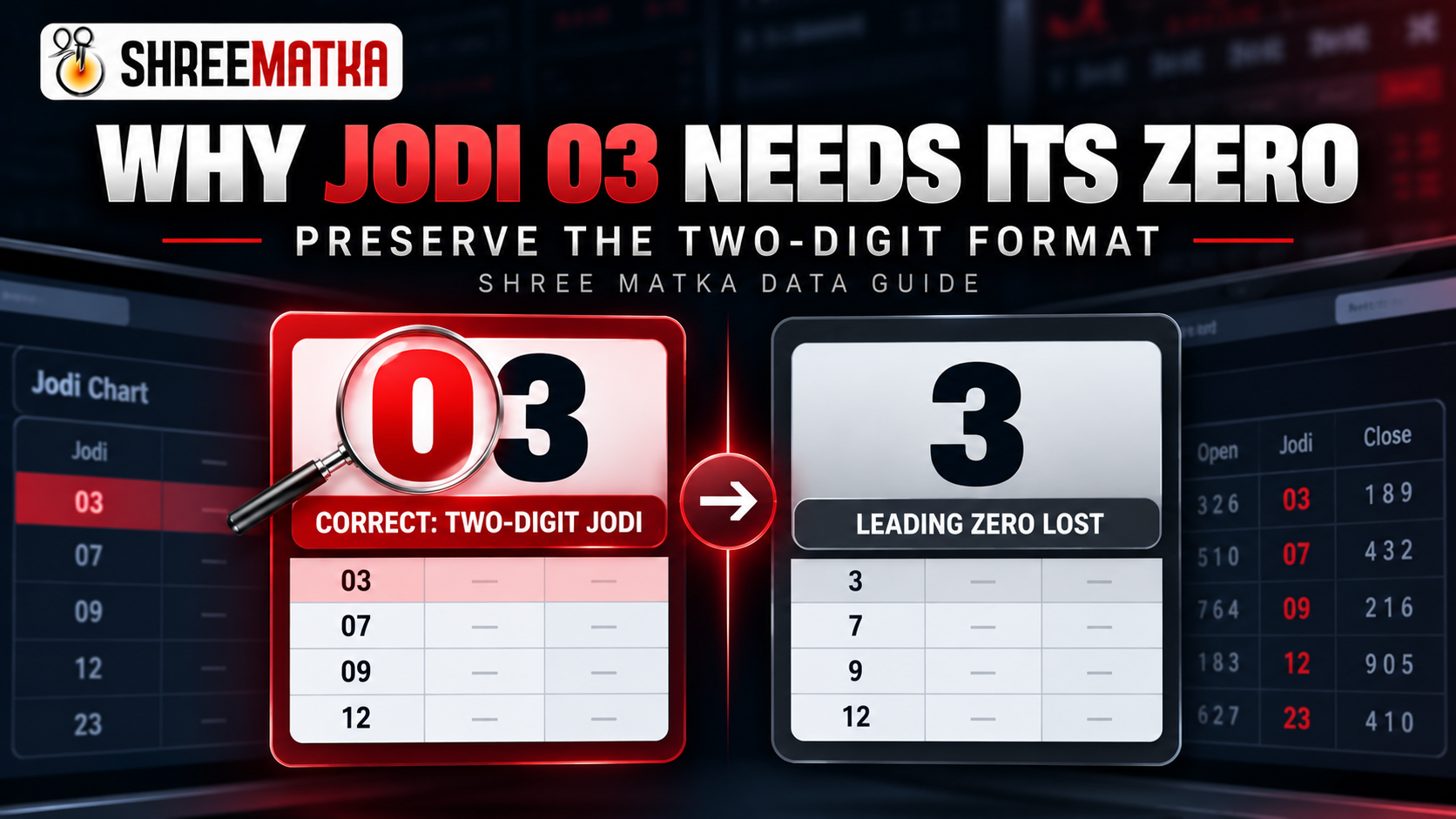
In the vocabulary of Indian satta matka charts and historical records, two terms form the foundation of all documented outcomes: Single Ank and Jodi. For anyone exploring market archives or researching single ank jodi rules, understanding these terms requires looking past promotional gambling jargon and examining the exact mathematical and positional conventions that govern how numbers are recorded.
Public discussions often confuse readers by blending historical recording rules with speculative "guessing formulas" or aggressive staking strategies. In reality, Single Ank and Jodi are simply structured numerical classifications. Understanding their mathematical definitions, positional rules, and probability baselines provides clarity and prevents the common misinterpretations that lead to financial loss.
This guide provides a comprehensive, non-promotional explanation of Single Ank and Jodi formats, details how they appear in verified chart tables, explains why sequence and field order matter, and establishes the foundational probability governing their occurrence.
1. What the Terms Mean in Verified Satta Matka Sources
To read any historical chart accurately, one must understand the distinct definitions of each component:
Single Ank (Single Digit)
- Etymology: Ank (अंक) is the Hindi and Sanskrit word for "digit" or "number."
- Scope: The Single Ank format refers exclusively to single integers within the base-10 decimal system:
{0, 1, 2, 3, 4, 5, 6, 7, 8, 9} - How It Is Derived: A Single Ank is never chosen arbitrarily; it is mathematically derived by adding the three individual digits of a declared three-digit pana (patti) and taking the unit digit (the total modulo 10).
- Example: If an open pana is
299, the digit sum is2 + 9 + 9 = 20. The tens digit (2) is dropped, leaving the unit digit0as the Open Ank.
- Example: If an open pana is
Jodi (Two-Digit Pair)
- Etymology: Jodi (जोड़ी) translates directly to "pair" or "couple."
- Scope: The Jodi format encompasses all possible two-digit combinations from
00through99(exactly 100 possible outcomes). - How It Is Derived: A Jodi unites the Open Ank and the Close Ank into a unified two-digit string.
To understand how these numbers interact with more complex three-digit combinations, consult our comprehensive guide on Understanding Jodi and Pana.
2. How the Formats Appear in Historical Records: The OOO-JJ-CCC Layout
In standardized historical archives—such as the Kalyan Pana Chart and Milan Day Pana Chart—results are universally recorded in a structured, tripartite display:
$\text{Full Result Line} = \mathbf{OOO - JJ - CCC}$
+-----------------------------------------------------------+
|                      FULL RESULT LINE                     |
|                                                           |
|       [ 560 ]      -       [ 15 ]      -       [ 249 ]    |
|      Open Pana              Jodi              Close Pana  |
|          |                    |                    |      |
|    5 + 6 + 0 = 11      [ Open + Close ]     2 + 4 + 9 = 15|
|    Unit Digit: 1         [ 1  and  5 ]      Unit Digit: 5 |
+-----------------------------------------------------------+
Deconstructing the Verified Snapshot Example: 560-15-249
Examine this verified Kalyan result from 12 September 2026:
- Open Session: The operator declares open pana
560. The sum of the digits is5 + 6 + 0 = 11. The unit digit is1. - Close Session: Two hours later, the operator declares close pana
249. The sum of the digits is2 + 4 + 9 = 15. The unit digit is5. - The Resulting Jodi: The Open Ank (
1) is placed in the tens position, and the Close Ank (5) is placed in the units position, yielding the central Jodi15.
This arithmetic audit trail ensures that every historical record is verifiable. If a published jodi does not mathematically equal the unit sums of its flanking panas, the record is defective. For details on how Mama567 audits and validates every line, review our Editorial & Data Policy.
3. Why Positional Sequence and Field Order Matter
In mathematical notation and market records, order is absolute. Conflating sequence rules is a frequent source of beginner confusion:
1. Directional Asymmetry
A Jodi of 15 is fundamentally different from a Jodi of 51:
- In
15, the Open Ank is1and the Close Ank is5. - In
51, the Open Ank is5and the Close Ank is1. - Even though both contain identical digits, they represent entirely distinct rows on the Kalyan Jodi Chart. There is no "reverse matching" in formal record keeping.
2. Ambiguity When Context Is Removed
If an informal chat post simply states "The number today was 5," the statement is ambiguous and functionally useless without operational context:
- Does "5" refer to the Open Ank?
- Does it refer to the Close Ank?
- Does it refer to the sum of a pana?
- Does it represent Jodi
05or50?
Documented archives avoid this ambiguity by always maintaining explicit labels for Open, Close, and Jodi fields.
4. Mathematical Probability Baselines: The Cold Reality of Numbers
One of the most dangerous fallacies in the number-games ecosystem is the belief that certain anks or jodis possess "higher energy," are "hot," or can be predicted using cyclical formulas. Mathematical probability reveals a very different, unyielding reality:
| Format | Total Possible Outcomes | Formula for Combinations | Theoretical Probability per Draw | Expected Percentage |
|---|---|---|---|---|
| Single Ank (Open or Close) | 10 | Digits 0 through 9 | $\frac{1}{10}$ | 10.0% |
| Jodi (Full Pair) | 100 | Pairs 00 through 99 | $\frac{1}{100}$ | 1.0% |
| Single Pana (3 distinct digits) | 120 | $\binom{10}{3} = \frac{10 \times 9 \times 8}{3 \times 2 \times 1}$ | $\frac{1}{220}$ (of total 220) | ~0.45% |
| Double Pana (2 matching digits) | 90 | $10 \times 9 = 90$ | $\frac{1}{220}$ (of total 220) | ~0.45% |
| Triple Pana (3 matching digits) | 10 | Digits 000, 111, ..., 999 | $\frac{1}{220}$ (of total 220) | ~0.45% |
A dated note, added 28 October 2026. The 220 in that table is the number of canonical forms, not the size of the draw. The app records panas with digits non-descending and 0 ranked highest, and lists 120 singles, 90 doubles and 10 triples — but a single form stands for 6 written arrangements, a double for 3 and a triple for 1 (120×6 + 90×3 + 10×1 = 1,000), so the forms are not equally likely even if the draw is: 0.6%, 0.3% and 0.1% per draw respectively, against 0.1% for any one written triple. The uniform "1 in 220" reading is an idealisation, and the shape split in the published records (78/21/1) is closer to the 1,000-outcome model than to the 220 one. Understanding "Single Digit" and "Double Patti" game formats sets out the convention and the two counts from the shipped app.
Independent Events Have No Memory
Each market draw is an independent trial. If the Jodi 15 has appeared twice in one week (as observed historically on Kalyan between September 10 and September 12), the probability of 15 appearing on the subsequent draw is not higher ("on a hot streak") nor lower ("due for a rest"). It remains exactly 1 in 100 (1.0%).
Treating past historical frequency as a guide to future likelihood is the classic Gambler’s Fallacy. For a rigorous statistical evaluation of this principle, explore The Role of Probability in Number Games.
5. What a Historical Record Can and Cannot Establish
When analyzing today's results or historical charts across any of Mama567's 19 tracked markets:
What Records Can Establish:
- They confirm the exact numerical sequence declared on a specific past date.
- They prove whether the arithmetic relationship between pana and ank was mathematically consistent.
- They document market rest days (e.g., Sunday closures) and scheduled declaration cutoffs.
What Records Cannot Establish:
- They cannot prove that the next draw will follow a pattern.
- They cannot reveal a hidden "master formula" or "leak."
- They cannot eliminate the mathematical house advantage inherent in betting formats.
6. Summary: Objective Data Literacy
- Single Ank: A single digit (0–9) derived from the unit sum of three pana digits. Probability = 10%.
- Jodi: A two-digit ordered pair (00–99) uniting the Open and Close anks. Probability = 1%.
- Order is Vital: The tens digit is always Open; the units digit is always Close.
- Charts are Archives: Study records to understand what occurred historically, but recognize that every future declaration is an independent event.
To learn more about the broader rules and bet types documented in the vertical, read our guide on Matka Bet Types Explained and always prioritize personal safety by reviewing our Responsible Play & Safety Policies.