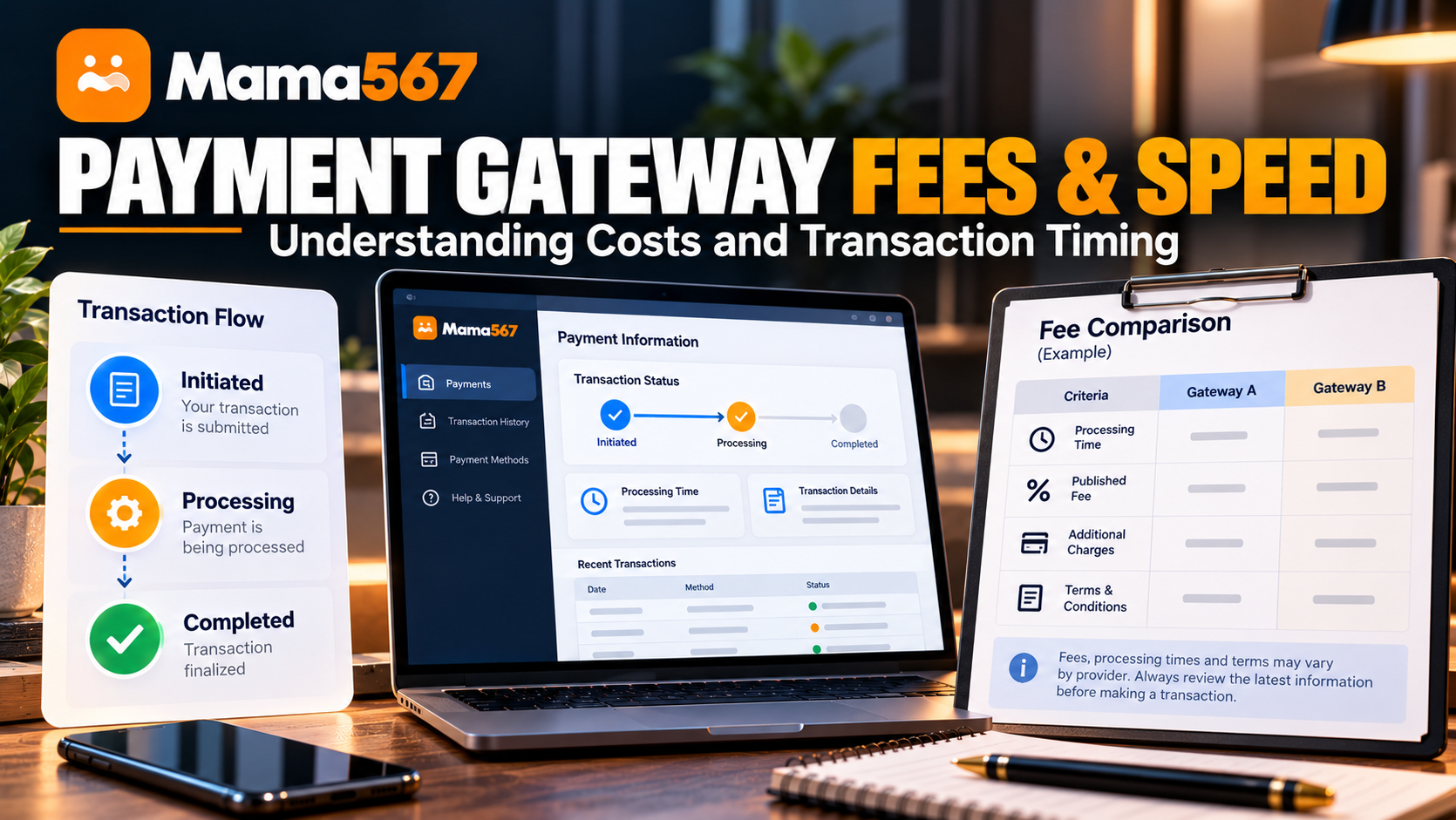
In the modern digital economy, payment gateways form the invisible financial plumbing that connects consumers, digital merchants, acquiring banks, and payment networks. When evaluating financial technology services, users and merchants are frequently presented with bold marketing claims: "instant processing," "real-time settlement," and "100% zero-fee payment gateway."
However, headline marketing often oversimplifies complex financial mechanics. A payment that appears "instant" on a smartphone screen frequently takes several days to formally settle across the banking system. Similarly, advertised "zero-fee" promotions often conceal underlying interchange charges, payment-method restrictions, or auxiliary service levies.
Understanding digital payments requires separating consumer-facing interfaces from underlying banking protocols. This technical analysis provides an objective guide to evaluating payment gateways, explains the critical distinction between transaction speed and settlement timing, deconstructs how gateway fees are structured, and clarifies what "zero-fee" claims genuinely mean under current Indian regulatory standards.
For related consumer security reading, consult our Payment Information Safety Guide, our Fast Withdrawal Guide, and our Account & Wallet Security Guide.
What Does Transaction Speed Actually Mean?
When a payment provider advertises "high-speed transactions," readers must ask a fundamental technical question: speed at which stage of the transaction?
A digital payment is not a single atomic event; it is a multi-step sequence involving multiple financial institutions. Confusing these stages is the primary cause of user misunderstanding regarding payment timing.
1. Payment Authorization
Authorization is the front-facing handshake that occurs when a customer enters an OTP, enters a UPI PIN, or provides card credentials:
- The payment gateway transmits the request to the customer's issuing bank.
- The bank verifies account balance, validates the security PIN, and places a temporary hold on the funds.
- Typical Speed: Completed within 2 to 5 seconds. This is the moment a smartphone displays a green checkmark or "Payment Successful" screen. However, authorization does not mean the funds have been transferred to the recipient's bank account.
2. Transaction Processing and Clearing
Once authorized, the transaction enters clearing:
- Transaction records are batched and validated across payment networks (such as NPCI for UPI, or Visa and Mastercard for card rails).
- Automated anti-fraud algorithms and risk-scoring systems screen the transfer for velocity anomalies and suspicious routing.
- Typical Speed: Completed within minutes to hours, depending on system load and network stability.
3. Merchant Settlement
Settlement is the actual movement of money from the acquiring gateway's nodal or escrow account into the destination business bank account:
- In India, under Reserve Bank of India (RBI) guidelines, standard gateway settlement operates on a T+1 or T+2 business day schedule (where T represents the transaction date).
- If a payment is authorized on Friday evening, settlement may not credit the recipient's current account until Tuesday morning due to weekend banking closures.
4. Refund Processing
If a transaction fails or is reversed, the reversal process must unwind each intermediate ledger entry:
- The gateway submits a refund instruction to the acquiring bank.
- The acquiring bank routes the instruction back through the network to the customer's issuing bank.
- Typical Speed: Standard banking refund cycles require 5 to 7 working days. Instant refunds exist only where specialized payment aggregators maintain pre-funded liquidity pools.
| Transaction Stage | What It Actually Represents | Standard Industry Timing |
|---|---|---|
| Authorization | Cryptographic verification of credentials and fund reservation. | 2–5 seconds |
| Clearing | Network validation and anti-fraud screening between institutions. | Minutes to hours |
| Settlement | Transfer of funds from gateway escrow into merchant bank account. | T+1 to T+2 business days |
| Instant Settlement | Expedited credit using gateway liquidity pools (often fee-bearing). | 15 minutes to 2 hours |
| Refund Reversal | Multi-party unwinding of debited funds back to original instrument. | 5–7 working days |
Why Advertised Transaction Times Can Differ
Advertised processing speeds represent theoretical optimums under ideal conditions. In practice, real-world transaction timing varies widely based on structural infrastructure variables:
- Payment Rail Architecture: Direct peer-to-peer bank transfers via UPI or IMPS operate on 24/7/365 real-time clearing engines managed by the National Payments Corporation of India (NPCI). Conversely, legacy card networks and NetBanking interfaces rely on periodic batch settlement windows.
- Banking Server Downtime: A payment gateway may operate with 99.99% uptime, but if the customer's specific issuing bank experiences core banking maintenance or database timeouts, the transaction will stall or fail.
- Automated Risk and Fraud Holds: High-value transactions or unusual velocity spikes trigger automated risk audits. During these reviews, gateways temporarily withhold settlement pending manual compliance verification.
- Public and Banking Holidays: Standard settlement cycles follow banking calendar days. Transactions processed immediately preceding national holidays or second/fourth Saturdays face extended holding periods.
Understanding these variables prevents users from confusing standard banking settlement latency with service failure.
What Does “Zero Fee” Really Mean?
The phrase "zero-fee payment gateway" is one of the most widely misunderstood terms in digital commerce. Marketing promotions frequently highlight "zero transaction fees" to attract merchants and consumers, but evaluating these claims requires dissecting the complete fee architecture.
The Components of Gateway Pricing
A complete payment gateway cost structure comprises multiple distinct fee categories:
- Setup and Integration Fees: The one-time fee charged to activate a merchant gateway account. Many modern aggregators waive this fee entirely (advertising "Free Onboarding").
- Annual Maintenance Charges (AMC): Fixed recurring fees charged annually to maintain platform access and software updates.
- Merchant Discount Rate (MDR): The percentage fee deducted from each transaction amount. This fee covers interchange charges paid to the issuing bank, network assessment fees paid to card rails, and processor margins.
- Goods and Services Tax (GST): Under Indian tax law, financial services—including payment gateway processing fees—attract an 18% GST levy. Even if a processor charges a modest 2% MDR, an additional 18% GST applies to that fee.
- Convenience / Platform Surcharges: In some customer-facing portals, merchants pass processing costs directly to the consumer as a "convenience fee" added at checkout.
When Is a Gateway Truly Zero-Fee?
In India, the primary instance of genuine "zero-fee" processing exists under Government of India zero-MDR mandates:
- Mandated Zero-MDR Instruments: Under Central Board of Direct Taxes (CBDT) and RBI regulations, banks and payment aggregators are prohibited from levying MDR on payments made via consumer UPI and domestic RuPay debit cards.
- Commercial and Credit Instruments: Zero-MDR mandates do not apply to corporate credit cards, commercial debit cards, international cards, NetBanking, or EMI options. Processing an international Visa or Mastercard typically incurs an MDR between 2% and 3.5%, plus GST.
Therefore, an advertised "zero-fee" gateway almost never means completely free processing across all payment methods. It typically indicates either zero setup fees or zero processing fees restricted exclusively to domestic UPI and RuPay transactions.
How to Compare Published Gateway Pricing
When evaluating payment technology providers, consumers and businesses should avoid relying on headline marketing and instead review published pricing disclosures using a standardized comparison framework:
| Evaluation Criterion | What to Inspect in Published Terms | Key Questions to Ask |
|---|---|---|
| Instrument-Specific MDR | Published rate schedule across UPI, RuPay, Visa, Mastercard, and NetBanking. | Does the zero-fee claim apply to credit cards, or only to consumer UPI? |
| Settlement SLA | Contractual settlement cycle (e.g., T+1 vs T+2 business days). | Are weekend transactions settled on Monday, or held until Tuesday? |
| Instant Payout Fees | Additional percentage or flat fee charged for on-demand settlement. | Is instant settlement free, or does it incur an extra 0.15%–0.50% charge? |
| Refund Charges | Whether gateway processing fees are returned to the merchant on refunds. | If a customer cancels, does the gateway retain its original MDR? |
| Chargeback Administration | Dispute filing fees levied when a customer disputes a transaction. | What fee is charged per contested dispute, regardless of outcome? |
| Minimum Thresholds | Minimum account balance required before settlement transfers execute. | Is there a minimum payout threshold that delays fund transfers? |
Common Misunderstandings About Payment Fees and Timing
1. Treating Authorization as Delivered Funds
Consumers often assume that because funds were debited from their bank account, the merchant or recipient has already received the money. In reality, debited funds sit in a regulated settlement escrow account until the clearing cycle completes.
2. Assuming "Instant" Means Risk-Free
Immediate payment authorizations through UPI do not provide fraud protection or chargeback mechanisms comparable to traditional credit cards. Once a direct bank-to-bank UPI transfer is authorized via PIN, it cannot be recalled or stopped through the payment app.
3. Believing Unverified Third-Party Payment Claims
Online forums and social messaging groups frequently promote unverified payment portals promising "Instant Zero-Fee Cash Withdrawals" or "Anonymous Deposit Gateways." These claims are classic hallmarks of digital financial scams designed to harvest banking credentials.
Platform Context: Mama567's Payment Scope
To evaluate payment claims effectively in the Mama567 ecosystem, users must distinguish between verifiable platform features and unauthorized third-party assertions.
1. Website Infrastructure
An audit of the public website at mama567apps.com confirms that the site contains no payment gateway integrations:
- As detailed across our Terms & Conditions and Privacy Policy, the website is an open, free informational directory for satta matka charts and market results.
- The website has no checkout forms, no deposit portals, no subscription fees, and no integrated payment aggregators.
- The site does not collect credit card details, UPI PINs, or net banking passwords.
2. Regulatory Boundaries
Under the Promotion and Regulation of Online Gaming Act, 2025 and corresponding 2026 Rules, online money gaming and real-money wagering face strict statutory prohibitions and financial transaction restrictions across India. Satta matka is illegal in the vast majority of Indian states. Mama567 does not operate commercial payment gateways for wagering or promote real-money gaming transactions.
Questions to Ask Before Relying on Any Payment Service
Before transferring funds or entering financial credentials on any digital platform:
- Is the Domain Legitimate? Confirm that you are on the verified website domain (
mama567apps.com) and verify that the browser displays an active HTTPS padlock. - Are Fees Transparently Itemized? Check whether the platform displays a clear, written fee schedule before you authorize the transfer.
- What Is the Official Contact Route? Ensure the service publishes verified customer support channels (such as the support contacts listed on our About Us page).
- Never Disclose Security Credentials: Never share One-Time Passwords (OTPs), UPI security PINs, ATM PINs, or net banking passwords with anyone claiming to provide customer support.
If you encounter suspicious payment solicitations or unauthorized transactions, file an immediate complaint through your banking provider and report the incident to the National Cyber Crime Reporting Portal at cybercrime.gov.in.
Frequently Asked Questions
Does a zero-fee payment gateway mean every transaction is free?
No. Advertised zero-fee claims typically apply to specific payment instruments—such as consumer UPI or RuPay debit cards under Indian government zero-MDR mandates—or refer only to the absence of upfront setup fees. Commercial credit cards, net banking, corporate cards, chargeback disputes, and 18% GST almost always carry associated costs.
What is the difference between payment authorization and settlement?
Payment authorization is the instantaneous verification handshake where the issuing bank confirms credential validity and reserves the funds. Settlement is the subsequent multi-step financial transfer where funds are moved from the customer's bank through the acquiring gateway into the recipient's bank account, which typically requires one to two business days (T+1 or T+2).
Can transaction speed differ based on the payment method used?
Yes. Instant payment rails like Unified Payments Interface (UPI) and Immediate Payment Service (IMPS) process authorizations in seconds. In contrast, debit cards, credit cards, and National Electronic Funds Transfer (NEFT) involve additional clearinghouse handshakes, fraud screening filters, and banking settlement windows that impact final availability.
Why are refunds significantly slower than incoming payments?
Incoming payment authorizations reserve funds instantly, but reverse refunds require multi-party reconciliation. The refund must be approved by the merchant, processed by the payment gateway, batched through the acquiring bank, and credited by the customer's issuing bank, a cycle that standardly takes 5 to 7 working days.
Does the Mama567 website process payments through a gateway?
No. The public website at mama567apps.com operates strictly as a free informational chart and result directory. The website features no checkout forms, merchant payment gateways, subscription tiers, or deposit mechanisms.
What should a user do if a payment appears delayed?
Preserve the 12-digit Unique Transaction Reference (UTR) number or payment transaction ID, record the exact timestamp, and contact your bank or payment app support. Never contact unverified third parties on messaging apps who promise to expedite payments in exchange for fees.