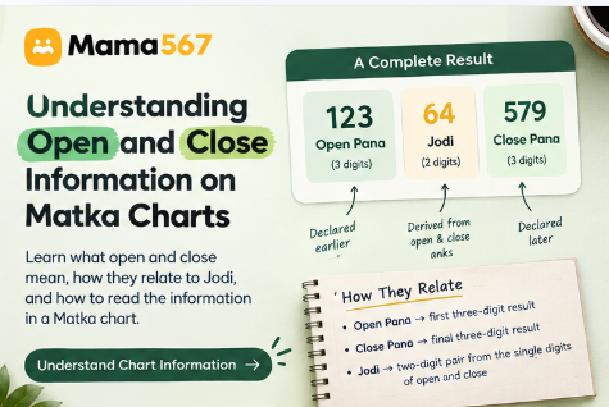
The phrases open close matka discuss with end result levels typically proven in Matka charts. The open result is declared in advance in a marketplace's scheduled session, while the near end result is said later. The Jodi seems among the 2 inside the complete end result format and is derived from their single-digit values.
This guide explains how open and near data is organised, how the numbers relate to each other, and what to check when a chart displays incomplete entries.
What Do Open and Close Mean in Matka Charts?
Open and near discover stages of a market's end result report. They aren't certainly labels for the first and final columns of a table; they refer to separate declarations inside the market's time table.
- Open Pana: The 3-digit wide variety declared for the opening end result.
- Close Pana: The 3-digit range declared for the final result.
- Jodi: The digit pair derived from the open and near panas.
A full end result is generally displayed on this layout:
Example of a Full Result
| 123 Open Pana Three digits | 64 Jodi Two digits | 579 Close Pana Three digits |
|---|
(Illustrative example for explaining the format, not an actual result.) In this format, the primary number is the open pana, the center wide variety is the Jodi, and the very last number is the near pana. The order enables readers to discover every component without complicating the three-digit numbers with the 2-digit result.
How Is the Jodi Related to Open and Close Results?
The Jodi is connected to the open and close panas through a simple digit-sum rule. Each pana is reduced to an unmarried digit, regularly referred to as an ank, by adding its three digits and keeping the closing digit of the whole. The open ank is written first, followed by the close ank.
Here is an illustrative calculation:
| Result Part | Number | Calculation | Ank |
|---|---|---|---|
| Open Pana | 123 | 1 + 2 + 3 = 6 | 6 |
| Close Pana | 579 | 5 + 7 + 9 = 21 | 1 |
Using these ranks, the Jodi might be sixty-one, not 64. This demonstrates why the Jodi has to be checked towards the panas instead of assumed from the order in which the numbers appear.
The instance above is for getting to know the calculation simplest. In an actual chart, the recorded open pana, Jodi and close pana have to be consistent with the equal rule.
How Open and Close Information Appears in a Chart
A pana chart usually presents a marketplace's daily data in a weekly grid. Each row represents a week, and every column represents a weekday. Within each day cell, the open pana, Jodi and close pana may be stacked vertically. A Jodi chart, in comparison, focuses on the 2-digit Jodi access.
| Chart Entry | What to Look For |
|---|---|
| Open Pana | The first three-digit result |
| Jodi | The two-digit value between the panas |
| Close Pana | The final three-digit result |
| Date | The day the result belongs to |
| Market name | The specific market associated with the record |
When reviewing a chart, start with the date and market call. Then read the entry from top to backside or left to right, relying on the chart's design. This saves you by accident matching an end result with the wrong date.
What Do Incomplete Open or Close Entries Mean?
Not every chart cellular will incorporate a whole end result at every second. A market may additionally still be anticipating an announcement, or it can not perform on that particular day.
Some charts use asterisks, which includes or to signify that a result has not been declared or is unavailable. The genuine display depends on the chart and the fame of the marketplace.
If you notice an incomplete entry, recollect those points:
1. Check the scheduled timing: The open and near declarations happen at special stages of the marketplace's consultation.
2. Check the date: A day without a scheduled result might also seem otherwise from a day expecting an announcement.
3. Review the chart once more after the event: The file can be updated as soon as the result is said and published.
4. Do not guess missing numbers: An incomplete cell is not evidence of what the final end result could be.
This distinction is essential due to the fact a placeholder represents unavailable facts, no longer more than a few that can be reliably inferred from neighbouring outcomes.
Why Understanding Open and Closed Information Matters
Knowing the distinction between open and near entries makes chart facts less complicated to read. It also helps readers to apprehend how a complete result is displayed and how the Jodi pertains to the two three-digit panas.
A few easy behaviors can make chart reading clearer:
- Confirm the marketplace and date before studying the numbers.
- Identify which entry is open and which one is closed.
- Understand how the Jodi is calculated from the two panas.
- Check whether a cell is whole before interpreting it.
- Treat ancient outcomes as data, not as reliable predictions of future outcomes.
These steps help lessen basic analysis errors without assuming that past effects screen what is going to occur next.
Understand Chart Information on Mama567Apps
Mama567Apps publishes Matka-related result information and historical charts that permit readers to explore open, near, pana and Jodi entries. Its chart guides provide an explanation for how those statistics are organised and how to pick out the specific range organizations.
If you are mastering Matka charts, begin with a complete result entry and perceive the open pana, Jodi and near pana. Then check the date and marketplace earlier than comparing the access with other facts.
Understand Chart Information by studying the terminology and layout used inside the charts. The motive is to study the displayed records correctly, not to deal with historic numbers as a guarantee of future results.
Conclusion
Understanding open near matka statistics starts with recognising the 3 principal elements of a result: the open pana, the Jodi and the near pana. Each has an extraordinary role, and understanding their order helps you interpret chart entries extra correctly.
By checking the date, market, quantity layout and announcement fame, you may navigate historic charts with greater confidence. Visit Mama567Apps to Understand Chart Information and discover how open and near information is displayed.
Always observe relevant neighborhood legal guidelines. Matka-associated consequences are uncertain; past results do not assure future results, and playing should not be dealt with as a source of earnings.
Also Read: Understanding Single Ank and Jodi Betting Formats in Detail