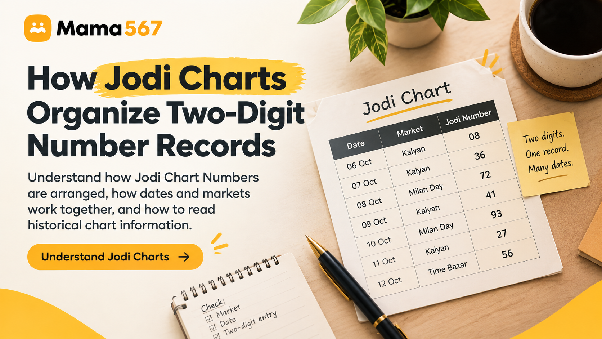
When reviewing Matka chart statistics, finding a selected entry is simpler while the numbers are organized continually. Jodi Chart Numbers are two-digit pairs displayed in organized data, allowing readers to discover entries and recognize how information is grouped across dates and markets.
Rather than focusing most effectively on man or woman numbers, it's far more useful to understand how a chart brings a couple of facts collectively. This manual explores the structure of -digit records, common chart layouts, and practical approaches to check the data available on websites which includes Mama567.
Understanding the Structure of Jodi Chart Records
A Jodi Chart can be regarded as a prepared record as opposed to really a list of numbers. Its layout facilitates readers to connect every displayed entry with its relevant date, marketplace, or reporting length.
Depending on the layout, a chart may additionally use an every day listing, a weekly grid, or an extended historic desk. Consistent headings assist readers pass among entries without confusing one date or market with any other.
Three structural factors are in particular beneficial:
- Grouping: Entries may be organized by market, day, or reporting period.
- Sequence: Dates set up the order in which information is presented.
- Reference labels: Headings and symbols provide context for decoding person entries.
These factors make a chart simpler to navigate, even when it contains much historical information.
How Two-Digit Entries Are Arranged
Jodi Chart Numbers use two digits as a single access. For example, 08, 36, and seventy-two are all two-digit pairs. A leading zero, while present, should be preserved as it forms a part of the displayed pair.
Charts might also give entries in one of a kind ways. Some use dates as row labels and wide variety entries in adjoining columns, even as others organization records by weekday or market. Readers must follow the real format as opposed to assuming each chart follows the equal structure.
The fictional desk illustrates how a simple report can join dates with two-digit entries.
| Record Date | Example Entry | Reference Period |
|---|---|---|
| 6 Oct 2026 | 08 | Tuesday |
| 7 Oct 2026 | 36 | Wednesday |
| 8 Oct 2026 | 72 | Thursday |
| 9 Oct 2026 | 41 | Friday |
These are fictional examples created for rationalization, no longer actual Matka results. The table links every entry to a date and weekday. A reader can locate a particular report without searching through unrelated entries.
The purpose of this example is to illustrate file company. The series no longer implies a trend or suggests which variety might also appear subsequently.
How to Compare Jodi Chart Records Carefully
Comparing data requires interest in context, not just the numbers themselves. Use the following technique whilst reviewing ancient information.
- Choose a steady reference length: Decide which dates or weeks you need to study.
- Confirm the marketplace labels: Make sure the records belong to the same market before evaluating them.
- Preserve the original entries: Keep both digits of their displayed order, including any leading zero.
- Check incomplete information: Look for explanatory notes when dates or entries are missing.
- Record observations neutrally: Describe what the chart displays without treating repetition as evidence of a future outcome.
This method helps maintain accuracy and prevents errors that can occur when different types of data are mixed together.
Jodi Chart Numbers and Pana Records
Although both chart formats relate to Matka result information, they present unique types of entries.
| Feature | Jodi Chart | Pana Chart |
|---|---|---|
| Entry format | Two-digit pair | Three-digit number |
| Main focus | Jodi entries | Pana entries |
| Reading approach | Keep the pair together | Read the complete three-digit entry |
| Historical use | Review dated Jodi records | Review dated Pana records |
The difference is beneficial when navigating web sites that offer multiple chart classes. A -digit Jodi entry must not be flawed for a three-digit Pana access.
Why Organized Historical Records Matter
A consistent chart layout facilitates readers to locate dates, check displayed entries, and understand how historical statistics is presented. It can also make it simpler to identify lacking facts or variations in formatting.
However, an organized document isn't a forecasting tool. Past Jodi Chart Numbers cannot reliably be expecting destiny consequences, and repeated entries do not guarantee that a number will seem again.
Exploring Jodi Chart Information on Mama567Apps
Readers can go to Mama567Apps to explore available Matka chart records. When viewing a relevant Jodi Chart, take note of the date labels, market information, and manner the 2-digit entries are grouped.
If you're evaluating chart classes, reviewing a Jodi Chart along with a Pana Chart can help make clear the difference between two-digit and three-digit information.
Understand Jodi Charts on Mama567Apps.com to be more acquainted with how chart records are offered and organized.
Conclusion
Understanding how Jodi Chart Numbers are organized helps readers navigate dated entries, preserve variety codecs, and evaluate historical data without puzzling specific markets or chart classes.
Visit Mama567 to understand Jodi Charts and explore available chart records. Remember that past effects do no longer guarantee future effects. Matka-associated gambling can be restricted or unlawful in your area, so observe relevant neighborhood laws and by no means treat gambling as a reliable supply of earnings.
Also Read: Mama567 Latest Version Update: New UI Features and Speed Enhancements